
died c. 389·Feast June 1
St. Florus of Lodève
Legendary first bishop and martyr of Lodève
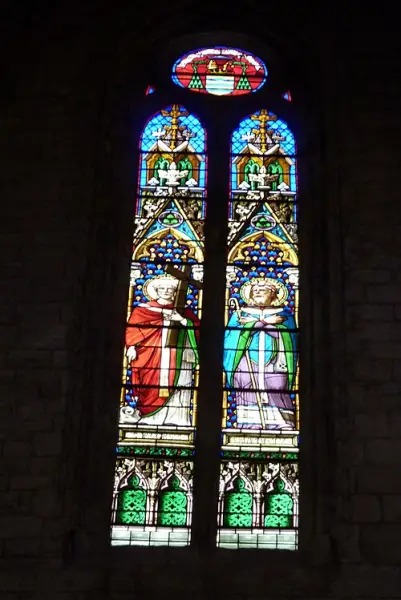
Overview
Florus of Lodève (French: Saint Flour; died c. 389) is honored as the legendary first bishop of Lodève in southern France. Tradition presents him as a preacher through Languedoc and the Auvergne who met death around 389; the written record, however, is among the haziest of the early Gallic bishops: the first written references to him appear only in the tenth century, and his first vita was added in the fourteenth century to the Speculum sanctorale, the great collection of saints' lives compiled by Bernard Gui. His tomb, however, proved fruitful. A monastery arose there and was re-founded in the eleventh century by Saint Odilo of Cluny, fifth abbot of Cluny. Around the abbey grew the town of Saint-Flour, which later became the seat of a diocese of the same name — an uncommon case of a town and a see owing both their name and their origin to a saint of whom almost nothing is certainly known. Florus is the patron saint of that diocese. Calendars disagree about his feast, which some keep on 1 June and others on 4 November. Whatever history lies behind the legends, the church of southern France received him as the missionary bishop who carried the faith into its uplands, died in its service, and left a city as his monument.
The Complete Life
First Bishop of Lodève
Florus — Saint Flour in French — is honored as the legendary first bishop of Lodève, in the south of France. The word 'legendary' is not a slight but a description of the evidence: his historical record is unclear, and the first written references to him appear only in the tenth century, some six hundred years after his supposed death. The first account of his life was added in the fourteenth century to the Speculum sanctorale, the vast repertory of saints' lives assembled by Bernard Gui.
Within that tradition Florus stands as apostle and first pastor of the city, the man who gathered the Christians of the Lodève region into a church and governed them as bishop. Around this core the legend gathered its ornaments, as the lives of nearly all the first bishops of Gaul did.
That a see should reach back to a founder it cannot document is the common condition of the ancient dioceses of France. Lodève counted Florus as its own from an early date, and the persistence of the city's devotion outlasted every uncertainty about the details of the life it honored.
§ References
Evangelist of Languedoc and the Auvergne
By tradition Florus evangelised in Languedoc and the Auvergne, the country of southern Gaul where the Christian faith took root in the closing centuries of the Roman empire. He was martyred in about 389, sealing with blood the work his legend attributes to him.
The mission field described in his tradition was vast for one man: the plains and plateaus between the Mediterranean and the Massif Central, a country of old Roman cities and isolated villages into which the faith of the cities penetrated slowly. The first bishops of such regions were remembered precisely as the men who carried the gospel beyond the urban walls, and Florus belongs to that company.
His cult, though late in reaching writing, was real and enduring. A monastery rose at his tomb, and the memory of the evangelist traveled with the monastery's fame. Whatever history underlies the story of his preaching and his death, the church of the south received him as the missionary who brought the faith to its uplands and died in its service, and it kept his feast on 1 June and on 4 November alike.
§ References
Saint-Flour, City of a Saint
The most tangible result of Florus's life is a place that still bears his name. From his grave sprang a monastery, renewed in the eleventh century under Odilo, fifth abbot of Cluny and a towering figure of the monastic revival. In the abbey's shadow rose the town of Saint-Flour, later exalted into the seat of a diocese bearing that name, whose patron is Florus himself.
Few saints can claim so durable a monument: a monastery, a town, and a diocese, all rooted in the grave of a man whose own biography survives only in late and legendary form. The pattern was a common one in medieval France — a saint's tomb draws pilgrims, pilgrims draw a church, a church draws a settlement — and at Saint-Flour it produced a city.
Both 1 June and 4 November are observed in his honour, each by its own calendar. The town and the diocese preserve what the documents cannot: the memory of the missionary bishop whose bones, believed to rest beneath their church, turned a lonely hill country into Christian civilization.
§ References
Timeline
- 389
Tradition holds that the first bishop of Lodève was martyred around this year after preaching in Languedoc and the Auvergne.
§ Introduction
- 900
The earliest written references to Florus appear, dating from the tenth century, long after his death.
§ Introduction
- 1000
Saint Odilo of Cluny, fifth abbot of Cluny, re-founded the monastery that had grown from the saint's tomb.
§ Introduction
- 1300
A first vita of Florus entered Bernard Gui's Speculum sanctorale, the collection of saints' lives, in the fourteenth century.
§ Introduction
The Record
- Patron of
- Diocese of Saint-Flour
- Canonization
- Pre-congregation saint; cult attested from the tenth century.
Prayer
Bibliography
Show 5 sources
- Marcellin Boudet, 1895: La légende de saint Florus d'après les textes les plus anciens, p. 7
- Encyclopédie Théo, Droguet et Ardant/Fayard, June 1990, ISBN 2-7041-0336-4
- Nominis: Saint Flour
- Book of Saints, 2015, St Augustine's Abbey, Aeterna Press
- Alban Butler: Leben der Väter und Märtyrer nebst anderen vorzüglichen Heiligen, Volume 16, Müller 1825
Profile text adapted from the Wikipedia article, licensed CC BY-SA 4.0.
Pray with this saint every day
Save St. Florus of Lodève to your favorites, read the full profile, and get feast-day reminders in the Saints app.
Get the Saints AppFree on the App Store for iPhone and iPad