
died c. 655·Feast October 31
St. Foillan
Irish missionary abbot and martyr of Fosses
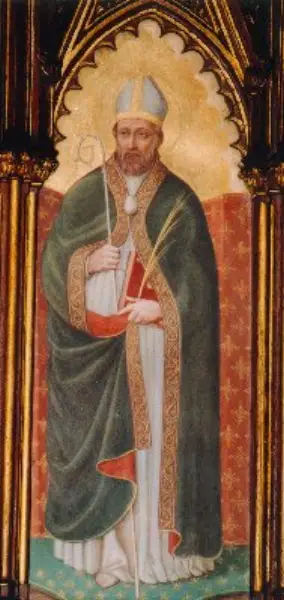
Overview
Foillan (Faélán, Faolán, Foélán; French: Feuillen) was an Irish missionary of the seventh century, brother of the saints Ultan and Fursa, whom he followed from Ireland to Anglo-Saxon England and on into Frankish Gaul. Through his mother Gelges, the Christian daughter of 'Aed Finn' of the royal house of Connacht, he was Fursa's uterine brother: the two shared a mother but not a father. About 633 he went with Fursa and Ultan to the Kingdom of East Anglia, where King Sigeberht put at Fursa's disposal the ground of a Roman shore-fort, Cnobheresburg — Burgh Castle in Norfolk, most likely — and a monastery rose and prospered there until about 650. About 643 Fursa placed the house in Foillan's charge. When Penda of Mercia ravaged East Anglia around 651, the monastery was pillaged; Foillan barely escaped, ransomed his captive monks, recovered the relics and holy books, and sailed for Péronne in Frankish Neustria, where Fursa was buried. Expelled from Péronne by Erchinoald, Mayor of the Palace, he was welcomed at Nivelles by St. Itta and St. Gertrude, whose monastery followed Irish discipline, and with Itta's help he founded a house of his own at Fosses-la-Ville. He seems to have been a bishop. He had sung the altar service at Nivelles on the day before Saint Quentin's feast when bandits waylaid him in the Sonian Forest and killed him; his body was recovered by St. Gertrude and buried at Fosses-la-Ville about 655. He is patron of Fosses and of truss-makers, dentists, surgeons, and children's nurses.
The Complete Life
A Brother of Saints
Foillan was an Irishman of the seventh century, born into a family the sources found worth describing at length. He was brother to two other saints of the age: Ultan, who withdrew to live as a hermit, and Fursa, the celebrated missionary whose visions were read for centuries. Foillan and Fursa are described as 'uterine brothers' — sons of the same mother but of different fathers. The Latin Lives of Foillan accordingly weave Fursa's ancestry into his own: the mother common to the two was Gelges, a Christian of royal blood, child of 'Aed Finn' — perhaps the Connacht king Áed mac Echach. Fursa's father, for his part, is named Fintan, son of Finlog, though the Bollandist editor found the sources at odds about whether that Fintan belonged to Momonia or to Mag Murthemni.
From such a household came children whom the churches of several nations would honor as saints. The family's standing — a daughter of a provincial king given in marriage within the faith — illustrates the character of seventh-century Irish society, where the bonds of kinship ran alongside the bonds of religion.
Foillan's later career, moving freely between Ireland, Anglo-Saxon England, and the world of the Frankish court, suggests a man formed in a tradition of learning, discipline, and readiness for travel.
§ Family
To the Kingdom of the East Angles
Foillan's monastic life is inseparable from his brother Fursa's. When the multitudes that gathered around Fursa began to harbor ill-feeling toward him, the holy man withdrew to a lonely island in search of solitude; Foillan, probably in company with Ultan, went with him. From that island, around 633, Fursa crossed through British territory into the Kingdom of East Anglia, taking with him a band of followers that included Foillan and Ultan and the priests Gobán and Dicuill.
Sigeberht, king of the East Angles, welcomed the missionaries and bestowed on Fursa the ramparts of a Roman shore-fort, Cnobheresburg by name — the spot generally taken to be Burgh Castle, the old Gariannonum, once of Suffolk and now of Norfolk — as ground for a monastery. There, between about 634 and about 650, the community flourished.
The earliest source for the brothers' English mission is the Vita Sancti Fursei, the primary account on which the Venerable Bede drew for his Historia Ecclesiastica Gentis Anglorum of 731. That Foillan stands within so well-attested a tradition — a saint witnessed to by Bede himself — gives an otherwise shadowy career an unusually firm documentary anchor for its age.
§ Mission to East Anglia
Abbot in a Falling Kingdom
About 643, seized again with the desire for solitude, Fursa placed the monastery of Cnobheresburg in Foillan's care and withdrew to find Ultan, who had gone to live as a hermit in the East Anglian wilderness; the two brothers spent a year together in austerity and prayer. At the end of that year, seeing invasion gathering over the kingdom, Fursa bade East Anglia farewell and crossed into Gaul, committing the monastery wholly to Foillan's government. A tradition preserved in the Virtutes Fursei adds that Fursa set out to revisit his brethren about 650 but died on the journey at his estate of Macerias, modern Mézerolles in Ponthieu, without reaching them.
The foreseen blow fell around 651. Penda, the Mercian king, ravaged East Anglia; King Anna was put to flight, and Cnobheresburg fell into the hands of the enemy. The monastery was given over to plunder, and its head came within a breath of dying. Speedily he paid ransom for his captured brethren, gathered up the relics, loaded ship with the sacred books and treasures of the altar, and made for Péronne in Frankish Neustria, where his brother lay.
At Péronne, Erchinoald, Mayor of the Palace, at first received him well; but the nobleman soon turned against his guests and expelled them. Foillan and his companions went on to Nivelles, where Itta and her daughter Gertrude, with Gertrude's brother Grimoald, welcomed them gladly.
§ Abbot of Cnobheresburg
Fosses and the Sonian Forest
Foillan, who seems to have borne the rank of bishop, was a mainspring of the liturgical life at Nivelles. The books and relics rescued from England were treasures in the eyes of Itta and Gertrude; and because the monastery kept the Irish rule, his monks dwelt alongside the holy women, caring for the services of the altar under the abbess's eye. By Itta's generosity Foillan raised a house for himself at Fosses-la-Ville, a short distance from Nivelles in what is now the province of Namur.
Once Itta had died, in 652, Foillan came to Nivelles on the day before the feast of Saint Quentin and offered the Mass. That done, he set out again on the road, going, we may suppose, about the affairs of his abbey. Deep in the Sonian Forest, robbers who lurked among the trees sprang their snare upon the saint and his men. All were killed and stripped, and the corpses were hidden away; Foillan's severed head, still murmuring prayer as the story tells, was flung into a pigsty close at hand.
It was Gertrude who found the dead. After she had kept some portion of the martyr for relic, his body was carried in state to Fosses-la-Ville and laid to rest there about 655. The founder had shed his blood within reach of his own abbey, and the church he raised became his tomb.
§ Foundation of Fosses, and martyrdom
Memory at Nivelles and Fosses
Foillan stands among the Irish missionaries who carried the gospel through Neustria in the seventh century — bearers of liturgy and altar vessels, planters of flourishing abbeys, and sharers in the Christianising of the country. His ties with Erchinoald, the Mayor of the Palace, and with Pepin's kin gave him real weight in the church affairs of the Franks, as his leadership at Nivelles and his abbey at Fosses-la-Ville both attest.
Nivelles and Fosses kept his memory together, and a monastery at Le Roeulx, in Belgium, was called by his name. So strong was that devotion that, as late as the 1100s, it moved Philippe de Harvengt, abbot of Bonne-Esperance, to write the saint's life at length. Near the same time, about the year 1100, Hillinus — deacon and singing-master at Fosses — turned the story into verse for his lord Sigebert; between 1102 and 1112 the same man collected, in prose, the marvels reported at Foillan's shrine. The Bollandists print several Latin Lives of unequal worth in the Acta Sanctorum.
The town of Fosses, near Charleroi, honours him as its patron. Namur keeps his feast on 31 October; Mechelen and Tournai on 5 November. Artists set a crown at his feet, a sign that worldly glory held no charm for him.
§ Veneration
Timeline
- 633
Left for the Kingdom of East Anglia in the company of his brother Fursa, together with Ultan and the priests Gobán and Dicuill.
§ Mission to East Anglia
- 634
The monastery of Cnobheresburg, built at the Roman shore-fort granted by King Sigeberht, began to flourish, continuing until about 650.
§ Mission to East Anglia
- 643
Fursa left the monastery of Cnobheresburg in Foillan's charge and departed East Anglia for Gaul.
§ Abbot of Cnobheresburg
- 651
Penda of Mercia ravaged East Anglia; Cnobheresburg was pillaged, and Foillan ransomed the monks and sailed for Péronne with relics and books.
§ Abbot of Cnobheresburg
- 652
Soon after the death of Itta, foundress of Nivelles, he offered the Mass there on the day before Saint Quentin's feast.
§ Foundation of Fosses, and martyrdom
- 653
Summoned by Abbess Gertrude of Nivelles, he and Ultan teach psalmody to her nuns and build a monastery at Fosses.
§ Musician
- 655
Slain by bandits in the Sonian Forest; his body, recovered by St. Gertrude, was buried at Fosses-la-Ville.
§ Foundation of Fosses, and martyrdom
- 1100
Hillinus, cantor at the church of Fosses, composed for his lord Sigebert a life of Foillan in verse.
§ Veneration
- 1102
Hillinus composed a prose book of the miracles of St. Foillan, written between 1102 and 1112.
§ Veneration
In Their Own Words
About the year 653, St. Gertrude, of Brabant, (daughter of Pepin, Mayor of the Palace), abbess of Nivelle, in Brabant, sent for St. Foillan and St. Ultan, brothers of our celebrated St. Fursey (Patron of Perrone), to teach psalmody to her nuns. These two Irish monks complied with her request, and built an adjoining monastery at Fosse, in the diocese of Liege.
The Record
- Major works
- Monastery of Fosses-la-Ville (foundation)
- Patron of
- Fosses·truss-makers, dentists, surgeons, and children's nurses
- Symbols
- represented with a crown at his feet, to show that he despised the honours of the world
- Canonization
- Pre-congregation martyr; venerated since the seventh century in East and West.
Prayer
Bibliography
Show 6 sources
- Bruno Krusch (Ed.), 'Additamentum Niuialense de Fuilano', Monumenta Germaniae Historica, SRM IV, Hannover 1902, p. 449–451
- Société des Bollandistes, Acta Sanctorum, October Vol XIII, 1883
- B. Colgrave and R. A. B. Mynors (Eds), Bede's Ecclesiastical History of the English People, 269–277 (HE III.19)
- Léon Van der Essen, "St. Foillan", The Catholic Encyclopedia, Vol. 6, New York: Robert Appleton Company, 1909
- Stephen, Leslie, "Foillan", Dictionary of National Biography, Vol. XIX, Smith, Elder & Co., London, 1889
- William H. Gratten Flood, A History of Irish Music, Dublin, 1906, p. 12
Profile text adapted from the Wikipedia article, licensed CC BY-SA 4.0.
Pray with this saint every day
Save St. Foillan to your favorites, read the full profile, and get feast-day reminders in the Saints app.
Get the Saints AppFree on the App Store for iPhone and iPad