
1st century AD·Feast June 15
St. Fortunatus of the Seventy
Corinthian disciple commended by the Apostle Paul
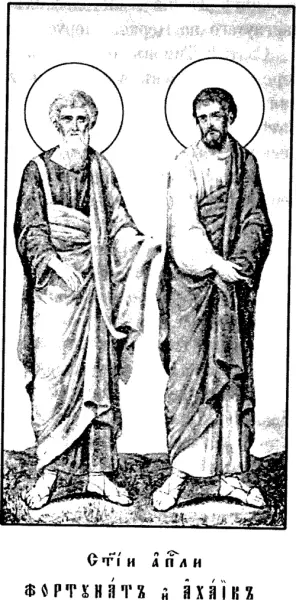
Overview
Fortunatus belongs to the earliest generation of Christians, named by Saint Paul himself in the closing greetings of the First Epistle to the Corinthians. Writing from Ephesus, Paul records his joy at the arrival of Stephanas, Fortunatus, and Achaicus, saying that they had supplied what was lacking from the Corinthian community. Church tradition explains that these were no casual travelers: he came from Corinth, a man of Roman descent as his Latin name betrays, and had made the voyage to Ephesus most probably bringing contributions for the apostle and his work. He and his companions then travelled home bearing Paul's first letter to the Corinthians, making them among the first couriers of a text that would become part of Scripture. For this quiet service the Church numbered him with the Seventy and honors him in the East as an apostle, keeping his memory on 15 June. His story is a reminder that the New Testament itself was carried, in its first days, by the faithful hands of ordinary believers.
The Complete Life
A Disciple from Corinth
The New Testament preserves only a single verse about Fortunatus, yet that verse opens a window onto the working life of the earliest churches. Paul names him alongside Stephanas and Achaicus in the First Epistle to the Corinthians, written from Ephesus, and declares that he was glad at their arrival because they supplied what was lacking from the Corinthian community. Later commentators, from the old Biblical cyclopedias to modern hagiographers, have filled in the picture from church tradition: Fortunatus was a disciple of Corinth, a man whose Latin name points to Roman birth or descent in that Greek city, which had been refounded as a Roman colony. He undertook the journey across the Aegean to visit Paul, and tradition judges that he did not come empty-handed, but most probably brought contributions gathered by the faithful for the apostle's support. Such a voyage, undertaken by an ordinary believer for the sake of the Gospel, speaks to the bond between Paul and the church he had founded. Corinth sat astride the trade routes of the Aegean, and its believers kept close to the apostle who had planted their church; travelers like these three men were the living post of the early Gospel, knitting scattered congregations to their founding teacher.
§ Church traditions
Apostle of the Seventy
The service of Fortunatus did not end at Paul's door. Together with Stephanus and Achaicus he carried the apostle's first letter back across the sea to Corinth, becoming a bearer of what the Church would one day recognize as inspired Scripture. The Christians of later centuries did not forget such labors. Eastern tradition enrolled Fortunatus among the Seventy, the wider circle of disciples sent out by the Lord, and gave him the title of apostle. The Orthodox Church keeps his feast on 15 June and sings his praise in the ancient tones of its hymnography. The kontakion addressed to him calls him a shining star whom the Church beholds forever, and celebrates how his miracles have manifested great enlightenment, so that the faithful cry out to Christ to save all who honor his memory. It is a remarkable afterlife for a man whom Scripture mentions only once: fidelity in small things proved, over the ages, to be a glory without end. Hymns like these are the Church's longest memory: they preserve, in poetry sung generation after generation, the gratitude that a quiet act of messenger-service could earn from the whole people of God.
§ Hymns
The Record
- Major works
- Carriage of Paul's First Epistle to the Corinthians from Ephesus to Corinth
- Canonization
- Pre-congregation; venerated from antiquity among the Seventy in the Eastern Orthodox Church
Prayer
Bibliography
Show 4 sources
- "Apostles Fortunatus, Akhaikos, and Stephanas of the 70", www.oca.org, retrieved 2025-01-31
- Hoole, Charles Holland (1888). The Classical Element in the New Testament, Considered as a Proof of Its Genuineness.
- "Fortunatus from the McClintock and Strong Biblical Cyclopedia", McClintock and Strong Biblical Cyclopedia Online, retrieved 2025-01-31
- "Lives of the Saints"
Profile text adapted from the Wikipedia article, licensed CC BY-SA 4.0.
Pray with this saint every day
Save St. Fortunatus of the Seventy to your favorites, read the full profile, and get feast-day reminders in the Saints app.
Get the Saints AppFree on the App Store for iPhone and iPad