
died c. 359·Feast June 14
St. Fortunatus of Naples
First attested bishop of Naples and anti-Arian defender
Overview
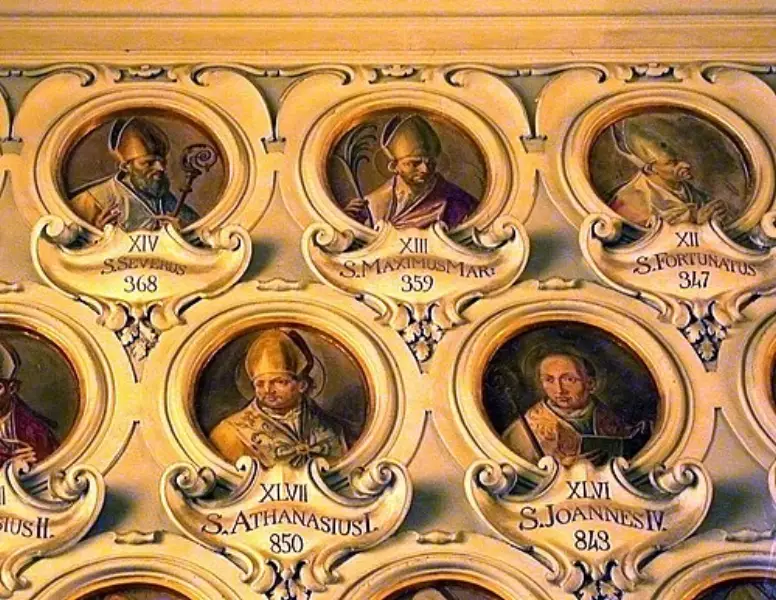
Fortunatus of Naples was a fourth-century Christian bishop whose historical existence is secured by one of the rarest commodities in early Neapolitan church history: a contemporary document. He stands among the recipients of a letter written by the bishops who assembled at the Arian Council of Philippopolis in the 340s, making him the first historically attested occupant of the see of Naples. Tradition adds that he was a fierce opponent of Arianism, the doctrine that denied the full divinity of Christ, and his name on a conciliar letter of that turbulent decade fits a pastor who stood firm for the Nicene faith. His tenure as bishop is traditionally held to run from 347 to 359. Remembered as the founder of a cemetery basilica beside the catacombs where he himself would be buried, he remained the object of civic devotion long after his death: his remains were moved to the old cathedral in the ninth century and to Sant'Eframo Vecchio in the thirteenth.
The Complete Life
Shepherd in the Age of Arian Controversy
Fortunatus emerges from history in the middle years of the fourth century, when the Church of the Roman Empire was convulsed by the Arian controversy over the divinity of Christ. His claim to remembrance rests on a firm foundation: he was one of the recipients of a letter sent by those who took part in the Arian Council of Philippopolis, held in the 340s, an assembly of bishops who had gathered in opposition to the party then dominant in the imperial church. To appear on such a letter is to appear in the documentary record itself, and for this reason Fortunatus is honored as the first historically attested bishop of Naples. Tradition has preserved the character behind the citation, describing him as a fierce opponent of Arianism. The years of his charge are fixed by pious calculation at 347 to 359, a twelve-year episcopate that placed him at the pastoral front line of a struggle fought with ink, councils, and exile. For a see that would become one of the great churches of southern Italy, such a documentary anchor matters: every later bishop of Naples stands in a line whose first datable occupant is the man who received that conciliar letter, and whose loyalty to the Nicene confession his city never forgot.
§ Introduction
Bishop Saint of Naples
The memory of Fortunatus took root in the stone of his city. Tradition holds that he established a cemetery basilica alongside the catacombs outside the walls, a burial ground in which he himself would one day rest, and which after the fifth century came to be known as the Catacombs of Saint Gaudiosus, named for the bishop buried there after him. His remains were not left undisturbed: in the ninth century Bishop John IV translated them into the old Naples Cathedral, gathering the first shepherd of the see beneath the church of his successors. In the thirteenth century the relics were moved once more, to Sant'Eframo Vecchio, which remains his major shrine. The Roman Catholic Church keeps his feast on 14 June, and Naples adds a local celebration on 8 November, when the city commemorates all the bishop saints of the Church of Naples, ranking Fortunatus first among them in history if not in time. Few fourth-century bishops of the Italian south left so continuous a trace in the devotion of their cities. Through cathedral, catacomb, and shrine his memory moved with Naples itself, from the burial grounds outside the walls to the heart of the city, until his feast became part of the rhythm of the local year.
§ Introduction
Timeline
- 347
Tradition sets the start of his episcopate over the see of Naples in this year.
§ Introduction
- 359
Tradition marks the close of his twelve-year tenure as bishop of Naples in this year.
§ Introduction
The Record
- Major works
- Foundation of a cemetery basilica beside the catacombs later known as the Catacombs of Saint Gaudiosus
- Patron of
- Commemorated among the bishop saints of the Church of Naples
- Canonization
- Pre-congregation; venerated as a saint by the Roman Catholic Church
Prayer
Bibliography
Show 1 sources
- "San Fortunato di Napoli"
Profile text adapted from the Wikipedia article, licensed CC BY-SA 4.0.
Pray with this saint every day
Save St. Fortunatus of Naples to your favorites, read the full profile, and get feast-day reminders in the Saints app.
Get the Saints AppFree on the App Store for iPhone and iPad