
died c. 400·Feast June 1
St. Fortunatus of Spoleto
Umbrian parish priest celebrated for love of the poor
Overview
Saint Fortunatus of Spoleto, who died around the year 400, was a parish priest serving in the Umbrian countryside near Spoleto in the generations when the Roman Empire was turning to Christ. Little historical detail of his life survives, but the record that matters most has been kept with care: the Roman Martyrology, in its latest official edition, commemorates him on 1 June and describes him as a native of Montefalco, the hill town that looks down on the Spoleto valley. He won the admiration of the faithful not by rank or learning but by charity, becoming known for his love of the poor even though he was himself a man of little. A beloved legend tells how, ploughing a field, he found two coins of slight worth, only to see them transfigured by a shaft of sunlight into what seemed pure gold; judging the shining treasure a temptation to avarice, he gave it at once to a poor man he met on the road. After his death a local cult arose, and a convent near Montefalco still bears his name.
The Complete Life
A Poor Priest for the Poor
Fortunatus served as a parish priest in the territory of Spoleto in Umbria, in the border years between the fourth century and the fifth, when the old imperial order was dissolving and Christian communities were taking root in the hill towns of central Italy. The Martyrology identifies him as a native of Montefalco, a settlement perched on its hill near Spoleto, and so a son of the country he served. Beyond these outlines, history is nearly silent; what the sources choose to preserve is the shape of his heart. He became noted for his charity and for his love of the poor, and the tradition is careful to add that he practiced this generosity while being a poor man himself. In an age that often measured holiness by martyrdom or by episcopal rank, the Church of Umbria remembered instead a village priest whose whole distinction lay in giving, and gave him to the universal Church as an example. The countryside he served was poor and troubled, and the record suggests that his people learned his sanctity not from pulpit eloquence but from the daily evidence of a priest who shared their poverty and kept nothing for himself.
§ Introduction
The Legend of the Two Coins
One story, preserved among the traditions that gathered around his name, compresses his spirituality into a single afternoon. One day, while ploughing a field, Fortunatus turned up two coins of apparently little value and slipped them into his pocket. That evening, meeting a poor man on the road, he resolved to give him the coins; as he did so, the sunlight suddenly struck them and made them shine like gold. A lesser soul might have paused at such a sign, counting the discovery as providence's reward for honest labor. Fortunatus judged otherwise: not wishing to be tempted by avarice, he at once pressed the coins into the beggar's hands and hastened on his way, unwilling even to linger beside what had shone. The legend understands wealth, even miraculous wealth, as a danger to be fled rather than a prize to be kept, and shows a heart so trained in generosity that it declined to savor its own goodness for more than a moment. The tale has charmed painters and preachers alike, because it catches in a small domestic scene the whole economy of grace: what God gives is given to be passed on, and the light that falls upon a gift is a test, not a trophy.
§ Introduction
Cult at Montefalco
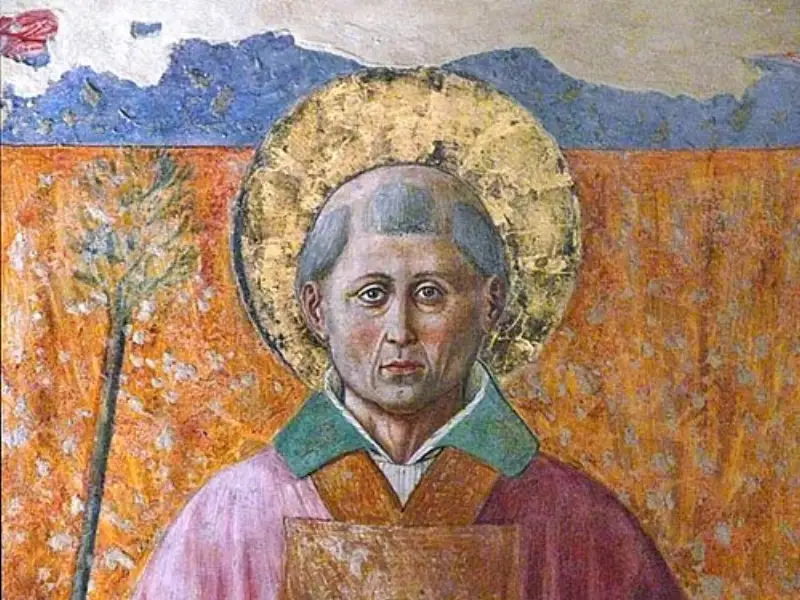
The gratitude of the Umbrian faithful outlived the priest who had served them. When he had gone to God, the people of the region gathered their devotion around Fortunatus's memory, and a convent near Montefalco came in time to bear his name. The convent preserves a notable cycle of decoration, including a fresco of the saint painted by Benozzo Gozzoli, the Renaissance master whose brush gave the hillside shrine a lasting artistic witness. The Church ratified what the people had long known: the latest official edition of the Roman Martyrology, promulgated with the authority of Pope John Paul II, commemorates Saint Fortunatus on 1 June, securing his place in the calendar of the saints. He is honored as the patron of Montefalco, the town of his birth, which keeps the memory of its poor priest beneath the frescoes and on the feast day the Martyrology assigns him. Devotion of this kind outlasts the fashion of centuries. Pilgrims and patrons kept the convent's buildings standing, and the painter called to decorate them gave the saint a place among the artistic glories of Umbria. In the Martyrology his entry is brief, but brevity is its own testimony: the Church asks of a confessor only that he be found faithful, and on that point the memory of Montefalco has never wavered.
§ Introduction
The Record
- Patron of
- Patron of Montefalco
- Canonization
- Pre-congregation; inscribed in the Roman Martyrology under June 1
Prayer
Bibliography
Show 3 sources
- Martyrologium Romanum, ex decreto sacrosancti oecumenici Concilii Vaticani II instauratum auctoritate Ioannis Pauli Pp. II promulgatum, editio typica altera, Typis Vaticanis, A.D. MMIV (2004), p. 316, ISBN 88-209-7210-7
- "San Fortunato di Spoleto", santiebeati.it
- Holweck, Frederick George. A Biographical Dictionary of the Saints, B. Herder, 1924, p. 394
Profile text adapted from the Wikipedia article, licensed CC BY-SA 4.0.
Pray with this saint every day
Save St. Fortunatus of Spoleto to your favorites, read the full profile, and get feast-day reminders in the Saints app.
Get the Saints AppFree on the App Store for iPhone and iPad