
died 537·Feast October 14
St. Fortunatus of Todi
Umbrian bishop who defended Todi from the Goths
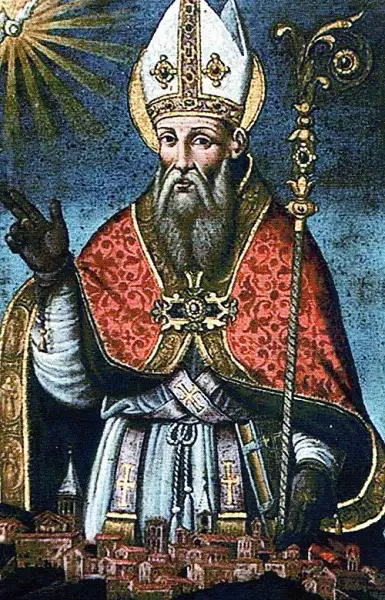
Overview
Saint Fortunatus, who died in 537, was a sixth-century bishop of Todi in Umbria and remains that city's patron saint. A foreigner by origin, he came to Italy from Poitiers to live as a hermit, and the holiness of his life — marked by miracles and the casting out of demons — drew such attention that in 528 the clergy and people pressed him to accept the bishopric, which his predecessor Callistus had vacated by a martyr's death at the hands of the Goths. As bishop he is credited with saving Todi from being sacked by the Ostrogoths, converting many of its people, and destroying a temple of the god Pan, whose stones went to build a church. He dedicated the church of San Fortunato, where his remains lie to this day. Gregory the Great, born near the hour of Fortunatus's death, took a deep interest in his life and praised him as a man of great virtue who attended devotedly to the sick. His basilica at Todi, rebuilt by the Franciscans from 1292, enshrines his relics to this day.
The Complete Life
A Hermit from Poitiers
Fortunatus began his Christian life far from the Umbrian hills where he would be remembered forever. He came to Italy from Poitiers, the Gallic city of Saint Martin's country, leaving his homeland behind in order to live as a hermit. The sources are sparing about the years of this hidden life, but they are unanimous about the reputation it produced: the hermit became known for miracles and for the power of casting out demons, gifts that in the mind of the sixth century marked a man as belonging unmistakably to God. Such fame cannot be concealed in a hermitage. Pilgrims and the curious found their way to him, and word of the holy stranger from Poitiers traveled through the countryside of Umbria until it reached Todi itself. When that city suddenly found itself without a bishop, its thoughts turned at once to the hermit whose prayer had already become a public blessing, and the sanctity he had sought in solitude was summoned into the service of the whole people. In that hidden schooling he learned the poverty and patience that would mark the rest of his life.
§ Life
Called to the See of Todi
The call to the episcopate came to Fortunatus in 528, and it came as the request of a people in mourning. His predecessor in the see of Todi, Callistus, who had governed the church from about 502 to 528, had been killed by the Goths, so that Fortunatus succeeded not to a quiet inheritance but to a bishopric stained with the blood of a martyr. The clergy and the people urged their choice upon him, drawn by his miracles and his power over evil spirits, and he consented to take up the burden. As the first cathedral of the city was the church of Sant'Ilario, there he would have exercised the ministry of teaching and sanctifying that the office demanded. The episode is a classic study in the early medieval understanding of church leadership: a bishop was not self-appointed but sought out, and the hermit who had fled the world accepted the world's need as the voice of God. In accepting, he bound himself to a city under threat, and the courage his new office demanded would soon be tested by the same storms that had struck down the bishop before him.
§ Life
Defender of the City
The Gothic wars that had claimed his predecessor soon tested the new bishop, and tradition records that Fortunatus answered them with the weapons of faith. He is honored for having defended Todi during a Gothic siege, and more particularly with keeping the Ostrogoths from plundering the city — an achievement the sources attribute to his holiness rather than to arms. His mission was not only defensive. The tradition credits him with converting many of the people of Todi, gathering his flock deeper into the Christian life even as danger surrounded them. He also attacked the old paganism directly, destroying a temple dedicated to the god Pan and using the materials of the ruined shrine to build a church, so that the very stones of idolatry were made to serve the worship of Christ. In his later years he consecrated the church of San Fortunato, which still preserves his bones and remains the great monument of his episcopate. The gesture of building with the rubble of a pagan shrine became a parable the city remembered: where the old worship had stood, a Christian altar rose, and the triumph of the Gospel was written into the very masonry of Todi.
§ Life
Praised by Gregory the Great
The finest testimony to the character of Fortunatus comes from the greatest churchman of the age that followed him. Pope Gregory the Great, who was born around the time Fortunatus died, showed a marked interest in the bishop's life and passed on the memory of him in his writings. Gregory praised Fortunatus as a man of eminent virtue, unremitting in the attention he gave to the sick — a summary of sanctity made not of visions and thunderbolts but of steadfast compassion at the bedside of the suffering. Gregory himself preserved the scene in which he questioned an old man of Todi about the bishop he had known, begging to be told what miracles he had wrought and what manner of man he was. The curiosity of the pope is the measure of the bishop: decades after his death, the hermit of Poitiers was still spoken of by the plain people of his city as a friend of God whose intercession and example mattered. Here was sanctity of the kind Gregory loved to recover from living memory: not legend, but the testimony of ordinary people who had known the man and treasured what they had seen.
§ Life
The Basilica on the Hill
The veneration of Fortunatus took permanent form in the church of San Fortunato at Todi, dedicated to the saint and holding his relics. The first building on the site rose as a Palaeo-Christian temple in the seventh century, hardly a century after his death; in the eleventh a Benedictine monastery was attached to it, and Pope Innocent III consecrated the altars honoring Fortunatus and Cassianus of Imola in 1198. In 1292 the Franciscans, who had taken over the shrine, began the new Gothic edifice with its distinctive hall structure that still crowns the hill above the city. Beneath its pavement the crypt keeps a sepulcher holding the bones of Fortunatus alongside those of other saints, together with the tomb of Jacopone da Todi, the Franciscan poet. As patron of Todi, the bishop who once defended its walls now watches over it from the basilica that bears his name. The persistence of this shrine across thirteen centuries says much about the bond between a city and its bishop. Conquerors, reformers, and mendicants each left their mark on the hill, yet the tomb below kept its tenant, and the people of Todi kept returning to pray where he lay.
§ Veneration
Timeline
- 528
Urged by clergy and people, the hermit from Poitiers accepted the bishopric of Todi, vacant since Callistus was killed by the Goths.
§ Life
- 537
Death of Fortunatus, the sixth-century bishop of Todi whom tradition credits with saving the city from the Ostrogoths.
§ Introduction
- 600
A Palaeo-Christian temple, the first church on the site, rose at Todi in the seventh century and later held his relics.
§ Veneration
- 1000
A Benedictine monastery was attached to the church of San Fortunato, where the bishop's bones are preserved.
§ Life
- 1198
Pope Innocent III consecrated the altars honoring Fortunatus and Cassianus of Imola at San Fortunato.
§ Life
- 1292
The Franciscans began building a new Gothic church of San Fortunato with a hall structure.
§ Veneration
In Their Own Words
A certain poor old man was brought to me –because I always love to talk with such men- of whom I inquired his country, and hearing that he was of the city of Todi, I asked him whether he had known Bishop Fortunatus. He said he knew him very well. 'Then I beseech you,' said I, 'tell me whether you know of any miracles that he did, and, since I am very desirous to know, explained to me what manner of man he was.'
The Record
- Major works
- Foundation of the church built from the materials of the destroyed temple of Pan·Consecration of the church of San Fortunato at Todi
- Patron of
- Patron of Todi
- Canonization
- Pre-congregation; cult approved by ancient usage and praised by Pope Gregory the Great
Prayer
Bibliography
Show 6 sources
- "St. Fortunatus of Todi", archived from the original on 22 October 2012, retrieved 4 November 2012
- "Latin Saints of the Orthodox Patriarchate of Rome", archived from the original on 10 November 2012, retrieved 4 November 2012
- Schäfer, Joachim, "Fortunatus of Todi", Ecumenical Encyclopedia of Saints, archived from the original on 31 July 2023, retrieved 31 July 2023
- Odden, Per Einer. "Den hellige Fortunatus av Todi (d. 537)", Den katolske kirke, 28 December 2015
- "San Fortunato di Todi" [Saint Fortunato of Todi] (in Italian), archived from the original on 13 October 2012, retrieved 4 November 2012
- Dudden, Frederick (1905), Gregory the Great, vol. 2, London: Longmans Green, p. 339, OCLC 914226
Profile text adapted from the Wikipedia article, licensed CC BY-SA 4.0.
Pray with this saint every day
Save St. Fortunatus of Todi to your favorites, read the full profile, and get feast-day reminders in the Saints app.
Get the Saints AppFree on the App Store for iPhone and iPad