
d. c. 287–305·Feast August 8 / November 8
Four Crowned Martyrs
Nine martyrs of Rome and Pannonia, patrons of stonemasons
Overview
The Four Crowned Martyrs, known in Latin as the Sancti Quatuor Coronati, are in fact nine individuals honoured together as martyrs of the early Church. Tradition divides them into two companies. The first are Severus (or Secundius), Severianus, Carpophorus, and Victorinus, said to have been soldiers — clerks responsible for a regiment's records — who refused to sacrifice to Aesculapius and were put to death by order of the emperor Diocletian at Rome or at Castra Albana. Their names, according to the Golden Legend, were unknown when they died and were learned only through the Lord's revelation years later, which is why they were called simply the Crowned Ones, crowned with martyrdom. The second company are Claudius, Castorius, Symphorian, Nicostratus, and Simplicius, sculptors from Sirmium who refused to carve a pagan statue for Diocletian or to sacrifice to the Roman gods; they were sealed alive in leaden coffins and drowned in the Sava River. Critical scholarship, notably the Bollandist Hippolyte Delehaye's work, has concluded that there was probably only one original group — the stonemasons — whose relics were brought to Rome. Their cult is anchored at the Roman basilica of Santi Quattro Coronati on the Caelian Hill, and their patronage of sculptors and stonemasons has endured from medieval guilds to the present.
The Complete Life
Nine Names Behind One Crown
Behind the single title of the Four Crowned Martyrs stand nine men whose origins the tradition preserves only in outline. The second company — Claudius, Castorius, Symphorian, Nicostratus, and Simplicius — are remembered as sculptors from Sirmium, a city of Pannonia on the Sava, men of a skilled trade practiced in the service of the Roman world. The first company — Severus or Secundius, Severianus, Carpophorus, and Victorinus — are described in the Passion of Saint Sebastian as soldiers, specifically cornicularii, the clerks entrusted with a regiment's records and paperwork, martyred at Rome or at Castra Albana in the Alban hills. Even the names carry a warning about the fragility of memory: the Golden Legend relates that the first four died anonymously, their identities learned only through revelation after many years, and scholars such as Alban Butler suspected that the names were in fact borrowed from the martyrology of the diocese of Albano Laziale. The anomaly of five names in a group called four troubled later writers so deeply that a second passio was composed to account for it. Whatever the historical layers, the devotion gathered all of them under one crown.
§ First group
Craftsmen and Soldiers Called to Confess
The two companies of the Crowned Martyrs were called to confess Christ from very different stations in life. The five of Pannonia were marble masons, men whose craft gave them their enduring patronage; the Acts preserved by Porphyrius record a subtle test of conscience, for the sculptors raised no objection to carving figures of Victoria, Cupid, or the Chariot of the Sun, treating them as ornamental work, but they refused to make a statue of Aesculapius for a heathen temple — an act of worship rather than of craft. For this refusal they were condemned to death as Christians. The four soldiers of the Roman group faced a plainer choice: as cornicularii they kept the records of their regiment, and when commanded to sacrifice to Aesculapius they refused, choosing death over a pinch of incense. In both cases the vocation that emerges is the same — fidelity to the one God within the structures of imperial service. Curiously, scholarship has noticed that the story's setting may itself have wandered: the passio speaks of porphyry quarrying, which belongs not to Pannonia but to Egypt's Mons Porphyrites in the Thebaid, a land Diocletian visited and where he quarried the imperial stone.
§ Second group
Martyrdom Under Diocletian
The mission of the Crowned Martyrs was fulfilled in death under the persecution of Diocletian, whose reign from 284 to 305 framed the last great assault of the empire on the Church. The five sculptors of Sirmium, having refused the statue of Aesculapius and the sacrifice to the Roman gods, received the emperor's sentence: they were to be placed alive in coffins of lead and drowned in the Sava River. Tradition dates the drowning to about the year 287, though the Catholic Encyclopedia places it toward the end of 305, and Simplicius was put to death with the five. The four soldiers, perishing two years after the sculptors in the account of the Passion of Saint Sebastian, were beaten to death at Rome or Castra Albana by the same emperor's order. The infamy of the sentence — artisans sealed in lead and sunk in their own river, clerks bludgeoned beside their capital — made a deep impression on the early Church. Delehaye's judgment that only one group of martyrs actually existed, the stonemasons whose relics were carried to Rome, does not diminish the witness: men who would not serve an idol with their craft died confessing the God who made them.
§ Confusion and conclusions
The Crown That Names Them
The spirituality of the Four Crowned Martyrs is contained in their name. They are the Crowned Ones because, as the Golden Legend explains, the crown of martyrdom was theirs even when their names were not known; the crown needed no inscription. From this grew a devotion that prized faithfulness over fame — the idea that God knows his own witnesses even when the Church on earth must call them simply the Crowned. The revelation of the four soldiers' names after many years, decreed to be commemorated together with the five sculptors, extended the lesson: two companies, ten or nine men, one reward. The cult's imagery is artisanal as much as martial, for the martyrs' refusal was made with the tools of their trade; a chisel in the hand of a Christian does not become an instrument of idolatry. Medieval readers met them through the Golden Legend and Usuard's martyrology, which spread their feast across the Middle Ages. Their spirituality thus belongs to working Christians: the sanctification of craft, the discipline of a conscience that distinguishes ornament from worship, and the quiet confidence that a life hidden with Christ is crowned whether or not the world ever learns the name.
§ Joint veneration
Burial, Shrines, and the Keeping of Relics
The bodily remains of the Crowned Martyrs became the centre of their cult almost immediately. The four soldiers of the Roman group were buried, according to tradition by Pope Miltiades and Saint Sebastian, in a sandpit at the fourth milestone of the Via Labicana, in the cemetery of Santi Marcellino e Pietro where the executed Christians of Rome were laid; Sebastian's own skull is preserved in that church. The relics of the Pannonian company were in time brought to Rome, and Delehaye held that these translations explain how the two groups came to share one feast. The bodies kept in the crypt of Santi Marcellino e Pietro rest in four ancient sarcophagi, and an inscription of 1123 records that the head of one of the martyrs is buried at Santa Maria in Cosmedin. On the Caelian Hill, in the area where tradition located their execution, a basilica rose in their honour in the fourth and fifth centuries; Santi Quattro Coronati held rank among Rome's titular churches and was repeatedly restored; the formal translation of the martyrs to that church appears in the Liber Pontificalis, entered among the acts of Pope Leo IV in the middle of the ninth century.
§ Basilica of Santi Quattro Coronati
Ancient Feasts and the Martyrology
The Four Crowned Martyrs were never canonized in the modern sense; they belong to the ages of pre-congregation veneration, when the Church recognised martyrs at their tombs. Their feast was celebrated at Albano on August 7 or 8 as early as the Calendar of Feasts of 354, one of the oldest dated witnesses to any Roman cult, and Alban Butler traced the four soldier-martyrs' names to the martyrology of the diocese of Albano Laziale, which kept the feast on August 8 rather than November 8. Once the names of the first group had been revealed, a decree ordered that the two companies be honoured together, and tradition attributes that ruling to Pope Melchiades. Usuard's martyrology of the ninth century carried the double cult through the Middle Ages. The current Roman Martyrology preserves the distinction: November 8 belongs to Simpronianus, Claudius, Nicostratus, Castorius, and Simplicius — marble masons, the martyrology says — while August 8 keeps Secundus, Carpophorus, Victorinus, and Severianus of Albano. They are venerated across the Catholic Church, the Eastern Orthodox and Oriental Orthodox churches, and the Anglican Communion.
§ Confusion and conclusions
From Masons' Guilds to Orsanmichele
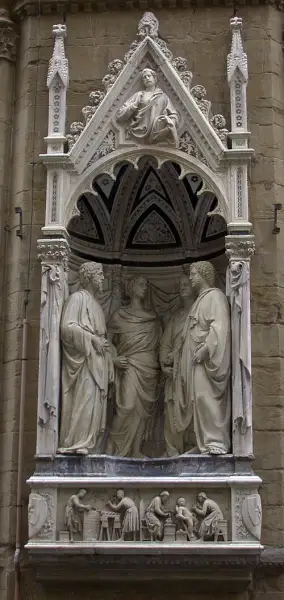
The legacy of the Crowned Martyrs runs from Roman catacombs to Renaissance sculpture and modern fraternal lodges. Their cult reached England early: Bede records a church dedicated to them at Canterbury, explained either by Augustine of Canterbury's monastery standing near the Roman basilica or by relics sent from Rome to England in 601. Their association with stonework made them the natural patrons of the craft; the stonemasons of Germany adopted them as patron saints of Operative Masonry, and English Freemasonry honoured them so thoroughly that one of its chief scholarly journals is titled Ars Quatuor Coronatorum. In Florence, where the Golden Legend made their story familiar, the guild of stone and wood masters, the Maestri di Pietra e Legname, kept them as patron saints and commissioned Nanni di Banco, one of their own members, to carve the sculptural group completed around 1415 for Orsanmichele — one of the landmarks of early Renaissance art, preceded by Niccolò di Pietro Gerini's depiction of about 1385 and followed by treatments such as Filippo Abbiati's. Modern scholarship, from Delehaye's commentary of 1910 to recent studies, has refined but not dissolved the enigma: nine names, two feasts, one crown.
§ Depictions
Timeline
- 287
Five sculptors of Sirmium, condemned for refusing to carve a statue of Aesculapius, are sealed in lead coffins and drowned in the Sava.
§ Second group
- 289
Two years after the sculptors, four soldier-clerks who would not sacrifice to Aesculapius are put to death by Diocletian's order.
§ First group
- 305
The Catholic Encyclopedia instead sets the sculptors' drowning by leaden casket in the River Save toward the close of this year.
§ Second group
- Aug 354
The feast of the Albano martyrs, kept on August 7 or 8, is cited in the Roman Calendar of Feasts of this year.
§ Confusion and conclusions
- 601
Relics of the martyrs are possibly dispatched from Rome to England, helping explain the early Canterbury dedication Bede records.
§ Veneration
- 847
Pope Leo IV's acts in the Liber Pontificalis record the martyrs' remains being moved to the Caelian Hill church.
§ The Passio sanctorum quatuor coronatorum
- 1123
An inscription of this year records that a single martyr's head rests in Santa Maria in Cosmedin.
§ Joint veneration
- 1385
Niccolò di Pietro Gerini paints the martyrs in a depiction dated about this year.
§ Depictions
- 1415
Nanni di Banco, a member of the stone and wood workers' guild, completes his sculptural group of the saints at Orsanmichele in Florence.
§ Depictions
- 1910
The Jesuit philologist Hippolyte Delehaye brings out a commentary on the martyrs' Passio in the Acta Sanctorum.
§ The Passio sanctorum quatuor coronatorum
The Record
- Patron of
- sculptors, stonemasons, and stonecutters·against fever·cattle
- Canonization
- Pre-congregation; venerated as martyrs from the earliest centuries, with feasts on August 8 and November 8 in the Roman Martyrology
Prayer
Bibliography
Show 12 sources
- William Granger Ryan, The Golden Legend: Readings on the Saints (Princeton University Press, 1993), vol. 2, 290–91.
- "Latin Saints of the Orthodox Patriarchate of Rome". www.orthodoxengland.org.uk. Retrieved 2020-09-05.
- "CATHOLIC ENCYCLOPEDIA: Four Crowned Martyrs". www.newadvent.org. Retrieved 2020-09-05.
- del Bufalo, Dario. Porphyry: Red Imperial Porphyry, Power, and Religion. Turin: Umberto Allemandi, 2012. pp. 65–82. ISBN 9788842221463
- Alban Butler, Sarah Fawcett Thomas, Paul Burns, "Butler's Lives of the Saints," (Continuum International Publishing Group, 1997), 63.
- Parc Gradual (GB-Lbl Add. MS 39678), 134v
- "Monumental Sculpture from Renaissance Florence", National Gallery of Art. Archived from the original on 2006-08-21. Retrieved 2013-01-24.
- Martyrologium Romanum (Typis Vaticanis 2004, ISBN 88-209-7210-7), p. 612
- Martyrologium Romanum (Typis Vaticanis 2004, ISBN 88-209-7210-7), p. 439
- "Quator Coronati | Masonic Dictionary". www.masonicdictionary.com. Archived from the original on 2020-08-01. Retrieved 2020-09-05.
- Maskarinec, Maya (2017). "Hagiography as History and the Enigma of the Quattro Coronati". Rivista di Archeologia Cristiana. 93. Vatican City: Pontifical Institute of Christian Archeology: 345–409. ISSN 0035-6042.
- Rosa Giorgi, "Saints: A Year in Faith and Art" (Harry N. Abrams, Inc., 2006).
Profile text adapted from the Wikipedia article, licensed CC BY-SA 4.0.
Pray with this saint every day
Save Four Crowned Martyrs to your favorites, read the full profile, and get feast-day reminders in the Saints app.
Get the Saints AppFree on the App Store for iPhone and iPad