
1st century AD·Feast not given in the source article
Four Evangelists
Matthew, Mark, Luke, and John, authors of the Gospels
Overview
Christian tradition gives the name of the Four Evangelists to Matthew, Mark, Luke, and John — the writers to whom the Church ascribes the four canonical Gospel accounts. The word evangelist means a person who proclaims good news, and their books exist to tell the good news — the gospel — of Jesus. Convention holds that two of the four were apostles of Jesus himself: Matthew, a former tax collector also known as Levi, called by Jesus into the Twelve, and John, the youngest of the Twelve. The other two are counted among the apostolic men: Mark, a follower of Peter, and Luke, a doctor who addressed his account to Theophilus, wrote the Acts of the Apostles, and was a close friend of Paul of Tarsus; Orthodox tradition records both as members of the seventy apostles sent out in Luke 10. Matthew, Mark, and Luke are called the Synoptic Gospels since they tell many of the same episodes, frequently in a shared order and at times word for word, while John's account stands apart with its eternal overview of Jesus the Logos and its higher christology. Beyond their books, the four are inseparable from Christian art: each is symbolised by a winged living creature drawn from the visions of Ezekiel and Revelation — man, lion, ox, and eagle — and together these form the Tetramorph that surrounds Christ in Majesty across the churches of Europe.
The Complete Life
A Tax Collector, a Peter's Man, a Doctor, and the Beloved Disciple
The four men whom the Church calls the Evangelists came to their writing from very different lives, as tradition records them. Matthew, whose Greek name was Matthaîos, had been a tax collector under the name of Levi until Jesus called him to be one of the Twelve Apostles — a profession despised in his day, chosen by Christ as a foundation for an apostle. Mark, Mârkos in Greek, was not of the Twelve but a follower of Peter, and for that reason tradition honours him as an apostolic man; Orthodox tradition numbers him among the seventy disciples whom the Lord sent out in Luke's tenth chapter. Luke, Loukas, was a doctor by profession, the companion and close friend of Paul of Tarsus, and likewise counted among the seventy. John was a disciple of Jesus and the youngest member of the Twelve. Two apostles and two apostolic men: the early church's formula for why these four voices, and no others, were received as the authoritative tellers of the good news of Jesus — a company drawn from tax booth, household of Peter, medical practice, and the inner circle of the Lord himself.
§ Gospels
Proclaimers of Good News
Evangelist means one who proclaims good news, and the title belongs to these four because their books exist to announce the good news — the gospel — of Jesus; Mark's account opens with the phrase that gives the genre its name. The vocation of the evangelist was therefore not merely that of a recorder but of a herald: each man shaped the memory of Jesus's words and deeds into a book destined for public reading in the assembly. Matthew composed the first gospel in the canonical order, beginning with Joseph's genealogy traced from Abraham. Mark, drawing on his discipleship to Peter, delivered the second account. Luke wrote his orderly narrative for Theophilus and went on to compose the Acts of the Apostles, extending the story from the resurrection to the missions of Paul. John, the youngest of the Twelve, began where the others ended: with the eternal overview of Jesus the Logos. In the New Testament their works carry the simple titles that have shaped two millennia of reading, each book named simply and permanently for the evangelist who wrote it.
§ Gospels
Four Books, One Gospel
The mission of the four was accomplished in the writing of books that would carry the gospel to the ends of the earth. Matthew, Mark, and Luke bear the collective name of Synoptic Gospels: they recount many identical episodes, frequently in a shared order and at times word for word — three accounts that look at the life of Jesus with one eye. John's gospel stands beside them with a deliberately higher christology, opening on the Word before all ages. Tradition and scholarship part ways on the order of composition: patristic witness and canonical position have long cited Matthew as the first gospel account, yet most biblical scholars judge Mark's to have been written first, and John's last of the four; the usual dating periods themselves suggest this order. Convention nonetheless keeps the customary phrasing — the Gospel of Matthew, Matthew's Gospel, and so on — honouring the arrangement by which the church first received them. Whatever the scholarly ordering, the four books were received together as one fourfold gospel, the complete testimony of the apostolic age to Jesus of Nazareth.
§ Naming
Man, Lion, Ox, and Eagle
The spirituality of the evangelists has been mediated to generations of Christians through their symbols, the four living creatures harnessed to God's throne-chariot in Ezekiel's first chapter and beheld again in the Book of Revelation — though neither biblical source itself links the creatures to the evangelists. The meanings grew over centuries, taking early shape in Jerome's formulation and reaching complete form under Rabanus Maurus, who gave the beasts a triple reading: they stand first for the evangelists themselves, then for the nature of Christ, and last for the virtues a Christian needs on the way to salvation. Matthew's winged man signifies the incarnation and Christ's human nature, teaching believers to use their reason for salvation. Mark's winged lion — emblem of courage and of kingship — points to the resurrection, for the lion was thought to sleep with its eyes open, an image of Christ in the tomb, and to Christ the king. Luke's winged ox, an emblem of sacrifice, service, and strength, points to the Passion and Christ the high priest. John's eagle, able to look straight into the sun, embodies the ascent to Christ's divine nature, summoning Christians to look on eternity without flinching on their journey toward union with God.
§ Symbols
The Tetramorph in Stone, Glass, and Vellum
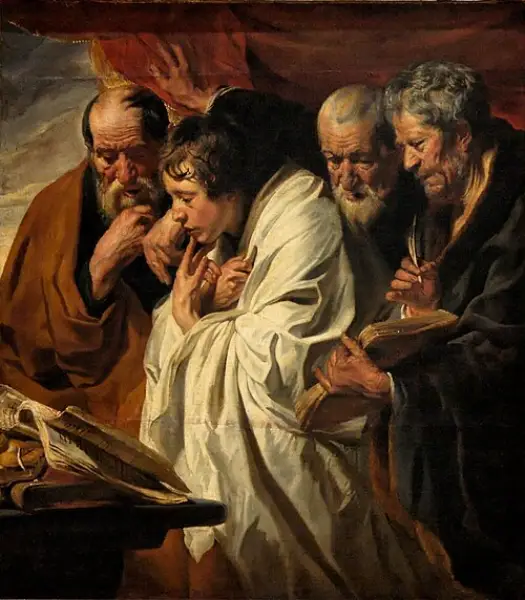
Few subjects in Christian art have had so long and rich a life as the four evangelists. In Evangelist portraits derived from the classical tradition they appear as writing authors, sometimes dictating to themselves in the form of their symbolic creatures. When the four symbols appear together they form the Tetramorph, ubiquitous in the Romanesque art of Europe on church frescoes, murals, portals, and apses, and the constant accompaniment of Christ in Majesty: the man at the upper left above Christ's right hand, the lion above his left arm, the ox and the eagle beneath, an arrangement reflecting both Ezekiel 1:10 and the medieval ranking of the nobility of the beasts — man as king of creation, lion of beasts of prey, ox of domesticated animals, eagle of birds. The motif flourished in the great manuscripts, from the Echternach and Egmond Gospels and the Book of Kells to the eighth-century Codex Amiatinus, the earliest surviving complete Vulgate Bible, and in a twelfth-century processional cross showing Christ amid the four creatures. From the thirteenth century its use declined as a new imagery of Christ in Majesty displaying the wounds of the Passion took its place, yet the subject returned ceaselessly in painting, from Bloemaert and Rubens to Jordaens.
§ Symbols
Timeline
- 690
The illuminated Echternach Gospels, produced around this date, pair each evangelist with his symbolic winged creature.
§ Depictions
- 700
The Codex Amiatinus, the earliest surviving complete Vulgate Bible, was made in the eighth century.
§ Depictions
- 820
A Carolingian Gospel book from Aachen carried a depiction of the four evangelists.
§ Depictions
- 1100
A processional cross of the twelfth century showed Christ surrounded by the symbols of the evangelists.
§ Symbols
- 1200
From the thirteenth century the traditional arrangement of the four symbols began to decline as a new Christ in Majesty came into use.
§ Symbols
- 1612
Abraham Bloemaert painted The Four Evangelists around this date; the work is now at the Princeton University Art Museum.
§ Depictions
- 1614
Peter Paul Rubens painted the four evangelists.
§ Depictions
- 1625
Jacob Jordaens painted The Four Evangelists, a work executed between 1625 and 1630.
§ Depictions
The Record
- Major works
- Gospel of Matthew·Gospel of Mark·Gospel of Luke·Acts of the Apostles (Luke)·Gospel of John
- Symbols
- winged man or angel (Matthew)·winged lion (Mark)·winged ox or bull (Luke)·eagle (John)
- Canonization
- Pre-congregation; honoured as saints across the Catholic, Eastern Orthodox, Oriental Orthodox, and Anglican traditions
Prayer
Bibliography
Show 7 sources
- Denova, Rebecca (26 February 2021). "The Gospels". World History Encyclopedia. Archived from the original on 24 February 2024. Retrieved 3 March 2024.
- Lincoln, Andrew (25 November 2005). Gospel According to St John: Black's New Testament Commentaries (reprint ed.). Bloomsbury Publishing. p. 18. ISBN 978-1-4411-8822-9.
- France, R. T. (11 July 2007). The Gospel of Matthew. Wm. B. Eerdmans Publishing. p. 18. ISBN 978-0-8028-2501-8.
- Schaff, Philip. "Latin Christianity: Its Founder, Tertullian". Christian Classics Ethereal Library. Retrieved 3 March 2024.
- Jerome, Saint (December 2008). "Preface". Commentary on Matthew. The Fathers of the Church. Vol. 117. Translated by Thomas P. Scheck. CUA Press. p. 55. ISBN 978-0-8132-0117-7.
- Male, Emile (1972) [1913]. The Gothic Image: Religious Art in France of the Thirteenth Century (reprint ed.). New York: Harper & Row. pp. 35–7. ISBN 978-0064300322.
- Farnell, David. "The Synoptic Gospels In The Ancient Church: The Testimony To The Priority Of Matthew's Gospel". Masters Seminary Journal.
Profile text adapted from the Wikipedia article, licensed CC BY-SA 4.0.
Pray with this saint every day
Save Four Evangelists to your favorites, read the full profile, and get feast-day reminders in the Saints app.
Get the Saints AppFree on the App Store for iPhone and iPad