
1170 – 1218·Feast April 24 or 25
St. Franca Visalta
Cistercian abbess of Piacenza and ascetic
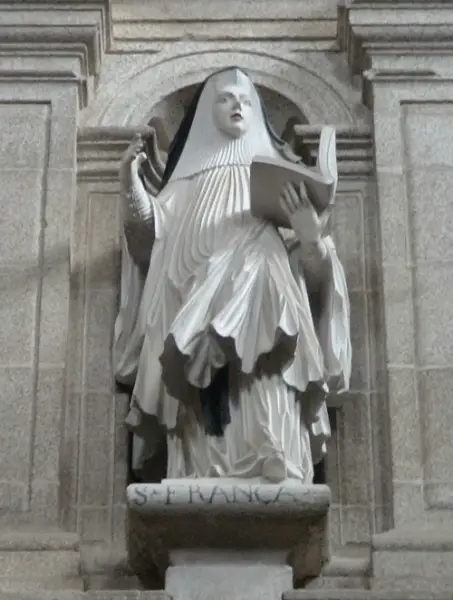
Overview
Known in religion as Franca of Piacenza, Franca Visalta served as a Cistercian abbess and is honoured as a Catholic saint; her life ran from 1170 to 1218. Born in Piacenza, Italy, she was given to religious life extraordinarily early, becoming a Benedictine nun in the convent of St Syrus at the age of seven, and in time she was made abbess while still young. Her tenure, however, foundered on the severity of the discipline she imposed: she was removed from office and isolated, and of all her community only one nun, Carentia, stood by her rule. With Carentia she went to a Cistercian convent at Rapallo, and there Franca's real work began. Her next step was to prevail upon her parents for the means to raise a Cistercian house at Montelana; there the two women entered the order together, and Franca ruled the new foundation as abbess. The austerities she had once demanded of others she now practised upon herself, keeping them even as her health failed, and she passed most nights praying for hours in the chapel. She later moved her Cistercian community to Pittoli, where she died on 25 April 1218 — her forty-eighth birthday. Pope Gregory X beatified her in March 1273 and canonized her that same September, and she is invoked against nightmares and diseases of the eyes.
The Complete Life
A Child Given to God at Piacenza
Franca Visalta was born on 25 April 1170 in Piacenza, a city of the Lombard plain whose church life reached back to the earliest centuries of Italian Christianity. Her parents destined her for God from infancy: at the age of only seven she entered the Benedictine convent of St Syrus as a nun, an age at which most children of her era were only beginning their schooling. Such an offering, unusual in any century, placed the whole of her formation within cloister walls; the psalms, the work, and the discipline of the Benedictine day were the only world she grew up in. The convent of St Syrus anchored her to her native city, and it was there that the traits that would define her life first showed themselves — a seriousness about religious observance that far outran her years. That intensity would soon carry her to office, then cost her the office, and finally make her the founding mother of a Cistercian community of her own; but its roots lay in the child who was given to God at Piacenza before she could have chosen anything for herself.
§ Franca Visalta
Young Abbess and Removed Superior
Within the convent of St Syrus, Franca rose quickly, becoming abbess at a young age. The trust of her community, however, collided with her own understanding of the religious life: the austerities she imposed on the sisters proved so harsh that she was stripped of the abbacy and set apart. A single sister, Carentia, sympathised with the discipline Franca demanded and stayed true to her. The episode might have ended in bitterness or obscurity; instead it became the doorway to Franca's true vocation. Carentia left for a Cistercian convent at Rapallo on the Ligurian coast, and Franca's path turned toward the reforming order whose observance matched her own instinct for rigour. Her answer was to prevail upon her parents for the means to raise a Cistercian house at Montelana, and into it Franca and Carentia went together — the dispossessed abbess now a foundress, the failed superior now free to live the strictness she had always sought. What she could no longer impose on others, she would spend the rest of her life imposing, without relief, on herself. In this reversal the shape of her sanctity becomes clear: loss of office as the occasion of a deeper fidelity.
§ Franca Visalta
Foundress at Montelana
The foundation at Montelana was Franca's own work in a double sense: she obtained the house through the generosity of her parents, and she governed it as abbess once it was established. There the Cistercian life she had long envisioned took shape. The order she embraced was itself born of a desire for stricter fidelity to the Rule of St Benedict, and Franca embodied that desire to an unusual degree. The community she and Carentia entered became the sphere of a discipline practised rather than merely legislated — and practised chiefly on the abbess herself. Her early failure at St Syrus taught her, if it taught her anything, that the strictness she loved could not survive as commandment alone; at Montelana it became witness. She held the community together in the Cistercian observance, and the house endured, later removing to Pittoli under her leadership. In the history of the Cistercian nuns of Lombardy her foundation stands as the fruit of a chastened ambition: the abbess who lost her first office for excessive severity built her second on the harder authority of example.
§ Franca Visalta
Night Prayer and Relentless Austerity
The spirituality of Franca Visalta was ascetical to its core and anchored in prolonged prayer. At Montelana and later at Pittoli she maintained the strict austerities on herself, refusing herself the softening that age, office, or infirmity might have excused, and she kept them even when her health was visibly failing. Her nights belonged to the chapel: she spent most nights there, praying for several hours while the community slept. This was the pattern of a woman who had learned that religious authority founded on severity toward others collapses, but severity toward oneself can become intercession. The hardships she once demanded of her unwilling sisters at Piacenza she now offered as prayer on their behalf and for the world. Her biographers connect this vigilance with the graces her cult later claimed: the invocation of the faithful against nightmares — the terrors of the night she had confronted nightly — and against disorders and diseases of the eyes, fittingly entrusted to a saint whose own gaze was fixed so long in darkness upon the Eucharistic light. Kneeling, crowned by Christ: so her iconography shows her, the ascetic rewarded.
§ Franca Visalta
Pittoli and a Birthday Death
In her last years Franca moved her Cistercian community from Montelana to Pittoli, the place of her death. Her health, long undermined by the austerities she would not abandon, was failing, yet she continued the discipline and the night prayers that had shaped her whole religious life. She died at Pittoli on 25 April 1218, dying — as the coincidence of dates records — on her forty-eighth birthday, the day on which she had been born in Piacenza half a century before. The community she had gathered out of a single loyal companion, Carentia, survived her as a Cistercian house. Her death closed a life whose arc ran from a child oblate at seven, through the humiliation of removal from office, to the authority of a foundress whose severity had been converted into self-sacrifice. In the convent at Pittoli her memory was kept, and from it the cause of her recognition spread to the universal Church within the lifetime of those who could remember her. The birthday death struck her contemporaries as a seal set upon a life wholly given.
§ Franca Visalta
Honours of Gregory X
Recognition of Franca's sanctity came barely a half-century after her death. She was beatified on 21 March 1273, and on 21 September of the same year Pope Gregory X canonized her — a pontiff whose brief reign was itself marked by the concerns of reform and the affairs of the Eastern Church, and who found in the Cistercian abbess of Piacenza a model of the strict observance he valued. The speed of the process, from beatification in spring to canonization in autumn of a single year, suggests how uncontested her cult had become in the Cistercian world and in Lombardy. Her feast was fixed for 24 or 25 April, the days surrounding the anniversary of both her birth and her death. She is honoured in the Catholic Church as Saint Franca Visalta of Piacenza of the Cistercian order, remembered wherever the order's houses stood — her statue, kneeling and crowned by Christ, watches from the Monastery of Arouca in Portugal, far from the Lombard valley where she prayed. The two feast days, 24 and 25 April, have kept her memory alive in the Cistercian calendar ever since.
§ Franca Visalta
Patron of the Sleepless and the Blind
Franca's afterlife has been that of a saint of the quiet sufferings. Her patronage extends against nightmares and against eye disorders and diseases, both entrusted to her because of the shape of her life: the woman who spent her nights in the chapel of Pittoli became the advocate of those whose nights are tormented, and the ascetic whose eyes were fixed on prayer became the helper of failing sight. Her attributes in art — kneeling, and crowned by Christ — summarise the theology of her story, the abbess who was deposed by her community and crowned by her Lord. The Cistercian order keeps her among its thirteenth-century saints, and her cult reached across Europe, as the statue in the Monastery of Arouca in Portugal attests. Historians of the order remember her also for a subtler legacy: the demonstration that the disciplinary rigour of the early Cistercian ideal could survive its rejection by one community, provided the reformer was willing to bear it alone. Franca bore it for forty years, and the Church she served judged the bearing itself to have been heroic. Her life remains a study in how severity, chastened by failure, can ripen into charity.
§ Franca Visalta
Timeline
- 25 Apr 1170
Born in Piacenza, Italy.
§ Introduction
- 1177
Enters the Benedictine convent of St Syrus in Piacenza as a nun at age seven.
§ Introduction
- 25 Apr 1218
Dies at Pittoli after transferring her Cistercian community there.
§ Introduction
- 21 Mar 1273
Beatified.
§ Introduction
- 21 Sep 1273
Canonized by Pope Gregory X.
§ Introduction
The Record
- Major works
- Cistercian house at Montelana, built at Franca's persuasion and ruled by her as abbess
- Patron of
- against nightmares·against eye disorders and diseases
- Symbols
- kneeling, crowned by Christ
- Canonization
- Beatified 21 March 1273; canonized 21 September 1273 by Pope Gregory X
Prayer
Bibliography
Show 3 sources
- "Biodata". Archived from the original on 2008-10-08. Retrieved 2008-08-17.
- Alban Butler (revised by Peter Doyle, ed. Paul Burns), Butler's Lives of the Saints: April new full edition (Tunbridge Wells, Kent, England: Burns and Oates 1999), p. 185.
- Acta Sanctorum Month of April Part 3, April 25, pp. 379–404.
Profile text adapted from the Wikipedia article, licensed CC BY-SA 4.0.
Pray with this saint every day
Save St. Franca Visalta to your favorites, read the full profile, and get feast-day reminders in the Saints app.
Get the Saints AppFree on the App Store for iPhone and iPad