
1384 – 1440·Feast March 9
St. Frances of Rome
Roman noblewoman, mystic, and foundress of the Oblates
Overview
Francesca Bussa de' Leoni was born into the Roman aristocracy in 1384 and, despite wishing at eleven to become a nun, was married at about twelve to Lorenzo Ponziani, who commanded the papal troops of Rome. The arranged match proved happy and lasted forty years, during which Frances served the poor of a city ravaged by plague, flood, famine, and the warfare of the Western Schism. She turned part of the Ponziani estate into a hospital, gathered other noblewomen into charitable work, and became renowned for a gift of healing — more than sixty cases were attested at her canonization proceedings. Her visions, her bodily vision of her guardian angel, and her prophecies drew wide devotion. On the feast of the Assumption in 1425 she founded a confraternity of pious women under Olivetan authority, and in 1433 a monastery at Tor de' Specchi, whose members shared a common life without formal vows. Nursing her wounded husband through his last seven years, she became a widow in 1436, entered the monastery as its superior, and died in Rome on 9 March 1440. Canonized by Paul V in 1608, she is patroness of Benedictine oblates, widows, and automobile drivers.
The Complete Life
A Bride of the Ponziani
Francesca Bussa de' Leoni was born in 1384 in Rome, in the rising district of Parione, to Paolo Bussa de' Leoni and his wife Iacobella dei Roffredeschi, a couple of wealth and ancient name. She was christened in the church of St. Agnes that stands on the famous Piazza Navona. Her childhood unfolded in a city that the Western Schism and its wars were slowly strangling, though the family's standing shielded her from the worst of it. At eleven she resolved to become a nun; at about twelve her parents overruled her and gave her in marriage to Lorenzo Ponziani — a commander of Rome's papal troops and heir of an immensely rich house. What might have been a grief became instead one of the great married loves of the saints: the union, though arranged, proved happy and endured forty years. Frances formed a deep friendship with her sister-in-law Vannozza, and the two young women went together among the poor of Rome, nursing the sick in their homes. Their example shamed and inspired other wealthy women of the city to do the same, so that the Ponziani household became, almost from the first, a center of organized charity.
§ Life
Mistress of the Household, Servant of the City
Soon after her wedding Frances fell gravely ill. Her husband summoned a man who dabbled in magic, whom she drove from the room with a rebuke of Satan's servant; she later told Vannozza that St. Alexis had come to her in vision and restored her health. When her mother-in-law died, Frances took charge of the household, and her charity grew with her authority. During a season of flood and famine she converted part of the family's estate into a hospital and gave away food and clothing to the destitute. Her father-in-law, angered by the expense, seized the keys of the supply rooms — then returned them, the story goes, when he found the corn bin and wine barrel mysteriously replenished after Frances finished praying. Her deeper vocation matured slowly. On the Assumption feast of 15 August 1425 she founded the Olivetan Oblates of Mary — pious women joined in a confraternity under the Olivetan monks at the Abbey of Santa Maria Nova — neither cloistered nor bound by formal vows, free to join prayer with service. In March 1433 she built them a monastery at Rome's Tor de' Specchi by the Campidoglio, and on 4 July of that year Pope Eugene IV approved the congregation of oblates with private vows.
§ Life
Charity in a City at War
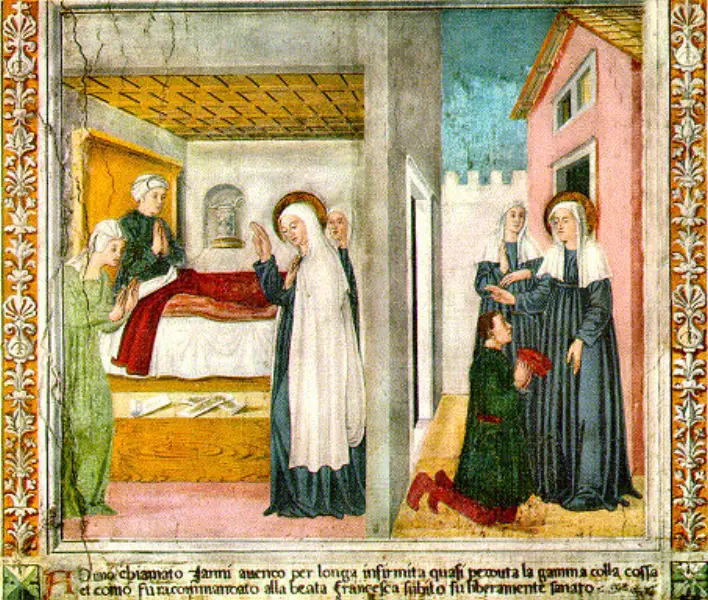
The Western Schism made Frances's Rome a battlefield. Lorenzo served the true pope against the anti-popes, and the family paid the price. Their son Battista was ordered delivered as a hostage to the Neapolitan commander; obeying her spiritual director, Frances led the boy to the Campidoglio, pausing in the Church of the Aracoeli to entrust his life to the Blessed Mother. When the soldiers tried to mount the child for captivity, the horse would not move under heavy whipping, and the escort, seeing the hand of God, gave the boy back to his mother. During a stretch of forced exile most of Lorenzo's property was destroyed, and in one Neapolitan occupation of Rome he was so severely wounded that he never fully recovered. The plagues took two of Frances's children. With the city in ruins and wolves entering the streets, she opened her home again as a hospital and drove her own wagon through the countryside gathering firewood and medicinal herbs. Contemporaries credited her with a gift of healing: more than sixty cases were formally attested during her canonization proceedings, wonders performed for a population that had almost nothing left but her.
§ Life
The Drama of Heaven
The Catholic Encyclopedia summarizes her inner life with unusual richness. With her husband's consent she practiced continence and advanced in contemplation; her visions often took the shape of dramas enacted before her by heavenly personages. She possessed, the account records, the gifts of miracle and ecstasy, and — most beloved in her iconography — the bodily vision of her guardian angel, who is said to have lit her road with a lantern as she moved by night. Her revelations concerned Purgatory and Hell, and she foretold the ending of the Western Schism that had divided Christendom for her entire adult life. She could read the secrets hidden in consciences and uncover plots of diabolical origin, gifts she used not for spectacle but for the healing of souls brought to her. What struck her examiners most, however, was not the extraordinary but the ordinary: the encyclopedia notes that what set her apart were humility and detachment, obedience and patience. In an age when mystics were suspected on every side, Frances anchored her visions to a life of unremarkable fidelity — a wife managing a great house, a mother burying children, a nurse driving a wagon for wood — and let the heavens interrupt the work, not replace it.
§ Life
Widow and Superior
The last chapter of Frances's married life was spent at a sickbed. Lorenzo, wounded too badly in the Neapolitan occupation of Rome to ever fully recover, required care for the final seven years of his life, and Frances nursed him herself, day after day, though by then she was guiding a growing congregation. Only when he died in 1436 did she leave the family house for good, moving into the monastery she had built at Tor de' Specchi and accepting election as its superior. She was by this time in her early fifties, famed across Rome for holiness, and the community she now governed was unlike most in the city: women living in common without solemn vows, bound instead by private vows and by the pattern she had shown them of prayer joined to service. She led them for barely four years. On 9 March 1440 she died in Rome, and her body was buried in the Church of Santa Maria Nova, the Olivetan abbey whose monks had first authorized her oblates. Some months later, her grave was opened and her body was found incorrupt — the first of many signs that the city which had watched her wagons would not soon let her memory go.
§ Life
Incorrupt and Enthroned
Rome canonized its own with unusual speed for the age: on 9 May 1608, Pope Paul V raised Frances of Rome to the altars, not quite six generations after her death. In the decades that followed, a diligent search was made for her remains, hidden away through the troubled age in which she lived. The trail was not simple. Her body, found incorrupt only months after her burial, had been laid away for safety; her grave was positively identified on 2 April 1638, though only bones remained by then. On 9 March 1649 — the anniversary of her death — her bones were returned to the Church of Santa Maria Nova, and that date has been her feast day ever since. In 1869 the body was exhumed once more and placed in a glass coffin where the faithful could venerate it, as they do still. The church of her burial, once known as Santa Maria Nova, is now commonly called the Church of St. Frances in her honor, and the Church of Santa Francesca Romana near the Forum stands as her major shrine. Rome, which she had served in its hungriest years, thus returned the service, keeping her bones at the heart of the city.
§ Veneration
Patroness of Oblates and Motorists
The institute Frances founded proved as durable as her fame. The Tor de' Specchi monastery remains the only house of the congregation, and the community gathered in 1433 is known today as Frances of Rome's Oblates — women who still share a common life without religious vows, in exactly the pattern she devised. Within the Benedictine family she is honored as patroness of all oblates, the lay associates who live by the Rule of Benedict amid ordinary careers, and she is likewise a patron of widows. Her strangest and most modern patronage came in 1925, when Pius XI named her the heavenly patron of automobile drivers, reasoning from the legend that an angel lit her road with a lantern on her travels and kept her safe from every hazard; a blessing on cars descends from her patronage. Artists have kept her visible for six centuries: Antoniazzo Romano painted her at Tor de' Specchi in 1468, and Giosuè Meli sculpted her in the nineteenth century. Five hundred years after her death, the aristocratic bride who wanted to be a nun still guards travelers, mourners, and the lay faithful of her Benedictine family.
§ Patronage
Timeline
- 1384
Born in the Parione district of Rome to Paolo Bussa de' Leoni and his wife Iacobella dei Roffredeschi, and christened at the Church of St. Agnes on Piazza Navona.
§ Life
- 15 Aug 1425
Founded the Olivetan Oblates of Mary — pious women banded into a confraternity under the Olivetan monks of Santa Maria Nova, unbound by formal vows.
§ Life
- Mar 1433
Opened a monastery at Rome's Tor de' Specchi by the Campidoglio so that members of the confraternity could live in common.
§ Life
- 4 Jul 1433
Pope Eugene IV approved the group as a congregation of oblates holding private religious vows.
§ Life
- 1436
Widowed by the death of Lorenzo Ponziani after nursing him through seven years, she moved into the Tor de' Specchi monastery and became its superior.
§ Life
- 9 Mar 1440
Died in Rome and was buried in the Church of Santa Maria Nova.
§ Life
- 9 May 1608
Canonized by Pope Paul V in Rome.
§ Veneration
- 2 Apr 1638
Her grave, hidden during the troubled times of her era, was identified after a diligent search.
§ Veneration
- 9 Mar 1649
Her remains were laid to rest again in the Church of Santa Maria Nova, the date thereafter kept as her feast day.
§ Veneration
- 1869
Her body was exhumed and has since rested in a glass coffin where the faithful venerate it.
§ Veneration
- 1925
Declared patron saint of automobile drivers by Pope Pius XI, recalling the angel said to light her path on journeys.
§ Patronage
In Their Own Words
Begone, thou servant of Satan, nor ever venture into these walls again!
The Record
- Major works
- Olivetan Oblates of Mary, confraternity founded on 15 August 1425·Monastery of Tor de' Specchi in Rome, founded 1433, still the only house of the institute·Hospital opened in part of the Ponziani family estate during flood and famine·Charitable service among Rome's sick and poor with her sister-in-law Vannozza
- Patron of
- patroness of Benedictine oblates·patron saint of automobile drivers·patron saint of widows
- Symbols
- her guardian angel bearing a lantern·monastic habit of the Oblates of St. Frances of Rome
- Canonization
- Canonized 9 May 1608 by Pope Paul V in Rome
Prayer
Bibliography
Show 6 sources
- Fullerton, Georgiana Charlotte (1855). The Life of St. Frances of Rome; of Blessed Lucy of Narni, of Dominica of Paradiso, and Anne. Burns and Lambert, Oxford University.
- Farmer, David Hugh (1997). The Oxford Dictionary of Saints (4th ed.). Oxford University Press. p. 191. ISBN 0-19-280058-2.
- "St. Frances of Rome". Catholic Encyclopedia. New York: Robert Appleton Company, 1913.
- "Saint Frances of Rome". Franciscan Media, 2016-03-09.
- "Saint Frances of Rome". Loyola Press.
- Harris/CNA, Elise (2024-03-09). "How St. Frances of Rome Became the Inspiration for 'a Blessing on Cars'". National Catholic Register.
Profile text adapted from the Wikipedia article, licensed CC BY-SA 4.0.
Pray with this saint every day
Save St. Frances of Rome to your favorites, read the full profile, and get feast-day reminders in the Saints app.
Get the Saints AppFree on the App Store for iPhone and iPad