
1850 – 1917·Feast November 13
St. Frances Xavier Cabrini
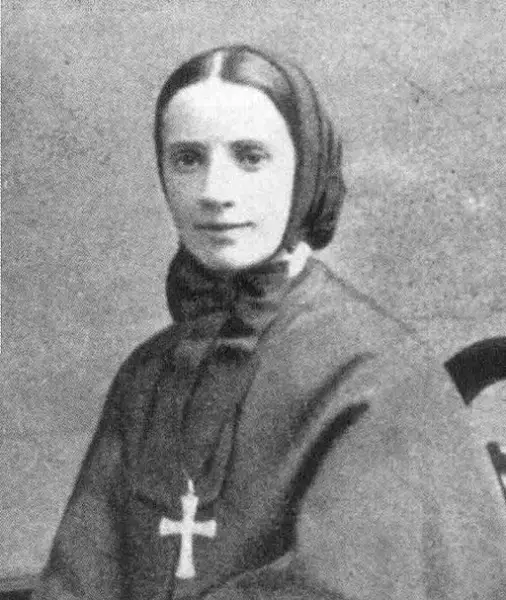
Mother Cabrini, first American saint and patroness of immigrants
Overview
Maria Francesca Cabrini was born in 1850 in Sant'Angelo Lodigiano, Lombardy, the youngest of thirteen children of a farming family. Frail from birth, she trained as a schoolteacher and twice sought admission to religious communities, only to be turned away on health grounds. In 1874 she was invited to manage a struggling orphanage in Codogno, where she finally took vows, adding the name Xavier in honor of the missionary apostle whose East Asian dream she shared. When that house collapsed in 1880, she founded her own sisterhood, the Missionaries of the Sacred Heart (MSC). Pope Leo XIII redirected her missionary ambitions from Asia to the Italian immigrants of New York, and she arrived there in 1889 with six sisters. Facing prejudice from both society and an Irish-dominated hierarchy, she built schools, orphanages, and hospitals for the newcomers. Over the following decades she crossed the Atlantic twenty-four times, extending her institutes across the United States, Latin America, and Europe, and became a naturalized American citizen in 1909. She died in Chicago in 1917, having established sixty-seven institutions. Canonized in 1946, she was hailed as the first American saint and was named patroness of immigrants in 1950.
The Complete Life
A Frail Child of Lombardy
Maria Francesca Cabrini came into the world on 15 July 1850 in Sant'Angelo Lodigiano, a town in Lombardy then ruled from Vienna as part of the Austrian Empire. The thirteenth and youngest child of Agostino and Stella Cabrini, farmers of the district, she arrived two months premature and remained small and delicate all her life; only four of her siblings lived beyond adolescence. As a girl she visited her uncle Don Luigi, a priest of Livraga whose house stood beside a canal. There she folded paper boats, set violets aboard, called the flowers her missionaries, and launched them downstream toward India and China — a child's game that foreshadowed a lifetime of longing for the missions. Twice danger came from the water; once she was swept downstream and found alive on a riverbank, a rescue she attributed to God. Her older sister Rosa taught school, and Frances followed her: at thirteen she entered the Daughters of the Sacred Heart school at Arluno, graduating with honors in 1868 and a teaching certificate in hand. She returned to her home parish to teach, then spent three further years substituting in the schools of Castiraga Vidardo, building the practical skill that would one day run schools on two continents.
§ Early years
Doors Closed, Doors Opened
Religious life did not come easily. After her parents died around 1870, she applied to the Arluno community of Daughters of the Sacred Heart, the sisters who had schooled her, and was refused on the ground that her health was too weak. In 1872, while nursing the sick through a smallpox outbreak, she caught the disease herself, and the Canossian Sisters of Crema likewise declined her. It was said that the parish priest had quietly asked both orders to say no, unwilling to lose so able a teacher. In 1874 a priest at Codogno offered her something different: the leadership of a badly run orphanage in the hands of the Sisters of Providence. There she at last took vows, adding the name Xavier for Francis Xavier, the missionary whose East Asian field she coveted for herself. Her tenure was no gentler than her waiting had been. Two sisters who controlled the finances resented her and worked to thwart her until, in 1880, the Providence community at Codogno dissolved and the orphanage closed. Consulting Bishop Domenico Gelmini of Lodi, she heard that no order existed to train women missionaries; her reply was to announce that she would found one. That same November she bought a former Franciscan convent and gathered the first sisters of her new congregation.
§ Orphanage in Italy
Not to the East but to the West
A papal audience changed her course. In September 1887 she went to Rome, won ready permission for a convent there, and asked Leo XIII to bless missions to Asia. The pope had other anxieties: the floods of poor Italians sailing to New York, in danger of drifting from the Church unless someone fed and guided them. His counsel to her was to turn not eastward but westward. In December 1888 she committed to New York; the pope recognized her institute as a missionary body, the first Italian sisters so approved; and on the last day of March 1889 she landed at Manhattan with six companions. Archbishop Michael Corrigan, who had wanted Italian priests rather than sisters and had warned her to delay, told the travelers to go home. She answered that she carried letters from the pope, and stayed. Her first night was spent in a decrepit rooming house, the Scalabrinians having failed to meet the ship. Undeterred, the sisters opened a makeshift school in a church balcony for two hundred children, knocked on tenement doors in Little Italy, and, with funding from Countess Mary Reid DiCesnola, opened an orphanage on the Lower East Side. In 1890 she moved it to West Park, where a novitiate and boarding school grew into the American headquarters of the young congregation.
§ Mission in New York
Prayer and Interior Silence
Her interior life was forged in motion. In Buenos Aires in 1896 she told those around her that prayer and interior silence were great necessities for anyone occupied with a thousand concerns — speaking, listening, spending herself even on many good things — and that together they brought the soul to mystical rest. Her letters home show the same discipline under fire. When anti-Italian insults greeted her sisters in New York, she asked Italy to send cloth so their habits might be immaculate, determined that contempt should not define them. In her orphanages she practiced a stubborn mercy: where other institutions dismissed girls at fourteen, she insisted that no child leave except to an adoptive family or to a trade that could support an independent life. She once wrote that what women could not do on a large scale against grave social ills was being done in the small sphere of every house they opened, where orphans, the sick, and the poor were sheltered. Devotion to the Sacred Heart of Jesus gave the congregation both its name and its rule of charity, and the thousands of letters examined for her cause reveal a steady, practical trust in providence sustained across twenty-four Atlantic crossings and foundations on five coastlines.
§ Other missions
The Ship She Missed
From Chicago, where she arrived in 1899, she worked steadily westward and southward: Denver in 1902, Seattle in 1903, a warm dinner with Mother Katherine Drexel in Philadelphia in 1907 at which she urged the American foundress to take her troubles straight to Rome. In 1909 she became a naturalized citizen of the United States, both to secure her institute's legal footing after her death and to declare her solidarity with the people she served. Her second Columbus Hospital opened in Chicago's Lincoln Park in 1911 over neighborhood resentment; during construction a vandal cut the water mains and flooded the site, and an arson attempt met the extension hospital rising on the Near West Side. Early in 1912 she and several sisters reserved berths on the maiden crossing of the Titanic, then switched to an earlier sailing when troubles at the Chicago hospital called her home; the great liner sank without them. In 1916 she visited Southern California and built a chapel above the San Fernando Valley. The next year, in failing health, she traveled to Chicago to be cared for by her sisters. On 21 December 1917 she sat wrapping sweets as Christmas gifts for the children of the Italian school; the following morning she collapsed in her chair and died of chronic endocarditis, sixty-seven years old.
§ Later years
From Cause to Altar
Her cause moved quickly. In 1933 the sisters exhumed her remains and divided them as the process required: her head went to the motherhouse chapel in Rome, her heart to Codogno, an arm bone to the national shrine in Chicago, and the rest of her body to the New York shrine. Two cures carried the process forward. Peter Smith, born in Columbus Hospital in 1921, was blinded when a nurse accidentally administered a harsh silver nitrate solution that doctors said had destroyed his corneas; after a relic of Cabrini was touched to his eyes and a medal pinned to his gown, his sight was found restored within seventy-two hours. Sister Delphina Grazioli, dying in Seattle after four surgical procedures between 1925 and 1929, saw a vision of Cabrini and made a recovery the Vatican accepted as miraculous. Citing both cases, Pope Pius XI beatified her on 13 November 1938, with Smith — by then a priest — attending the ceremony. Pope Pius XII canonized her on 7 July 1946, and an estimated 120,000 people filled Soldier Field in Chicago for a Mass of thanksgiving. In 1950 the same pope named her patron saint of all immigrants, and her feast is kept on 22 December in the Roman Martyrology, the United States observing 13 November instead.
§ Veneration
An Empire of Charity
Few founders have left so physical a map. Sixty-seven institutions — schools, orphanages, hospitals — stood across the United States, Latin America, the Caribbean, and Europe at her death, and in 1926 her sisters at last reached China, fulfilling her oldest dream. The hospitals she founded in Manhattan and Chicago grew into medical centers bearing her name, and her congregation now serves in fifteen nations, educating, healing, and sheltering the poor. Her memory is written into civic life as well: a founder's statue in St. Peter's Square, a public memorial in Battery Park, schools, parishes, and university halls across the country, the Cabrini-Green housing project in Chicago, and a Colorado state holiday, Cabrini Day, that replaced Columbus Day in 2020. Three major shrines — in Lincoln Park, on Lookout Mountain at Golden, and in upper Manhattan — guard her memory and, in New York, her remains, displayed beneath a sculpted mask and hands in a bronze-and-glass reliquary. Pope Francis has credited her charitable work in Argentina with helping inspire his own vocation, and Pope Leo XIV pairs her with John Baptist Scalabrini as two great saints of the pastoral care of migrants. A 2024 film carried her story to a new generation.
§ Legacy
Timeline
- 15 Jul 1850
Born in Sant'Angelo Lodigiano, the youngest of thirteen children of Agostino and Stella Cabrini.
§ Early years
- 1868
Graduated cum laude from the Daughters of the Sacred Heart school at Arluno with a teaching certificate, then taught at her home parish school.
§ Early years
- 1874
Took over a poorly-run orphanage in Codogno and took religious vows with the Sisters of Providence, adding the name Xavier.
§ Orphanage in Italy
- Nov 1880
Founded her new congregation, the Missionaries of the Sacred Heart (MSC), at a former Franciscan convent in Codogno.
§ Orphanage in Italy
- Sep 1887
Traveled to Rome and met Pope Leo XIII, receiving permission for a Roman convent but being redirected toward New York.
§ Papal recognition
- Dec 1888
Gave her consent for New York while the pope recognized her congregation as a missionary body, the first Italian sisters so approved.
§ Papal recognition
- 31 Mar 1889
Arrived in New York City with six MSC sisters to begin work among Italian immigrants.
§ Arrival
- 1890
Purchased Jesuit property at West Park, New York, moving her first American orphanage there and founding an MSC novitiate.
§ First orphanage in United States
- 1892
Founded Columbus Hospital in Manhattan and severed institutional ties between her order and the Scalabrinians.
§ Other missions
- 1899
Arrived in Chicago to serve the city's large Italian population.
§ Later years
- 1909
Naturalized as a United States citizen to secure her order's legal standing and show solidarity with those she served.
§ Later years
- 1911
Opened a second Columbus Hospital in the Lincoln Park neighborhood of Chicago.
§ Later years
- 22 Dec 1917
Died suddenly of chronic endocarditis at Columbus Hospital, Chicago, aged sixty-seven.
§ Death
- 1933
Her remains were exhumed and divided among Codogno, Rome, Chicago, and New York during her canonization process.
§ Veneration
- 13 Nov 1938
Beatified by Pope Pius XI on the strength of the Smith and Grazioli cures.
§ Veneration
- 7 Jul 1946
Canonized by Pope Pius XII; about 120,000 people attended a thanksgiving Mass at Soldier Field in Chicago.
§ Veneration
- 1950
Named patron saint of immigrants by Pope Pius XII in recognition of her worldwide foundations.
§ Veneration
In Their Own Words
I have letters from the pope
...not to the East, but to the West...
Prayer and interior silence are great necessities for the person who is occupied with a thousand concerns
What we as women cannot do on a large scale to help solve grave social ills is being done in our small sphere of influence in every state and city where we have opened houses.
I can count on an exceptional counselor, the Holy Spirit.
Take courage, stand aside and run without stopping and be afraid to look back.
The Record
- Major works
- Missionary Sisters of the Sacred Heart of Jesus, founded at Codogno in 1880·Sacred Heart Orphan Asylum on the Lower East Side of Manhattan, her first American orphanage·St. Cabrini Home at West Park, New York, orphanage, novitiate, and American headquarters·Columbus Hospital in Manhattan (1892) and Columbus Hospital in Chicago (1911)·Schools and missions in New Orleans, Nicaragua, Grenada, Brazil, and Argentina·Chapel above the San Fernando Valley, California, built in 1916
- Patron of
- patron saint of immigrants (named 1950)
- Symbols
- religious habit of the Missionary Sisters of the Sacred Heart·small paper boats carrying violets, from her childhood games
- Canonization
- Beatified 13 November 1938 by Pope Pius XI; canonized 7 July 1946 by Pope Pius XII
Prayer
Bibliography
Show 6 sources
- Maynard, Theodore. Too Small a World: The Life of Mother Frances Cabrini. Foreword by Timothy Cardinal Dolan. San Francisco: Ignatius Press, 2024 [original: 1945]. ISBN 978-1-62164-704-1.
- De Donato, Pietro. Immigrant Saint: The Life of Mother Cabrini. New York: McGraw Hill, 1960.
- DiGiovanni, Stephen Michael (1991). "Mother Cabrini: Early Years in New York". The Catholic Historical Review. 77 (1): 56–77. ISSN 0008-8080.
- Rademacher, Nicholas (2017). "Commemorating the Centennial of Mother Cabrini's Death". American Catholic Studies. 128 (3): 111–124. ISSN 2161-8542.
- Ripatrazone, Nick (Spring 2023). "Mother Cabrini, the First American Saint of the Catholic Church". Humanities: The Magazine of the National Endowment for the Humanities. Vol. 44, no. 2.
- Sullivan, Mary Louise (1987). "Mother Cabrini: Missionary to Italian Immigrants". U.S. Catholic Historian. 6 (4): 265–279. ISSN 0735-8318.
Profile text adapted from the Wikipedia article, licensed CC BY-SA 4.0.
Pray with this saint every day
Save St. Frances Xavier Cabrini to your favorites, read the full profile, and get feast-day reminders in the Saints app.
Get the Saints AppFree on the App Store for iPhone and iPad