
1804 – 1866·Feast September 19
St. Francesco Maria da Camporosso
Capuchin beggar of Genoa, the Holy Father of the port
Overview
Francesco Maria da Camporosso, born Giovanni Croese on 27 December 1804 in the Ligurian village of Camporosso, was a Capuchin friar who became one of Genoa's best-loved holy men. The son of a farmer, he worked the land as a boy and joined the Capuchins as a postulant in 1822, taking his new religious name at Voltri in 1824. At the convent of the Immaculate Conception near the port of Genoa he was appointed alms collector in 1834 and made the friars' chief beggar in 1840. The work was hard and humiliating at first: he was heckled in the streets and even pelted with stones, and he answered by picking up the stones and kissing them in forgiveness. His humility and his long hours of adoration before the Eucharist gradually won the city's heart, and dockworkers and the poor came to seek his counsel and comfort. In an August 1866 cholera epidemic he nursed the stricken until he caught the disease himself and died on 17 September of that year. Genoa still calls him Padre Santo. Leo XIII opened his cause in 1896; Pius XI beatified him in 1929; and John XXIII canonized him in 1962.
The Complete Life
A Farmer's Son from Camporosso
Giovanni Croese entered the world on 27 December 1804 at Camporosso, a village of the Ligurian Republic that had just fallen within the reach of Napoleon's reordering of Italy. His parents, Anselmo Croese and Maria Antonia Garza, had him baptized two days later, on 29 December, in the local parish church — the normal rhythm of a Catholic mountain village, and the only world the boy knew for his first eighteen years. His childhood was spent in physical work: he helped his father with the farm chores that kept a Ligurian family fed, learning early the habits of labor, obedience, and frugality that would later make him so patient a beggar. His faith, too, was formed in the parish. In 1816, on the Corpus Christi feast, he received his First Communion, a devotion to the Eucharist that would mark the rest of his life and fill the long hours he would one day spend kneeling before the Blessed Sacrament in Genoa. Nothing in the record suggests ambition or restlessness in those years — only a steady country boy, growing strong on farm work, until at eighteen the quiet pull toward the friars became impossible to ignore.
§ Life
Beast of Burden
On 14 October 1822 Giovanni offered himself to the Capuchin Franciscans as a postulant; in the fall of 1824, at Voltri, he took a new name: Fra Francesco Maria. In 1825 he entered the novitiate at the order's convent of Saint Barnabas in the hills above Genoa, announcing his program of life in a single sentence — he had come, he said, to be the convent's beast of burden. He began the novitiate on 7 December 1825 and ten days later was vested in the habit. After profession he was assigned in 1826 to the convent of the Immaculate Conception at Genoa's very heart and its port, the posting that would define him. There in 1834 he was appointed quaestor, the friar charged with collecting alms for that district, and in 1840 he rose to chief beggar of the community, responsible also for the brothers who went out collecting alongside him. It was humble, exhausting work, and he embraced it as his particular path to God: the money he gathered fed the friars and financed their charitable works, so that every coin coaxed from a passerby became a work of mercy twice over.
§ Life
The Beggar of the Port
The streets near the Genoese port did not welcome him at first. heckled by passersby and even assailed with stones, Francesco Maria answered violence with a gesture the city never forgot: he would pick up the stones hurled at him and kiss them, a sign of forgiveness offered to the very men who threw them. The insult that might have broken another man became his sermon. As the years passed, his reputation for personal holiness spread through the wharves and alleys, and the crowds changed: people came deliberately to find him, to ask his prayers and seek his blessing. He liked to tell his listeners that giving blessed him more than receiving, and he poured out help and comfort on everyone he met — dispensing what the sources call merciful love, and setting examples of virtue among the workers and the poor of the port. Behind the public begging lay a hidden life of prayer: the friar passed countless hours kneeling in quiet reflection before the Eucharist, drawing from that adoration the patience the streets demanded. For more than thirty years he was the familiar holy figure of that quarter, a Capuchin among dockhands, linking the convent and the harbor.
§ Life
Merciful Love Before the Eucharist
The spirituality of Francesco Maria was built on two supports: the Eucharist and forgiveness. He passed countless hours kneeling in silent reflection before the Blessed Sacrament, and the strength he drew there showed itself in his face toward others. His self-description as the convent's beast of burden was not false modesty but a theology of rank: he put himself at the bottom of the house so that the friars above him could pray and serve, and he regarded the begging route as his own pulpit. Among the workers and the poor of the port he disseminated what his biographers call merciful love, offering help and comfort to all in need and modeling virtue by example rather than instruction. His most famous teaching was enacted, not spoken: when crowds heckled him and threw stones, he gathered the stones up and kissed them in token of forgiveness, turning an assault into an act of reparation. He liked to say that giving blessed him more than receiving did, inverting the beggar's trade — for what he collected, he insisted, belonged to the poor and to the works of the friars, while what he gave away was peace, patience, and the mercy of God.
§ Life
Padre Santo of Genoa
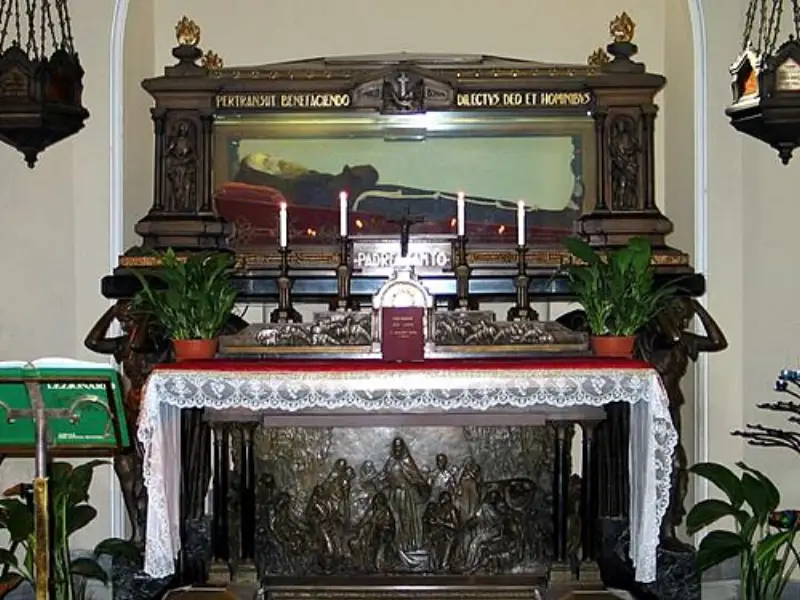
In August 1866 cholera swept Genoa, and the old beggar of the Immaculate Conception, now sixty-one, went to the victims. He gave what help he could to the stricken of the epidemic until he contracted the disease himself, and he died on 17 September 1866, not long after the sickness took hold — a death that sealed a reputation a city had spent decades learning to trust. The Genoese had long since given him the title Padre Santo, the Holy Father, and they called him that in life and have called him that ever since. The people's instinct proved reliable: his remains, which had rested after his death at the convent where he had served, were transferred in 1911 to a chapel of the Genoese church of the Immaculate Conception, where they still lie and where pilgrims have continued to venerate them in the centuries since. The man who had been stoned in those same streets died as the city's best-beloved religious figure, mourned by the dockworkers and the poor he had served, and his grave in the port district became immediately a place of prayer for the sailors, laborers, and families whose lives he had touched.
§ Life
From Servant of God to the Altars
The church moved more slowly than the street, but it moved in the same direction. The diocesan cause opened on 9 August 1896 under Leo XIII, thirty years after the friar's death, and the late Capuchin was named a Servant of God. On 18 December 1922 Pius XI confirmed that Francesco Maria had practiced virtue in a heroic degree, titling him Venerable, and the same pope, after approving two miracles worked through his intercession, beatified him on 30 June 1929 in Saint Peter's Basilica. The machinery then ground forward: the cause for canonization was formally opened on 30 March 1931, and in time two further miracles were confirmed to complete the case. It fell to Pope John XXIII, himself a Venetian patriarch close in spirit to the humble friars of northern Italy, to pronounce the canonization on 9 December 1962 within Saint Peter's Basilica, in the very first autumn of the Second Vatican Council, which the pope had convened that October. The beggar who had once been pelted with stones in the streets of Genoa was thereby enrolled among the saints of the universal Church, thirty-three years after his beatification and nearly a century after his death.
§ Sainthood
The Holy Father Still Remembered
Francesco Maria's afterlife has been quiet but persistent, in the way of saints who belonged to a neighborhood. In Genoa his title Padre Santo has never fallen out of use: the Genoese called him that in his lifetime, and continue to call him that now, a piece of the city's spoken memory as fixed as its saints' days. His remains have lain since 1911 in a chapel at the church of the Immaculate Conception in Genoa, the convent church where he spent his whole religious life, and pilgrims still come to pray beside the glass that holds them. In his native village, the church has named him patron of Camporosso itself, so that the farmer's boy who left the hills to beg by the sea now watches over the place that bore him. The Capuchins keep his feast on 19 September, the anniversary of his death, and his image — always in the habit he wore for over forty years — accompanies the order's memory of its humblest sons. For the poor of every port city he remains what he was in life: proof that a beggar with kissed stones in his hands can convert a city.
§ Sainthood
Timeline
- 27 Dec 1804
Giovanni Croese born at Camporosso to father Anselmo Croese and mother Maria Antonia Garza.
§ Life
- 29 Dec 1804
Baptized in his local parish church two days after his birth.
§ Life
- 1816
Received his First Communion on the feast of Corpus Christi.
§ Life
- 14 Oct 1822
Sought admission to the Capuchin Franciscans as a postulant.
§ Life
- 1824
Assumed a new religious name in the fall at Voltri.
§ Life
- 7 Dec 1825
Began his novitiate at the Capuchin convent of Saint Barnabas on the hills above Genoa, declaring he had come to be its beast of burden.
§ Life
- 17 Dec 1825
Was vested in the Capuchin habit.
§ Life
- 1826
After completing the novitiate, received obedience to the convent of the Immaculate Conception, by Genoa's center and port.
§ Life
- 1834
Appointed quaestor, or alms collector, for the port district, dedicating himself to gathering donations for the friars' works.
§ Life
- 1840
Made the friars' chief beggar, charged with overseeing the other brothers who went out collecting alms.
§ Life
- 17 Sep 1866
Died of cholera contracted while aiding victims of the epidemic that struck Genoa in August of that year.
§ Life
- 9 Aug 1896
Cause for sainthood commenced under Pope Leo XIII and he was named a Servant of God.
§ Sainthood
- 1911
Remains transferred to a chapel at the convent of the Immaculate Conception in Genoa.
§ Life
- 18 Dec 1922
Pope Pius XI confirmed his heroic virtue and titled him Venerable.
§ Sainthood
- 30 Jun 1929
Beatified by Pope Pius XI after the approval of two miracles at Saint Peter's Basilica.
§ Sainthood
- 30 Mar 1931
The cause for his canonization was formally opened.
§ Sainthood
- 9 Dec 1962
Canonized by Pope John XXIII in Saint Peter's Basilica after the confirmation of two further miracles.
§ Sainthood
In Their Own Words
I came to the convent to be its beast of burden
The Record
- Major works
- Decades of alms collection for the Capuchin friars and their charitable works in Genoa·Care for the victims of the 1866 cholera epidemic in Genoa·Spiritual help and comfort to the dockworkers and poor of the port district
- Patron of
- patron saint of Camporosso
- Symbols
- Capuchin habit
- Canonization
- Beatified 30 June 1929 by Pope Pius XI; canonized 9 December 1962 by Pope John XXIII in Saint Peter's Basilica
Prayer
Bibliography
Show 4 sources
- "Saint Francis Mary of Camporosso". Capuchin Friars Australia. Archived from the original on 5 October 2016.
- "Francis Mary of Camporosso". Roman Catholic Saints.
- "Saint Francesco Maria da Camporosso (Giovanni Croese)". Santi e Beati.
- Index ac status causarum beatificationis servorum dei et canonizationis beatorum (in Latin). Typis polyglottis vaticanis, January 1953, p. 78.
Profile text adapted from the Wikipedia article, licensed CC BY-SA 4.0.
Pray with this saint every day
Save St. Francesco Maria da Camporosso to your favorites, read the full profile, and get feast-day reminders in the Saints app.
Get the Saints AppFree on the App Store for iPhone and iPad