
1510-1572·Feast September 30 (October 10 in the 1688 General Roman Calendar)
St. Francis Borgia
Duke of Gandía, Jesuit Priest, and Third Superior General of the Society of Jesus
Overview
Francis Borgia — Francesc de Borja in his native Valencian — was born on 28 October 1510 into two of Europe's most famous bloodlines: Alexander VI, the pope, and Ferdinand II, king of Aragon, were both great-grandfathers of his. A pious child who wanted to be a monk, he was instead sent to the court of his cousin Emperor Charles V, where he served with distinction on campaign. Marriage to the Portuguese noblewoman Leonor de Castro brought eight children and a rising career: Marquess of Lombay, then Viceroy of Catalonia in 1539. That same year he convoyed the body of Empress Isabella to Granada, an encounter with mortality that marked him. Succeeding as fourth Duke of Gandía in 1543, he soon faltered diplomatically, retired from court, and after Leonor's death in 1546 resolved to join the young Society of Jesus: he settled his affairs, renounced his titles for his eldest son, and was ordained a Jesuit priest on 25 May 1551. He helped found what became the Gregorian University in Rome, fled the city secretly rather than accept a cardinal's hat, and served as Jesuit commissary-general in Spain, founding a dozen colleges. Elected third Superior General in 1565 after Diego Laynez's death, he governed the fast-growing order and founded the Collegium Romanum until his death in Rome on 30 September 1572.
The Complete Life
Early Life
Francis Borgia was born on 28 October 1510 in the duchy of Gandia in the kingdom of Valencia, into one of the most consequential families of sixteenth-century Europe: a great-grandson both of Pope Alexander VI and of King Ferdinand II of Aragon. His father was the third duke of Gandia; his mother a granddaughter of the archbishop of Zaragoza, himself a royal bastard. The child was devout, and the wish he expressed to become a monk was set aside by a family that had grander uses for him: he was sent to the court of his kinsman the emperor Charles V, where he was received warmly and rose in favor, accompanying the emperor on campaigns and learning the business of a great court. In 1529 he married Leonor de Castro, a Portuguese noblewoman, and the marriage, by all accounts affectionate, produced eight children.
§ Early life
Conversion and Vocation
The turn in Borgia's life is associated with a famous scene: in 1538 he was appointed to escort the body of the empress Isabella from Toledo to Granada, and on opening the coffin to identify the remains he saw the face of the young queen whom all Spain had admired, corrupted beyond recognition. Whether or not the anecdote is exact in every detail, contemporaries close to him reported that the vanity of greatness was decided for him then. He did not act at once. He continued as viceroy of Catalonia and then as duke of Gandia on his father's death, but his interior life changed, falling under Jesuit influence, and he made the Spiritual Exercises. When Leonor died in 1546 the way was open. Borgia put his affairs in order, renounced his titles in favor of his eldest son, and entered the Society of Jesus, being ordained priest on 25 May 1551; the secret of his ducal rank was so well kept at first that he served as a priest unrecognized.
§ Jesuit priest
Mission and Ministry
Borgia's service to the young Society was immediate and decisive. Ignatius of Loyola used him in Rome and Spain, and in 1554 he took charge of the Jesuits of Spain as their commissary general, founding about a dozen colleges and set the pattern of the order's Spanish expansion. When Pope Julius III showed the intention of making him a cardinal, Borgia, agreeing with Ignatius, left Rome secretly for the Basque Country to avoid the dignity. He helped in the establishment in Rome of what became the Gregorian University. When Diego Laynez died in January 1565, the Society chose Borgia as its third superior general, the office he held for the rest of his life. His generalate, from 1565 to 1572, covered the order's most explosive growth: provinces multiplied in Europe and the missions of America and Asia, and Borgia governed the whole with detailed supervision, founding the Collegium Romanum and codifying the order's practice.
§ Jesuit priest
Spirituality and Teaching
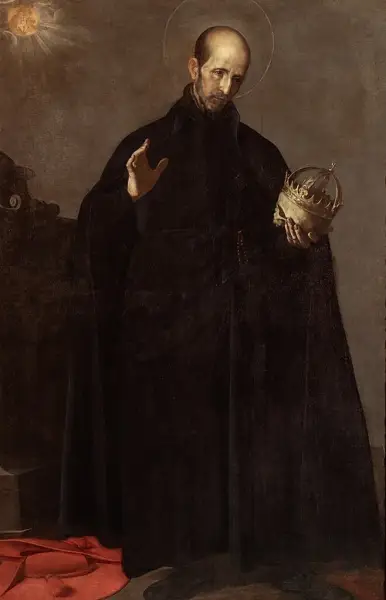
Borgia's spirituality was that of the Exercises become permanent: detachment verified by the facts of his life, since he had actually given up what most men only renounce in prayer, followed by an organized life of labor. His letters as general, practical and precise, carry the Ignatian grammar of the two standards and the discernment of spirits into administrative counsels, and his biographers note his combining of courtly manners with penitential austerity retained from the years after his wife's death. He promoted devotion to the humanity of Christ and to the angels, and his care for the missions made him one of the great patrons of the church's global expansion in its first global century. The classic portrait of him with a skull wearing a ducal coronet, his customary attribute, compresses his teaching into one emblem: all dignities end so.
§ External links
Trial and Final Years
Borgia governed the Society until his strength was spent, dying in Rome on 30 September 1572. His final years were filled with the crises of a far-flung order in the aftermath of the Council of Trent, the implementation of the new catechism and breviary, the disputes over the order's status in Spain and Portugal, and the continuing deaths and triumphs of the missions. Spain received his body back in 1617, housed in a Jesuit professed house in Madrid whose construction the duke of Lerma financed, and moved there finally in 1627. After the church that held his relics was destroyed by arson in 1931, his ashes were salvaged and finally laid to rest in the Jesuits' new complex on the calle de Serrano, where his shrine remains.
§ Death and legacy
Canonization
Urban VIII beatified Borgia at Madrid on 23 November 1624, and Clement X canonized him on 20 June 1670. The General Roman Calendar received his feast in 1688, celebrated on 10 October; after the calendar reforms of 1969 his feast was moved to 30 September, the day of his death, and the Jesuit order keeps it on 3 October. He was the first superior general of the Society to be canonized, and his canonization, a century after his death, confirmed the judgment of his contemporaries that the grandee who became a Jesuit had fulfilled both vocations.
§ Death and legacy
Legacy
Borgia's legacy stands on two pillars. As general he shaped the Society's institutions in the generation after its founders, and much of the order's organization in Europe, America, and Asia at the height of its first expansion bears his stamp. As a convert from greatness he became one of the church's classic examples of evangelical renunciation actually performed, the case cited for centuries when preachers needed a modern instance of the rich young man who did sell all. He is invoked against earthquakes and as patron of Gandia and of Portugal, and parishes across the Catholic world bear his name. The skull with the coronet remains his attribute in art, and the ducal palace of Gandia, later a Jesuit novitiate, keeps his memory in the place of his birth.
§ Introduction
Timeline
- 28 Oct 1510
Born in the Duchy of Gandía, in the Kingdom of Valencia, heir of the ducal Borgia line.
§ Early life
- Sep 1529
Married the Portuguese noblewoman Leonor de Castro Mello y Meneses at Madrid; Charles V then made him Marquess of Lombay.
§ Adult life and career
- 1539
Convoyed the corpse of Isabella of Portugal to her burial at Granada and the same year became Viceroy of Catalonia.
§ Adult life and career
- 1543
Succeeded his father as fourth Duke of Gandía; later retired from court after a failed royal marriage negotiation.
§ Adult life and career
- 1546
After the death of his wife Eleanor, resolved to enter the newly founded Society of Jesus.
§ Jesuit priest
- 1550
Having renounced his titles in favor of his eldest son Carlos, entered the Society of Jesus.
§ Jesuit priest
- 25 May 1551
Ordained a priest of the Society of Jesus.
§ Jesuit priest
- 1554
Appointed the Jesuit commissary-general in Spain, where he went on to found a dozen colleges.
§ Jesuit priest
- 1565
After the death of Diego Laynez that January, elected the third Superior General of the Society of Jesus.
§ Jesuit priest
- 30 Sep 1572
Died in Rome after closely supervising the rapidly growing order and founding the Collegium Romanum.
§ Death and legacy
- 1617
His body was repatriated from Rome to Spain.
§ Death and legacy
- 23 Nov 1624
Beatified at Madrid by Pope Urban VIII.
§ Death and legacy
- 1627
His remains were relocated to a Jesuit professed house built in Madrid by the Duke of Lerma.
§ Death and legacy
- 20 Jun 1670
Canonized by Pope Clement X in Rome, nearly thirty-five years after his death.
§ Death and legacy
- 1688
His feast was added to the General Roman Calendar, to be observed there on 10 October.
§ Death and legacy
- 30 Jul 1901
The silver urn holding his relics was transferred to the Madrid church dedicated to the Sacred Heart and St. Francis Borgia.
§ Death and legacy
The Record
- Major works
- Liturgical compositions in contrapuntal style, praised by the 1913 Catholic Encyclopedia
- Symbols
- Ducal coronet set beside a crucifix (renounced nobility)·Jesuit cassock
- Canonization
- Beatified by Pope Urban VIII at Madrid on 23 November 1624; canonized by Pope Clement X on 20 June 1670
Prayer
Bibliography
Show 12 sources
- ↑ "CatholicSaints.info Saint Francis Borgia" . www.catholicsaints.info . Retrieved October 2, 2022 .
- 1 2 3 4 "CATHOLIC ENCYCLOPEDIA: Francis Borgia" . www.newadvent.org . Retrieved 2017-07-15 .
- ↑ "Saint Francis Borgia | Jesuit superior general" . Encyclopedia Britannica . Retrieved 2017-08-24 .
- 1 2 "Patron Saint | St. Francis Borgia Catholic Church" . saintfrancisborgia.org . Retrieved 2017-07-15 .
- 1 2 3 "Parish Patron Saint" . St. Francis Borgia Catholic Church . Archived from the original on 29 June 2015 . Retrieved 9 February 2024 .
- 1 2 3 "Saint Francis Borgia" . Franciscan Media . Archived from the original on 9 November 2020 . Retrieved 9 February 2024 .
- ↑ "Francis Borgia, SJ" . www.manresa-sj.org . Retrieved 2018-08-21 .
- ↑ Pierre Suau (1909), "St. Francis Borgia" , Catholic Encyclopedia
- ↑ Martín Corral Estrada (14 May 2019). "La primera Casa Profesa de Madrid" . Jesuitas Madrid .
- ↑ Martín Corral Estrada (17 June 2019). "La segunda Casa Profesa de Madrid" . Jesuitas Madrid .
- ↑ José Francisco Serrano Oceja (30 December 2017). "San Francisco de Borja: una parroquia con vocación universal" . ABC Madrid .
- ↑ "St. Francis Borgia - Saints & Angels - Catholic Online" . Catholic Online . Retrieved 2017-07-15 .
Profile text adapted from the Wikipedia article, licensed CC BY-SA 4.0.
Pray with this saint every day
Save St. Francis Borgia to your favorites, read the full profile, and get feast-day reminders in the Saints app.
Get the Saints AppFree on the App Store for iPhone and iPad