
1713-1748·Feast July 9 (Martyr Saints of China)
St. Francis Diaz
Priest, Dominican Friar, and Martyr
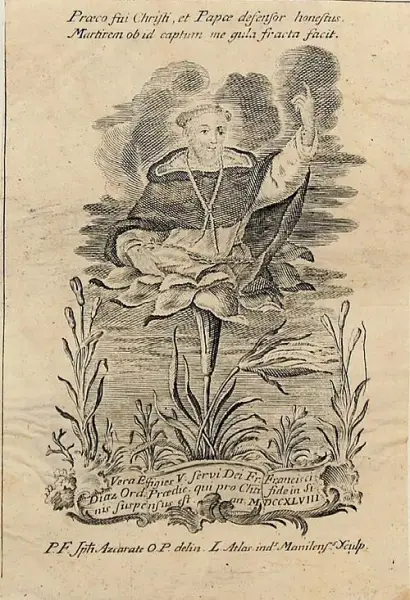
Overview
Francisco Diaz del Rincon was born at Écija in Andalusia on 12 October 1713, son of Juan Diaz and Isabel Maria Rincon y Rico. Weak eyes made study a trial, so his Dominican superiors let him prepare in moral theology alone. He took the habit in 1730 at the convent of St. Paul and St. Dominic in his hometown, and the pull toward the missions soon followed. In 1736 he sailed for Manila, finished his studies in the Spanish Philippines, and was ordained priest there. Two years later he crossed into China, landing first at Macao and then slipping into Fujian province. The Manchu laws of the day forbade foreign missionaries to propagate the faith, so Francis and his Dominican brothers worked as criminals in the eyes of the state: they traveled in disguise, preached quietly, and served scattered Catholic villages in deliberate, nonviolent defiance of the edicts. Arrested with his confreres in the persecution of 1746, he endured two years of prison and torture before being strangled to death at Fuzhou on 28 October 1748, one of a band of Spanish Dominicans who died together rather than abandon their flocks.
The Complete Life
Early Life
Francisco Díaz del Rincón was born at Écija in Andalusia on 12 October 1713, a son of Juan Díaz and of Isabel María Rincón y Rico. Weak eyes, a trouble for life, made study an ordeal during his schooldays, and when he took the Dominican habit in 1730, at the Écija house of Saint Paul and Saint Dominic, his superiors allowed him to prepare in moral theology alone rather than force him through the full course his sight could not bear. It was a modest formation for a man who would become one of the most famous Spanish Dominicans of his century, and it says something about the order's pragmatism and his own persistence. Écija was a town that sent a remarkable number of its sons to the overseas missions, and Francis felt the same pull early. Écija sits on the Genil in the grain country between Córdoba and Seville, a town of convents, and the Dominicans had been there since the thirteenth century; for a boy of devout family the choice of order was barely a choice at all.
§ Life
Conversion and Vocation
In 1736 Díaz left Spain for the missions of the Far East, sailing first to Manila in the Spanish Philippines, where he completed the studies his eyes had cut short and was ordained to the priesthood. The route he took — Spain to Mexico, across the Pacific to Manila, and from Manila into China — was the standard artery of the Dominican Province of the Most Holy Rosary, which staffed the Chinese mission from its base in the Philippines, and it made every missionary on it a member of a small, closely bound brotherhood working in a country that had outlawed them. Two years after reaching Manila, in 1738, Francis made that last crossing: to Macao first, and then secretly into Fujian province on the China coast. The crossing itself was an act of selection: the Province of the Holy Rosary took volunteers, and a friar with damaged eyes volunteering for China was understood to be accepting discomfort, danger, and probable death as the ordinary conditions of the job.
§ Life
Mission and Ministry
The Manchu laws of the eighteenth century forbade foreign missionaries to propagate the Christian faith in China, so Francis and his Dominican confreres worked as criminals in the eyes of the state. They traveled the countryside in disguise, preached quietly, administered the sacraments in the villages that had held the faith since the previous century, and moved on before the authorities could assemble a case. Their defiance was deliberate and nonviolent; they broke one law — the edict against European priests — and kept every other. Francis served in this way for eight years in Fujian, the province where the Dominican mission was strongest and where the cycle of arrest, ransom, and martyrdom had recurred since the 1640s. The work was also, in the strict sense, pastoral rather than expansionist: the congregations of Fujian dated from the previous century and their problem was not the absence of Christians but the absence of priests, and the Dominicans' clandestine circuits existed to keep existing communities alive.
§ Life
Trial and Final Years
In 1746 a new persecution swept Fujian. Francis was arrested with his fellow Dominicans and a group of Chinese lay Catholics, and the missionaries were held in prison at Fuzhou through two years of interrogation and torture intended to make them reveal the networks of Christians and to make the Christians apostatize. The Spanish friars in the case — among them Peter Sanz, the bishop-vicar of the mission, Francis Serrano, Joachim Royo, and John Alcober — were condemned to death. On 28 October 1748 Francis Díaz was executed by strangulation at Fuzhou with his companions, the sentence carried out in the usual quiet Chinese form, the cord, reserved for those the state wished to kill without spectacle. The five friars condemned together had worked the same circuit for years and were executed as a group, which is why the cause that eventually canonized them treated them as a single case. Chinese Catholics arrested with them received sentences ranging from enslavement to death, and some were killed for refusing to trample the crucifix.
§ Life
Canonization
The Fujian martyrs of 1746-48 were beatified by Pope Leo XIII on 14 May 1893 among the Dominican martyrs of China, and Francis Díaz was canonized by Pope John Paul II on 1 October 2000 as one of the 120 Martyrs of China, the company of Augustine Zhao Rong and companions killed between 1648 and 1930. He is kept with that group on 9 July. For the Dominican Order his case is a classic one: a friar of indifferent health and no conspicuous gifts, sent to the end of the world, killed for being where he had been sent, and remembered for nothing else. The cause moved slowly through the nineteenth century, when documentation from China was hard to obtain, and then joined the comprehensive Chinese martyrology assembled for the jubilee year 2000. At the canonization John Paul II named the martyrs' variety explicitly — Chinese and foreign, priests, religious, laypeople, men, women, and children — as the point of the group.
§ Life
Legacy
Díaz belongs to the small gallery of Spanish Dominican martyrs of Fujian, whose deaths in 1747 and 1748 closed the last great persecution of the Chinese church before the modern era and became, paradoxically, one of the mission's chief advertisements in Europe. In Écija and in the Dominican Province of the Holy Rosary his memory has been kept continuously, and since 2000 he has been a canonized saint of the universal Church. For the Chinese Catholic community of Fujian, whose ancestors hid the friars and paid for it, he is one of the group of foreign missionaries whose presence among them is the origin of their own communities' survival. In the Dominican historiography of the Chinese mission the Fujian martyrs mark the end of the old persecution cycle; the next century would bring the Boxers and the 1900 massacres rather than the judicial strangulation of the Qing courts, and the difference in method is itself a piece of Chinese legal history.
§ Life
Timeline
- 12 Oct 1713
Born at Écija in Spain, son of Juan Díaz and Isabel María Rincón y Rico.
§ Life
- 1730
Takes the Dominican habit at the convent of Saint Paul and Saint Dominic in Écija.
§ Life
- 1736
Departs Spain for Manila in the Philippines, where he finishes his studies and is ordained a priest.
§ Life
- 1738
Travels to China as a missionary, landing first at Macao before moving on to Fujian.
§ Life
- 1746
Seized by local officials and thrown into prison, where he suffers torture.
§ Life
- 28 Oct 1748
Put to death by strangulation together with his Dominican companions.
§ Life
- 14 May 1893
Beatified by Pope Leo XIII.
§ Canonization
- 1 Oct 2000
Canonized by Pope John Paul II alongside the other martyrs of China.
§ Canonization
The Record
- Patron of
- Missionaries working under persecution·Those who must worship in secret
- Symbols
- Dominican habit·Palm of martyrdom
- Canonization
- Beatified by Pope Leo XIII on 14 May 1893; canonized by Pope John Paul II on 1 October 2000 among the 120 Martyr Saints of China
Prayer
Bibliography
Show 3 sources
- ↑ https://domtaiwan.tripod.com/provincia/1700-1800.htm , 主历1700年至1800年, 道明会玫瑰省, retrieved February 17th 2024
- ↑ https://nominis.cef.fr/contenus/witnessesdominicainscanada.pdf , Witnesses of the Faith in the Orient, Dominicans of the Holy Rosary, retrieved February 17th 2024
- ↑ "Canonization of Augustine Zhao Rong and 119 companions, Martyrs in China, María Josefa del Corazón de Jesús Sancho de Guerra, Katharine Mary Drexel and Josephine Bakhita | John Paul II" . www.vatican.va . 1 October 2000 . Retrieved 2024-
Profile text adapted from the Wikipedia article, licensed CC BY-SA 4.0.
Pray with this saint every day
Save St. Francis Diaz to your favorites, read the full profile, and get feast-day reminders in the Saints app.
Get the Saints AppFree on the App Store for iPhone and iPad