
1607-1648·Feast January 15
St. Francisco Fernández de Capillas
Priest, Dominican, and Protomartyr of China
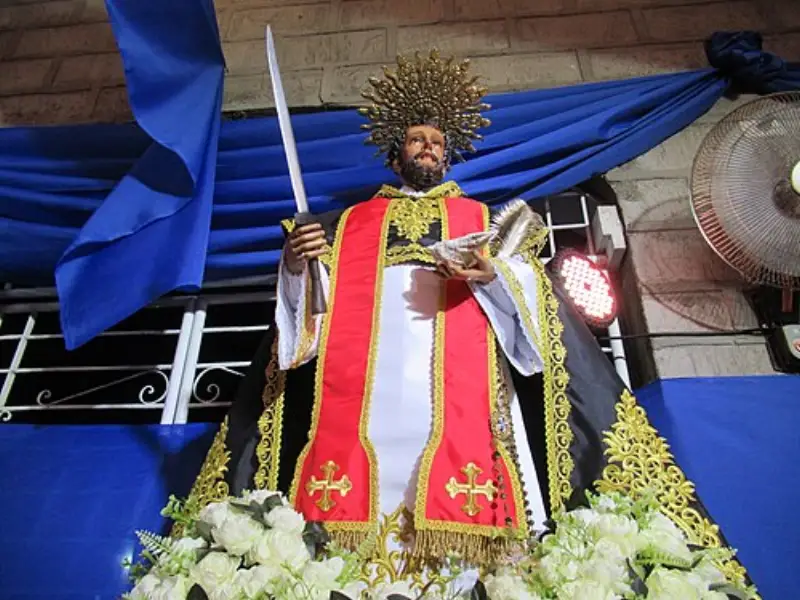
Overview
Francisco Fernández de Capillas was born at Baquerín de Campos in the Spanish province of Palencia in August 1607, and received the Dominican habit at seventeen from the priory of St Paul at Valladolid. Still only a deacon he sailed for the Philippines, landing at Manila in February 1631, and was ordained shortly after arriving. His decade of labor in the Cagayan Valley district of Tuao on Luzon he regarded as preparation for China, and in 1641 the provincial chapter released him to that mission. Passing through Taiwan among the last Spanish friars there before the Dutch expelled them, he reached Fujian in March 1642 with Francisco Díez, and the two evangelized around Fu'an so fruitfully that a community of the Dominican Third Order took root. In November 1644 Díez died and Manchu conquerors hostile to Christianity took Fu'an the same day. De Capillas was seized on 13 November 1647 while returning from a sick call, and tortured in prison, where he wrote calmly of the fellowship he found among his fellow prisoners. Condemned for disseminating false doctrines, he was beheaded at Fu'an on 15 January 1648, the first martyr within the Chinese empire.
The Complete Life
Early Life
Francisco Fernández de Capillas was born at Baquerín de Campos, a village in the Palencia province of Castile, on 14 August 1607 (his seventeenth-century biographers also give the 15th). At seventeen he received the habit of the Order of Preachers at the priory of St Paul in Valladolid, entering a Dominican province that had been sending friars to the Far East for a generation. While still a deacon he was assigned to the missions, and he landed at Manila in February 1631; priestly ordination followed shortly after his arrival in the Philippines.
§ Biography
Conversion and Vocation
De Capillas spent the next decade in the Philippines, in the district of Tuao in the Cagayan Valley of Luzon — remote mission country at the northern end of the island. He regarded those years plainly as preparation: his goal was China. At the Dominican provincial chapter held in Manila in 1641 he obtained permission to transfer to the order's Chinese mission, and set out with a companion, Francisco Díez. The route ran through Spanish Formosa, and the two were among the last Spanish friars on Taiwan before the Dutch expelled them later that year. They reached Fujian on the Chinese mainland in March 1642.
§ Biography
Mission and Ministry
In Fujian the two Dominicans joined a fellow friar who had survived an earlier round of persecution, and worked among the people of the region, above all in the cities of Fu'an and Ting-Moyang Ten. The mission prospered: the sources say they were fruitful enough that a Dominican Third Order community took root — lay Dominican tertiaries, Chinese Christians living the order's rule in their own households. The turning point came on 4 November 1644, a day of double loss: Francisco Díez died of natural causes, and later the same day Manchu forces took the city of Fu'an in their conquest of Ming China. The new regime was hostile to Christianity, and persecution of the Christians of Fujian began at once.
§ Biography
Trial and Final Years
On 13 November 1647 de Capillas was captured as he came back from Fu'an, where a sick-call had taken him to bring the sacraments to an invalid — a sick call that cost him his life. Taken amid insults to the local prison, he was repeatedly tortured, then moved, more dead than alive, to the jail reserved for criminals condemned to death. A letter survives from this captivity in which he describes a fellowship formed with his fellow prisoners, who asked him about the Gospel; forbidden to keep vigil at night, he prayed in bed before dawn, and wrote that he had found 'pearls' in prison that are not easy to find elsewhere. His conduct so won the jailers that they allowed food to be brought in, which he shared with the other prisoners. On 15 January 1648 he was sentenced to death on charges of spreading false doctrines and stirring the people against the new emperor, and was beheaded the same day at Fu'an.
§ Biography
Canonization
The Holy See honors de Capillas as the protomartyr of the missionaries in China — the first martyr within the Chinese empire — and the Dominican Order has long called him its glory. Pope Pius X beatified him on 2 May 1909 together with fourteen Chinese laypeople martyred in the same persecution. Pope John Paul II canonized him on 1 October 2000 within the company of the 120 Martyrs of China. The group's common memorial falls on 9 July, while his individual feast is kept on 15 January.
§ Introduction
Legacy
De Capillas fixed the pattern for two and a half centuries of Chinese martyrdoms: arrest during pastoral work, torture, a capital charge dressed up as sedition, and death. The Third Order community he planted at Fu'an proved durable — the same Fujian soil would produce later martyrs, including the layman Peter Wu Guosheng and others of the 120. For the Dominican family he remains the first and founding figure of its Chinese roll of honor, and his prison letter, with its calm joy, is among the most quoted texts of the early Chinese missions.
§ Biography
Timeline
- 15 Aug 1607
Born at Baquerín de Campos, Palencia, Spain, on 15 August 1607, the date the article's infobox gives.
§ Introduction
- Feb 1631
Still a deacon, he lands at Manila in February for mission work in the Philippines, and is ordained a priest shortly after arrival.
§ Biography
- 1641
The provincial chapter at Manila allows him to join the China mission; he is among the last Spanish missionaries in Taiwan that year.
§ Biography
- Mar 1642
Arrives in mainland China with Francisco Díez, landing in Fujian in March to join a Dominican who had survived persecution.
§ Biography
- 4 Nov 1644
His companion Francisco Díez dies at Fu'an, and on the same day Manchu forces seize the city, opening persecution of Christians.
§ Biography
- 13 Nov 1647
Captured on 13 November returning from a sick call at Fogan, and repeatedly tortured in the local prison.
§ Biography
- 15 Jan 1648
Sentenced for spreading false doctrine and beheaded the same day at Fu'an — the first martyr within the Chinese empire.
§ Biography
- 2 May 1909
Beatified by Pope Pius X on 2 May, together with fourteen Chinese laypeople who had died as martyrs.
§ Veneration
- 1 Oct 2000
Canonized by Pope John Paul II on 1 October as one of the 120 Martyrs of China.
§ Veneration
In Their Own Words
I am here with other prisoners and we have developed a fellowship. They ask me about the Gospel of the Lord. I am not concerned about getting out of here because here I know I am doing the will of God.
The Record
- Canonization
- Beatified by Pope Pius X on 2 May 1909 with fourteen Chinese lay martyrs; canonized by Pope John Paul II with the 120 Martyrs of China on 1 October 2000
Prayer
Bibliography
Show 8 sources
- ↑ "Den hellige Frans Fernández de Capillas (1607-1648)" (in Norwegian). katolsk.no. Archived from the original on 9 February 2008 . Retrieved 24 April 2009 .
- 1 2 3 4 "Dominicans of Singapore "St. Francis de Capillas" " . Archived from the original on 14 March 2016 . Retrieved 9 July 2012 .
- ↑ Walsh, Michael J., " Francis de Capillas", A New Dictionary of Saints Liturgical Press, 2007, p. 208 ISBN 9780814631867
- ↑ Andrade, Tonio . "Appendix B: Governors-General, Governors, and Missionaries". How Taiwan Became Chinese .
- ↑ "Saint Francisco Fernandez de Capillas, Protomartyr of China, January 15" . The Black Cordelias . 15 January 2009 . Retrieved 9 November 2020 .
- ↑ Vatican News Service Archived 29 September 2007 at the Wayback Machine
- 1 2 "Saint François Fernandez de Capillas", Nominis
- ↑ "Let Us Be Their Followers", Dominican Nuns, Menlo Park, California
Profile text adapted from the Wikipedia article, licensed CC BY-SA 4.0.
Pray with this saint every day
Save St. Francisco Fernández de Capillas to your favorites, read the full profile, and get feast-day reminders in the Saints app.
Get the Saints AppFree on the App Store for iPhone and iPad