
c. 1181-1226·Feast October 4
St. Francis of Assisi
Deacon, Founder of the Franciscan Order
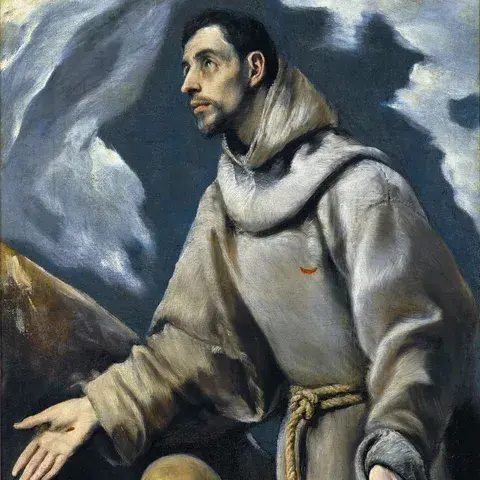
Overview
Giovanni di Pietro di Bernardone was born around 1181 in Assisi, son of a prosperous silk merchant and a noblewoman from Provence. A rich, high-spirited youth devoted to fine clothes and troubadours, he was captured in war against Perugia and then, back home, unsettled by a vision while enlisting for Apulia. Praying in the broken chapel of San Damiano he heard the crucifix tell him to repair its falling house; he took the command literally at first, selling his father's cloth and later, before the bishop, renouncing his patrimony and even his clothes. For two years he rebuilt ruined chapels, begged stones, and began nursing the lepers outside the town. In 1208, after hearing the Gospel of the mission sent out barefoot, he began preaching penance with a small band of brothers; in 1209 or 1210 Pope Innocent III informally approved their life. Clare of Assisi joined him in 1212, sowing the Poor Clares; in 1219 he walked into a crusader war to speak with Sultan al-Kamil; in 1223 Honorius III approved the Rule; at Greccio he staged the first living crib. On Mount Verna in September 1224 he received the stigmata, and he died on 3 October 1226, singing Psalm 141.
The Complete Life
Early Life
Giovanni di Pietro di Bernardone — Francesco, 'the little Frenchman,' a nickname from his father's cloth trade — was born at Assisi around 1181, the son of Pietro di Bernardone, a prosperous silk merchant who had made his money in the new commercial economy of the Italian towns, and Pica, conventionally said to be a noblewoman from Provence. He grew up rich, charming, and fashionable, the leader of Assisi's young men in their feasts and dreams of knighthood; he was, by every account including his own, a young man who wanted glory. In the war between Assisi and Perugia he was captured at the battle of Collestrada in 1202 and spent a year in prison, where illness began the reckoning; released, he tried again for a military career, riding south toward Apulia in the hope of knightly service — and turned back, telling companions he had a different bride to wed. What exactly happened on that road he never fully explained, which is itself the mark of the man.
§ Early life
Conversion and Vocation
The conversion came in stages, each one more literal than the last. Praying in the broken chapel of San Damiano outside the walls, he heard the crucifix speak: go, repair my house, which you see is falling down. He took it as an instruction about a building and sold his father's cloth at Foligno to pay for stones; his father dragged him before the bishop of Assisi to renounce his claims, and Francis, stripped by his own act of the clothes he stood in, gave back everything — patrimony, name, and garments — and stood naked under the bishop's cloak, saying thenceforth he would have only God as father. For two years he lived as a penitent oddity of the town: rebuilding ruined chapels, begging stones, kissing the leper whose approach had once sickened him and finding, in that act, what he called the turning point of his life. In 1208, at Mass in the Porziuncola, he heard the Gospel of the mission read — take no gold, no bag, no second coat — and understood it as his rule, word for word.
§ Founding of the Franciscan Order
Mission and Ministry
Francis began to preach penance in the Umbrian dialect, barefoot, and companions gathered: Bernard of Quintavalle, Peter Cattani, Giles, and the rest — twelve within the year, the number itself a program. In 1209 or 1210 he brought his band to Rome, and Pope Innocent III, the most powerful pope of the age, gave their form of life an informal oral approval — traditionally after a dream in which the poor man held up the Lateran. The Lesser Brothers were launched, and within a decade they had reached every country of Europe, an expansion Francis only partly controlled. Clare of Assisi came to the Porziuncola on Palm Sunday night 1212, and from her reception grew the Poor Clares; for the laity he composed what became the Third Order. In 1219 he sailed to Egypt and crossed the lines of the Fifth Crusade at Damietta to speak with Sultan al-Kamil — an encounter of arms and courtesy that both sides recorded without bloodshed. In 1223 Honorius III approved the Regula bullata, the rule in its final form; that Christmas, at Greccio, he made the manger of the nativity live, with an ox and an ass and the townspeople — the first living crib, and the beginning of a devotion now universal.
§ Founding of the Franciscan Order
Spirituality and Teaching
Francis left almost no formal teaching: what he left was a rule, a testament, some letters, canticles, and a life. Its center is poverty, held not as an economic program but as the imitation of Christ — the God who was born in a stable and died naked, and whose bride, Francis said, was Holy Poverty. From it flowed the rest: minority, the choice of being lesser rather than greater, structured into the order's very name; obedience to the clergy and the Church, held so tightly that he submitted his radicalism to bishops he did not always trust; love of creation as the family of the same Father, fixed forever in the Canticle of the Creatures, the first great poem in Italian; and peace, in the greeting he gave the world. He forbade his brothers to own money in any form, and his Testament, dictated at the end, begged them to keep the rule simply, without gloss — a dying instruction that his order would spend centuries contesting.
§ Introduction
Trial and Final Years
The last years were suffering and glory together. His eyes, damaged in the East or by weeping, failed; he renounced the government of the order he had founded; and on Mount La Verna in September 1224, keeping a forty-day fast, he received the stigmata — the wounds of the crucified printed in his hands, feet, and side — the first fully attested case in Christian history. He hid them, and lived two more years of illness, singing. He was mostly blind, bleeding, and subject to the treatments of the age; near the end he asked to be laid naked on the earth at the Porziuncola. He died there on the evening of 3 October 1226, aged about forty-five, singing Psalm 141 — with your loosing I shall be loosed — and blessing his brothers and the city that had once laughed at him.
§ Stigmata, final days and sainthood
Canonization
Francis was canonized with a speed the Church has rarely matched: on 16 July 1228, not two years after his death, by Pope Gregory IX — the former Cardinal Hugolino, his old protector and sometime antagonist — in Assisi itself. On the following day the pontiff set in place the basilica's foundation stone, the church raised to receive the remains. The speed was politics as well as devotion: the papacy wanted the Franciscan movement inside the Church, and canonization fixed it there. It also began the long argument over his legacy, since the basilica's grandeur and the order's property sat awkwardly beside the Testament's absolute poverty — the dispute that split his followers for generations and produced, eventually, the factions he had feared.
§ Introduction
Legacy
Francis is, after the apostles, the most reproduced figure in Christian art, and the most recognized saint outside Christianity. He rebuilt the church in the literal and the figurative sense, and the figuration has proved the truer: the friars remade the religious life of Europe, and the cities with it. The Canticle seeded Italian literature; the crib and the carol reshaped Christmas; the Canticle's kinship of creatures has made him, in the last century, the patron of ecology, named so by John Paul II in 1979 — and in 2015 the subject of the first encyclical to take a saint's name for its own. The Porziuncola, the little chapel he rebuilt by hand, stands enclosed inside the great basilica at Assisi: the whole paradox of his afterlife under one roof.
§ References
Timeline
- 1181
Born at Assisi to the silk merchant Pietro di Bernardone and the Provençal noblewoman Pica, and renamed Francesco by his father.
§ Early life
- 1202
Rides out with Assisi's expedition against Perugia and is taken captive at Collestrada, spending a year as a prisoner.
§ Early life
- 1203
Released from captivity, he comes home to Assisi and takes up his carefree way of life again.
§ Early life
- 1205
Sets out to enlist for Apulia but turns back after a strange vision and loses his taste for worldly pursuits.
§ Early life
- Feb 1208
At Mass in the Porziuncola in February he hears the Gospel commissioning the Twelve and embraces poverty, preaching penance through the countryside.
§ Founding of the Franciscan Order
- 16 Apr 1210
Pope Innocent III, moved by a dream, endorses the brotherhood — traditionally on 16 April, counted as the Franciscan Order's founding.
§ Founding of the Franciscan Order
- 1212
Sails from Italy late in the spring, hoping to reach Jerusalem, but a storm wrecks him on the Dalmatian coast.
§ Missionary work during the Fifth Crusade
- 28 Mar 1212
On the night of Palm Sunday Clare of Assisi leaves her family's palace; Francis receives her at the Porziuncola, founding the Poor Clares.
§ Poor Clares and Third Order
- 8 May 1213
Count Orlando di Chiusi grants him the use of the mountain of La Verna as a place of penance and prayer.
§ Missionary work during the Fifth Crusade
- 1217
A Franciscan presence in the Holy Land begins that will endure almost without interruption.
§ Missionary work during the Fifth Crusade
- 1219
Crosses to Egypt during the Fifth Crusade, is brought before Sultan al-Kamil near Damietta, preaches to the Muslims, and returns unharmed.
§ Missionary work during the Fifth Crusade
- 1220
Leaves the crusader camp for Acre and embarks for Italy in the second half of the year.
§ Missionary work during the Fifth Crusade
- 1220
Celebrates Christmas at Greccio with real animals and a straw-filled manger, arranging the first known living nativity scene.
§ Character and legacy
- 1221
Prepares the Regula non bullata, the longer First Rule that never received papal endorsement.
§ Reorganization of the Franciscan Order
- 1221
Travels across Italy in 1221 and 1222, preaching as far south as Catania in Sicily and as far north as Bologna.
§ Reorganization of the Franciscan Order
- 29 Nov 1223
Pope Honorius III approves the Second Rule, the Regula bullata, which becomes the order's official rule.
§ Reorganization of the Franciscan Order
- 1224
Composes the Canticle of the Sun, his great hymn of praise for brother sun, sister moon, and all creation.
§ Main writings
- 17 Sep 1224
During a forty-day fast on La Verna a seraphic vision marks him with the stigmata, the wounds of the crucified Christ.
§ Stigmata, final days and sainthood
- 1226
In the spring, frail and in severe pain, he dictates the Little Testament, also called the Testament of Siena, to Brother Benedict.
§ The "Little Testament"
- 3 Oct 1226
Dies on the evening of Saturday 3 October in a hut beside the Porziuncola, singing Psalm 141.
§ Stigmata, final days and sainthood
- 16 Jul 1228
Canonized by Pope Gregory IX at Assisi, less than two years after his death.
§ Stigmata, final days and sainthood
- 17 Jul 1228
The day after the canonization, Gregory IX lays the foundation stone of the Basilica of St. Francis in Assisi.
§ Stigmata, final days and sainthood
- 25 May 1230
Buried beneath the Lower Basilica, though Brother Elias soon has the tomb hidden to shield it from Saracen raiders.
§ Stigmata, final days and sainthood
- 1585
A secondary feast of the Stigmata, kept on 17 September, is inserted into the General Roman Calendar.
§ Feast day
- 1615
The feast of the Stigmata, suppressed in 1604, is restored to the calendar.
§ Feast day
- 1818
His burial place, unknown for centuries, is rediscovered beneath the basilica at Assisi.
§ Stigmata, final days and sainthood
- 18 Jun 1939
Pope Pius XII names him joint patron of Italy together with Catherine of Siena.
§ Patronage
- 29 Nov 1979
Pope John Paul II declares him the patron saint of ecology.
§ Nature and the environment
In Their Own Words
Be praised, my Lord, through all Your creatures, especially through my lord Brother Sun, who brings the day; and you give light through him. And he is beautiful and radiant in all his splendor!
Where there is charity and wisdom, there is neither fear nor ignorance. Where there is patience and humility, there is neither anger nor vexation. Where there is poverty and joy, there is neither greed nor avarice. Where there is peace and meditation, there is neither anxiety nor doubt.
We must not be wise and prudent according to the flesh, but, instead, we must be simple, humble and pure.
The Record
- Major works
- The Rule of the Friars Minor (Regula bullata, 1223)·The Testament (1226)·Canticle of the Sun (Cantico delle creature)·Prayers and Admonitions
- Patron of
- Animals·Ecology and the environment (declared by Pope John Paul II, 29 November 1979)·Italy (with Catherine of Siena)·The poor·Merchants·Peace
- Symbols
- Brown Franciscan habit with a rope belt of three knots·Stigmata·Birds and animals·Crucifix, book and skull
- Canonization
- Canonized by Pope Gregory IX on 16 July 1228, at Assisi
Prayer
Bibliography
Show 7 sources
- ↑ The tunic that Saint Francis actually wore was simpler. [ 1 ] It reportedly was made by himself to be unattractive and uncomfortable, [ 2 ] unlike modern Franciscan habits. [ 3 ]
- ↑ His mother was French and that may be why he was known as Francesco (Francis), a name with the possible meaning 'Frenchman'.
- ↑ Italian : Francesco d'Assisi
- ↑ Though an Italian nation state had yet to be established, the Latin equivalent of the term Italian ( italus ) had been in use for natives of the region since antiquity. For example in Pliny the Elder , Letters 9.23.
- ↑ e.g., Jacques de Vitry, Letter 6 February or March 1220 and Historia orientalis ( c. 1223–1225 ) cap. XXII; Tommaso da Celano, Vita prima (1228), §57: the relevant passages are quoted in an English translation in Tolan 2009 , pp. 19– and
- ↑ For grants of various permissions and privileges to Francis as attributed by later sources, see, e.g., Tolan 2009 , pp. 258–263. The first mention of the Sultan's conversion occurs in a sermon delivered by Bonaventure on 4 October 1267. S
- ↑ On the day of his election, the Vatican clarified that his official papal name was "Francis", not "Francis I". A Vatican spokesman said that the name would become Francis I if and when there is a Francis II. [ 84 ] [ 88 ]
Profile text adapted from the Wikipedia article, licensed CC BY-SA 4.0.
Pray with this saint every day
Save St. Francis of Assisi to your favorites, read the full profile, and get feast-day reminders in the Saints app.
Get the Saints AppFree on the App Store for iPhone and iPad