
1416 – 1507·Feast April 2
St. Francis of Paola
Hermit and founder of the Order of Minims
Overview
Francis of Paola was a Calabrian friar who established the Order of Minims, one of the most austere religious families of the later Middle Ages. Born at Paola near the Tyrrhenian coast in 1416 to devout and impoverished parents, he was named for Francis of Assisi, whose intercession his parents had sought before his birth. Sent at thirteen to the Franciscan convent at San Marco Argentano, he early gave up meat and linen, but he was never ordained a priest and chose instead the eremitical life, retiring as a teenager into a coastal cave. Companions gradually gathered around him, and in 1436 the community that became the Hermits of Saint Francis of Assisi took shape. Papal recognition followed from Sixtus IV in 1474, and the rule later received its definitive approval under Julius II, Alexander VI having already given the brothers the name Minims, meaning 'the least of all the faithful'. A perpetual Lenten abstinence from all animal products marked the order, together with humility and non-violence toward every creature. Summoned to France in 1482 to the deathbed of Louis XI, Francis stayed on as counsellor to Charles VIII and Louis XII, dying at Plessis-lez-Tours on 2 April 1507. Leo X canonized him in 1519, and John XXIII later declared him patron of Calabria.
The Complete Life
A Child of Prayer from Calabria
Francis was born around 1416 in Paola, a small town in the province of Cosenza, Calabria, set between Naples and Reggio near the Tyrrhenian Sea. His parents were poor and hardworking, and their piety was the organising force of the household: doing the will of God was, in the account of his early biographers, their single ambition. For several years no child came, and the couple begged heaven, through the merits of St Francis of Assisi, to grant them a boy whom they promised for God's service. When a boy was finally born they read his arrival as an answer, and gave him the name of the Poverello. Two more children followed. As an infant Francis developed a swelling that threatened the sight of one eye, and his parents again turned to St Francis of Assisi, vowing that the child would spend a year wearing the Franciscan little habit in one of the order's friaries, a customary medieval devotion. The eye recovered. Under such a roof the boy showed an early love of fasting, quiet and prayer. At thirteen he was placed in the Franciscan convent at San Marco Argentano, some forty kilometres from home, one of the oldest Franciscan foundations in Calabria. There he learned to read, and from that period, it is said, he abandoned linen garments and meat altogether, observing the Rule more strictly than the professed friars themselves. After a year his parents took him on pilgrimage to the Portiuncula at Assisi and on to Rome, and on his return he resolved on a life of seclusion.
§ Birth and early life
From Cave to Community
With his parents' consent Francis withdrew to a solitary spot half a mile from Paola, then moved to a remoter retreat on the coast, where he hollowed out a cave for himself. For about six years, beginning around 1432 when he was barely fifteen, he lived there alone on herbs gathered from a nearby wood, sleeping on bare rock and giving himself to prayer and self-mortification. At twenty he received two like-minded companions, for whom three cells and a chapel were built by the local people; a priest from the parish church came up daily to celebrate Mass while the three sang the divine praises. The year 1436 marks the start of the order Francis would found, the Hermits of Saint Francis of Assisi. Within seventeen years the brotherhood had grown sufficiently that, authorised by Pyrrhus Caracciolo, Archbishop of Cosenza, Francis raised a large monastery and church, a project that stirred such devotion in the surrounding countryside that even nobles carried stones to the site. Reports of miraculous cures spread, and witnesses later swore to them in the canonisation process. Francis demanded of his brethren an extraordinary severity: a fourth vow of year-round abstinence from meat was added to the traditional three, in the hope of reviving Lenten fasting, and humility became the distinguishing mark of a community that sought to live hidden from the world. In 1467 Pope Paul II sent the priest and jurist Baltasar de Spigno to inspect the lay confraternity; his initial objection of rustic excess gave way within a year to approval, and he himself joined the brethren in 1470, procuring from Archbishop Caracciolo the decree Decet nos that placed the congregation directly under the Holy See.
§ Confraternity
The Least of the Faithful
On 17 May 1474 Pope Sixtus IV, in the bull Sedes apostolica, recognised the Congregation of Hermits of Saint Francis of Assisi, granted its members the same rights as the mendicant friars, empowered them to write their own rule, and named Francis their superior general. The rule was later formally approved by Pope Alexander VI, who changed the brothers' title to Minims, the 'least of all the faithful', echoing Francis's habit of calling himself the least among the least. With his order sanctioned, Francis founded new houses across Calabria and Sicily: he acquired land at Paterno Calabro in 1472, established monasteries at Spezzano della Sila in 1474 and Corigliano Calabro in 1476, and founded another at Crotona under Brother Paolo Rendacio. In March 1464 he had left Paterno for Milazzo in Sicily, adding a Sicilian house to the growing family. Beyond his brotherhoods he brought convents of sisters into being and, imitating his patron, devised a third order for those who wished to live his rule in the world. Francis did not flatter rank: he rebuked the King of Naples for wrongdoing and endured persecution as a consequence. In 1506 Pope Julius II approved the definitive rule, along with a rule for the order's nuns and its Third Order. The Minims never became numerous, but their houses spread through many countries, and among the order's later sons was the great French bishop Francis de Sales.
§ Minims
A Perpetual Lent
The asceticism Francis imposed on himself and his brethren went beyond the ordinary fasts of the Church. His diet excluded not only animal flesh but every food derived from animals, eggs and dairy among them, so that modern writers have described him as a kind of vegan centuries before the word existed. This unbroken, lifelong abstinence was written into the very identity of the Minims, intended as a revival of the fading custom of Lenten fasting and as a daily reminder that the 'least of the faithful' claims nothing for his own appetite. From its founding the order was known for two great charisms, humility and non-violence: the name Minim signified living as the smallest and the least, embracing simplicity and frugality, while the refusal to harm any creature expressed a repudiation of cruelty in every form. The lives told of Francis afterwards illustrated this tenderness. He was said to have restored a favourite trout, Antonella, to life after a priest had caught and fried it, and to have called his pet lamb Martinello out of a lime kiln unharmed after workmen had slaughtered and eaten it. The accounts say he summoned his creatures by name even once they were gone, as if some life of theirs went on. Contemporaries also credited him with the gift of prophecy: he was said to have foretold the fall of Constantinople on several occasions in the years before the city fell to Mehmed II on 29 May 1453, and to have assured Louise of Savoy that a son destined for the throne would be born to her, the boy who became Francis I.
§ Diet
Adviser to Kings of France
As Louis XI of France neared his end, envoys crossed the sea to Calabria imploring Francis to attend him; only a direct papal command moved the friar to set out. Embarking at Ostia, he landed in France, and as he passed through Provence many who were sick in the plague then ravaging the region were said to have been cured through his intercession. He reached the king's residence at the Château de Plessis-lez-Tours, near La Riche, and remained with Louis until his death. Louis's heir, Charles VIII, kept Francis at court, made him tutor, turned to him for counsel at every turn, and raised a Minim house beside the chateau, with a second on Rome's Pincian Hill. Francis's influence reached deep into the French church: Jan Standonck founded the Collège de Montaigu along what he took to be Minimist lines. When Louis XII succeeded to the throne in 1498, he shared his predecessor's esteem and refused to let the aging friar return to Italy, though Francis longed to go home. He never left France. In his last three months he withdrew into complete solitude to prepare for death. On Holy Thursday of 1507 he gathered his community and urged above all mutual charity among the brethren and fidelity to their perpetual abstinence; on Good Friday he summoned them once more, delivered his last counsels, and named a Vicar General. His death came at Plessis on 2 April 1507, in his ninety-second year.
§ France
Honours and Incorrupt Remains
Pope Leo X canonized Francis in 1519, twelve years after his death, following his beatification in 1518. Though his miracles were counted as numerous, the Church emphasised that he was raised to the altars for his humility and for his discernment in weaving the contemplative life together with the active one. His liturgical feast was fixed on 2 April, the day of his death. Popular devotion attached itself quickly to his tomb: in 1562 Huguenot radicals in France broke it open and found the body incorrupt, then burned it and scattered the bones, which Catholic faithful gathered up and distributed as relics to churches of his order. Papal recognition of his patronage continued across the centuries. He has long been venerated as patron of boatmen, mariners and naval officers, an association rooted in the legend of his crossing of the Strait of Messina on his cloak, an episode Franz Liszt set to music in the second of his piano Legends. In 1943 Pius XII entrusted Italy's seafaring community to his patronage, and in 1963 Pope John XXIII proclaimed him the special protector of Calabria. He is also patron of numerous Calabrian towns and of communities as distant as Recife in Brazil and La Chorrera in Panama, a geography of devotion that mirrors the spread of the Minim order he founded.
§ Legacy and veneration
Stories That Shaped a Saint
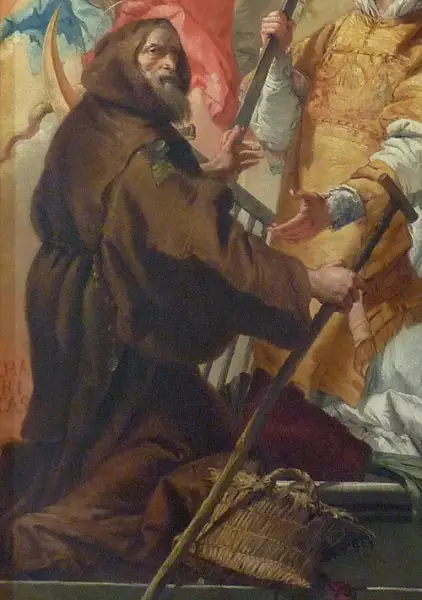
The legends that gathered around Francis of Paola reveal how his contemporaries and successors understood him. The most famous tells of the year 1464, when a boatman refused to carry him across the Strait of Messina to Sicily: Francis is said to have spread his cloak upon the water, fastened one corner of it to his staff to serve as a sail, and glided across while his companions rowed after in the boat. The episode became so celebrated that Franz Liszt made it the subject of the second of his Legends for solo piano, and it explains the honour in which seafarers have held him ever since. Another story concerns his nephew, whose death plunged the boy's mother, Francis's own sister, into loud grief. After Mass and the divine office had been offered for the boy's soul, Francis had the body carried into his cell and prayed over it until life returned; the young man, restored to his astonished mother, entered Francis's order and became the celebrated Nicholas Alesso, who later followed his uncle to France and was renowned for holiness and great deeds. Tales of compassion for animals abound, of creatures killed to be eaten and given back their lives. Painters kept his memory vivid too: Theodoor van Thulden depicted him prophesying the birth of the future Francis I to Louise of Savoy, a scene preserved in the Louvre and the Getty collections, and Giovanni Domenico Tiepolo placed him in a Venetian altarpiece. Pilgrim paths in Calabria, such as the Way of the Young Man and the Hermit's Way, still retrace the ground of his early life.
§ Legends
Timeline
- 27 Mar 1416
Born at Paola in Calabria to poor parents who had begged the intercession of Francis of Assisi for a son.
§ Birth and early life
- 1432
Withdrew as a youth of about fifteen into a cave hermitage on the Calabrian coast, remaining there roughly six years.
§ Birth and early life
- 1436
Received his first two companions, the beginning of the community later known as the Hermits of Saint Francis of Assisi.
§ Confraternity
- 29 May 1453
Constantinople fell to Mehmed II, an event Francis was believed to have foretold repeatedly during the later 1440s.
§ Gift of prophecy
- 1454
Built a large monastery and church at Paola with the sanction of Archbishop Pyrrhus Caracciolo of Cosenza.
§ Confraternity
- Mar 1464
Left Paterno Calabro for Milazzo in Sicily to establish another monastery.
§ Minims
- Apr 1464
According to the famous account, sailed across the Strait of Messina on his cloak after a boatman refused him passage.
§ Legends
- 1467
Received the emissary Baltasar de Spigno, sent by Pope Paul II to inspect the community, whose doubts soon turned to support.
§ Confraternity
- 30 Nov 1470
Archbishop Caracciolo promulgated Decet nos, placing the congregation directly under the Holy See.
§ Confraternity
- 1472
Acquired land at Paterno Calabro for the construction of a further monastery.
§ Minims
- 17 May 1474
Sixtus IV issued Sedes apostolica, recognising the congregation and naming Francis its superior general.
§ Minims
- 1482
Travelled to France at papal command and attended the dying Louis XI at the Château de Plessis-lez-Tours.
§ France
- 1498
Louis XII succeeded to the French throne and, like Charles VIII before him, kept Francis at court as an adviser.
§ France
- 2 Apr 1507
Died at Plessis-lez-Tours aged ninety-one, after a final gathering of his brethren on Holy Thursday and Good Friday.
§ France
- 1 Nov 1518
Beatified, less than twelve years after his death.
§ Legacy and veneration
- 1 May 1519
Canonized by Pope Leo X for his humility and his blending of the contemplative and active lives.
§ Legacy and veneration
- 1562
Huguenots broke open his tomb and burned his incorrupt body; Catholics recovered and spread the bones as relics.
§ Legacy and veneration
- 27 Mar 1943
Pius XII entrusted Italy's seafaring community to his patronage.
§ Legacy and veneration
- 1963
John XXIII designated Francis patron saint of Calabria.
§ Legacy and veneration
In Their Own Words
Go, sweep your house, that is, your conscience, and be a good Christian.
Antonella, in the name of Charity, return to life.
The Record
- Major works
- Rule of the Order of Minims·Congregation of Hermits of Saint Francis of Assisi·Third Order of the Minims·Convents of Minim nuns
- Patron of
- Calabria·Sicily·boatmen·mariners·naval officers·seafarers of Italy
- Canonization
- Beatified 1 November 1518; canonized by Pope Leo X on 1 May 1519.
Prayer
Bibliography
Show 7 sources
- Ohio Sisters of Notre Dame of Chardon (1985). Saints and feast days: lives of the saints: with a calendar and ways to celebrate. Chicago: Loyola University Press. ISBN 9780829405057.
- Foley, Leonard, "St. Francis of Paola", Saint of the Day: Lives, Lessons, and Feasts, Franciscan Media, ISBN 978-0-86716-887-7.
- Farmer, David Hugh (1997). The Oxford dictionary of saints (4th ed.). Oxford: Oxford University Press. p. 194. ISBN 0-19-280058-2.
- Butler, A. (1864) "St. Francis Of Paola, Confessor, Founder Of The Order Of Minims" in: The Lives or the Fathers, Martyrs and Other Principal Saints, Vol. IV, D. & J. Sadlier & Company.
- Simi & Segreti, St. Francis of Paola, Rockford, IL: Tan Books, 1977.
- "CATHOLIC ENCYCLOPEDIA: St. Francis of Paula". www.newadvent.org. Retrieved 2020-09-05.
- Father Cuthbert (1913). "St. Francis of Paola". In Herbermann, Charles (ed.). Catholic Encyclopedia. Vol. 6. New York: Robert Appleton Company.
Profile text adapted from the Wikipedia article, licensed CC BY-SA 4.0.
Pray with this saint every day
Save St. Francis of Paola to your favorites, read the full profile, and get feast-day reminders in the Saints app.
Get the Saints AppFree on the App Store for iPhone and iPad