
1748-1820·Feast February 18
St. Francis Regis Clet
Priest and Martyr
Overview
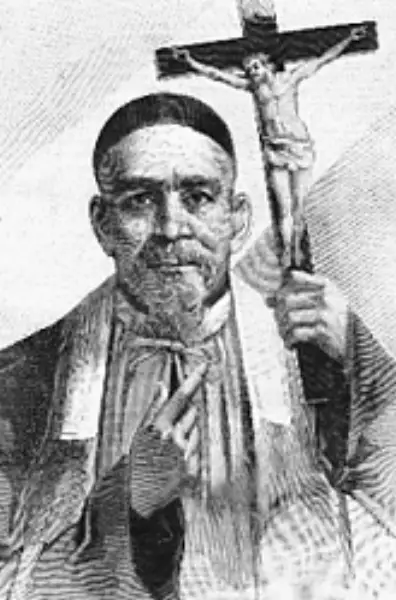
François-Régis Clet was born at Grenoble on 19 August 1748 into a comfortable, very large middle-class family: he was the tenth of fifteen children of Césaire and Claudine Clet. Drawn to the Vincentians, he entered the Congregation of the Mission in 1769, was ordained, and worked as a priest at Annecy and Paris, giving fifteen years to the internal seminary. In 1788, present in the capital for the election of a new superior general, he watched a mob attack the clergy, and the sight stirred in him the desire to offer himself for China. He sailed in July 1789 and reached Macao that October, where he wrestled with a language that never came easily, yet still managed to baptize on the order of a hundred people during his first assignment in Jiangxi. Transferred to Huguang in 1793, he labored for decades in a province hostile to foreign priests, moving between Christian settlements as persecution tightened. Arrested in June 1819, aged seventy-one, he was tortured, shuffled between Kaifeng and Wuchang, and finally condemned by a court for corrupting the emperor's subjects in religion. Bound to a cross on 18 February 1820, he was strangled until he suffocated.
The Complete Life
Early Life
Francois-Regis Clet was born in Grenoble in 1748 into a middle-class and very large family: his parents Cesaire and Claudine Clet had fifteen children, and he was the tenth of them. Baptized soon after his birth in the church of Louis, he joined the Congregation of the Mission — the Vincentians — in 1769 and was ordained in due course. He worked as a priest at Annecy and in Paris, and spent fifteen years on the staff of a seminary until 1788, when he was chosen to travel to Paris for the election of a new superior general, Jean-Felix-Joseph Cayla de la Garde. His life to that point was that of an unremarkable French seminary professor, and he was already forty when the Revolution redirected it.
§ Early life
Conversion and Vocation
While Clet was in Paris he watched a mob wreak destruction on the clergy — one of the first acts of the revolutionary violence that would drive most French religious out of France or underground. The experience did not crush his missionary desire; it fixed it. He volunteered for the mission in China, a country where Christianity was not accepted and where the French church's confiscated institutions could no longer employ him. In July 1789, weeks after the fall of the Bastille, he left for the East, and he reached his first destination, Macao, that October, where he and his two companions began the study of Chinese.
§ Introduction
Mission and Ministry
Clet struggled with the Chinese language all his life, yet in his first mission in Jiangxi province he was still able to baptize at least a hundred people. In 1793 he transferred to Huguang, a region unfriendly to foreign missionaries, where one of the largest Christian settlements he helped establish was destroyed. He worked on into old age through the renewed prohibitions of the Jiaqing reign: after a Chinese Catholic's arrest in 1811, documents addressed to the bishop were discovered, a plot was suspected, Christians were ordered to renounce the faith, and foreigners were ordered out of the country. Clet stayed in hiding and continued his ministry, an old man moving between refuges, until he was arrested in June 1819, at seventy-one.
§ Voyage to China
Trial and Final Years
After his arrest Clet was brutally tortured and held in very poor conditions. After about a week he was transferred to Kaifeng for a month, questioned and tortured again, and then moved to Wuchang, where his treatment improved and he was even able to receive communion. There he learned that his companion Father Lamiot had been arrested because of three letters exchanged between them. Brought before a court, he received a death sentence for corrupting the Emperor's subjects in matters of religion. On 18 February 1820, at seventy-one, he was bound to a cross and strangled by rope until life left him, having prayerfully made over the sacrifices of his life to God.
§ Final days
Canonization
Clet's cause moved in the ordinary Roman manner for the Chinese martyrs: he was declared venerable in 1843 and beatified in 1900, and on 1 October 2000 Pope John Paul II canonized him among the 120 Martyr Saints of China. He is one of the Vincentians in the group, alongside John Gabriel Perboyre, and the general sources name him among the martyrs of the Jiaqing persecution, killed by strangling after imperial sentence. His feast is kept on 18 February in the Vincentian calendar and in the general calendar of the Chinese martyrs on their common memorial of 9 July.
§ Introduction
Legacy
Clet is remembered as the embodiment of the long haul rather than the swift sacrifice: twenty-eight years of hidden missionary labor in China, half of them in a province hostile to him, ending in a martyrdom he accepted at an age when most men have long since retired. Within the Congregation of the Mission his letters home became part of its missionary self-understanding, joining the memory of Perboyre. For the church in Huguang and Jiangxi he belongs to the lineage of the earliest sustained Catholic communities of the interior, kept alive by missionaries and Chinese catechists at the cost of precisely the deaths the group of 120 commemorates.
§ Introduction
Timeline
- 19 Aug 1748
Born at Grenoble, tenth of the fifteen children of Césaire and Claudine Clet.
§ Early life
- 1769
Enters the Congregation of the Mission, the Vincentians, and is ordained there in due course.
§ Early life
- 1788
Sent to Paris for the election of a new superior general, he sees a mob destroy the clergy and resolves to serve in China.
§ Early life
- Jul 1789
Departs for China in July and reaches Macao that October, where he and two companions study Chinese.
§ Voyage to China
- 1793
Transferred to Huguang, a region unwelcoming to foreign missionaries, where he labors for decades.
§ Voyage to China
- 1811
After a Chinese Catholic's arrest, documents to the bishop surface; Christians are ordered to apostatize and foreigners expelled.
§ Voyage to China
- Jun 1819
Arrested in June at the age of seventy-one despite living in hiding.
§ Voyage to China
- 18 Feb 1820
Condemned for corrupting the emperor's subjects in religion, he is bound to a cross and strangled to death at Wuchang.
§ Final days
- 1843
Declared venerable.
§ Sainthood
- 27 May 1900
Beatified by Pope Leo XIII in Saint Peter's Basilica.
§ Sainthood
- 1 Oct 2000
Canonized by Pope John Paul II in Saint Peter's Square among the Martyr Saints of China.
§ Sainthood
The Record
- Symbols
- Crucifix·Palm branch
- Canonization
- Declared venerable in 1843; beatified in 1900; canonized by Pope John Paul II on 1 October 2000 as one of the Martyr Saints of China
Prayer
Bibliography
Show 10 sources
- ↑ "Saint Francis Regis Clet" . Daughters of Charity of Saint Vincent de Paul . Archived from the original on 2020-10-22 . Retrieved 2019-04-18 .
- ↑ Clark, Anthony (April 7, 2011). China's Saints: Catholic Martyrdom During the Qing (1644–1911) . Lehigh University Press. p. 144. ISBN 978-1-61146-017-9 . Retrieved November 30, 2022 .
- ↑ Clark, Anthony (April 7, 2011). China's Saints: Catholic Martyrdom During the Qing (1644–1911) . Lehigh University Press. p. 145. ISBN 978-1-61146-017-9 . Retrieved November 20, 2022 .
- ↑ Clark, Anthony (April 7, 2011). China's Saints: Catholic Martyrdom During the Qing (1644–1911) . Lehigh University Press. p. 146. ISBN 978-1-61146-017-9 . Retrieved November 20, 2022 .
- ↑ Clark, Anthony (April 7, 2011). China's Saints: Catholic Martyrdom During the Qing (1644–1911) . Lehigh University Press. p. 146. ISBN 978-1-61146-017-9 . Retrieved November 20, 2022 .
- ↑ Ducourneau, Jean-Yves (2001). "remes of Love" Francis Regis Clet (1748-1820): Priest "To the Extremes of Love" Francis Regis Clet (1748-1820): Priest of the Congregation of the Mission, Martyr in China of the Congregation of the Mission,
- ↑ "St. Francis Regis Clet" . catholic.net . Retrieved November 20, 2022 .
- ↑ Ducourneau, Jean-Yves (2001). "remes of Love" Francis Regis Clet (1748-1820): Priest "To the Extremes of Love" Francis Regis Clet (1748-1820): Priest of the Congregation of the Mission, Martyr in China of the Congregation of the Mission,
- ↑ "St. Francois Regis Clet" . Catholic.org . Catholic Online.
- ↑ "Saint of the Day – 18 February – Saint Francis Regis Clet CM (1748-1820) Priest and Martyr" . AnaStpaul.com . AnaStpaul. 18 February 2020 . Retrieved December 7, 2022 .
Profile text adapted from the Wikipedia article, licensed CC BY-SA 4.0.
Pray with this saint every day
Save St. Francis Regis Clet to your favorites, read the full profile, and get feast-day reminders in the Saints app.
Get the Saints AppFree on the App Store for iPhone and iPad