
1549 – 1610·Feast July 14
St. Francis Solanus
Franciscan missionary to South America and violin evangelist
Overview
Francis Solanus, born Francisco Solano y Jiménez at Montilla in Andalusia on 10 March 1549, was a Spanish Franciscan whose missions carried the Gospel across the mountains and plains of South America. Educated by the Jesuits, he chose instead the poverty of the Friars Minor, joining the reformed observance at Montilla at twenty and damaging his health permanently through its barefoot austerities. Ordained in 1576 at Seville, he worked as an itinerant preacher and confessor, tended the plague-stricken of Granada in 1583, and longed for martyrdom in North Africa before turning his hopes to the New World. Sent out at the request of Philip II, he sailed in 1589, survived a shipwreck in which he stayed behind with the enslaved captives aboard, and then spent twenty years evangelizing Tucumán and Paraguay, mastering native languages and playing his violin for the peoples he served. Called to Lima around 1601, he recalled the Spanish colonists to their baptismal promises, foretold the earthquake that would one day level Trujillo, and died there on 14 July 1610. Beatified in 1675 and canonized in 1726, he is patron of five South American nations and of Montilla, invoked against earthquakes.
The Complete Life
Barefoot in Montilla
Francisco Solano y Jiménez was born on 10 March 1549 at Montilla in Córdoba, third of the children of Mateo Sánchez Solano and his wife Ana Jiménez, a respectable Andalusian household of the Spanish Empire. His schooling came from the Jesuits, but their learning could not quiet his attraction to a harder road: the poverty and penance of the Franciscan friars. At twenty he joined the Friars Minor at Montilla, entering the novitiate of St. Lawrence Friary, a house of the reformed observance that kept a strict round of prayer, silence, and fasting. The young novice took the rule with a rigor that alarmed no one and ruined his constitution: he went always barefoot, abstained from meat, and wore a hairshirt throughout the entire year. The community approved; his body did not, and his health suffered permanently, leaving him sick and prone to fatigue for the rest of his life. He made solemn vows in 1569 and was sent to the Loreto friary at Seville for his seminary studies, where philosophy and theology were joined by music — a talent that would one day evangelize the pampas. He was ordained in 1576, in a ceremony his ailing mother could not attend, and named master of ceremonies of the community.
§ Early life
Preacher of the Villages, Seeker of Martyrdom
Once his final theological studies were done, Solano was assigned to itinerant preaching in the villages of the region around Seville, walking from parish to parish with the word, and in time he was licensed as a confessor. The work was fruitful, but his imagination had caught fire for something harder. Hoping to win martyrdom for preaching the Catholic faith, he formally requested to be sent to North Africa, where such a death was a genuine possibility; the request was denied. Refusing to let the dream die, he simply turned it westward, toward the American missions. Before departure, providence reordered his affections at home. When his father died, Solano returned to Montilla to care for his mother, and in that season of filial duty his reputation as a wonderworker took hold: several people were cured of their ills through his prayers. Then came a dress rehearsal for his missionary charity. In 1583, when pestilence broke out at Granada, he went to the sick and dying and tended them when others fled. By the time the call came, he had proved himself in the three works that would define his apostolate — preaching, healing presence, and readiness for danger.
§ Early life
Twenty Years in Tucumán
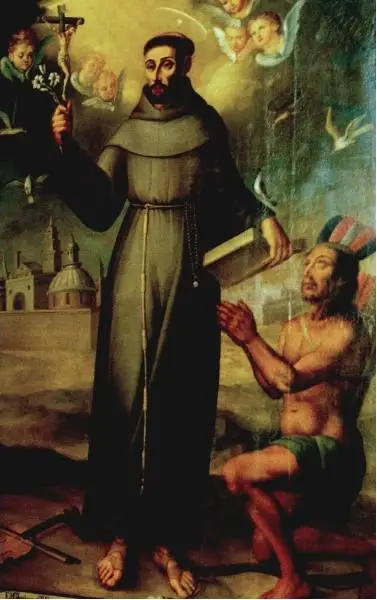
King Philip II asked the Franciscans for missionaries to carry the Gospel to the Americas, and in 1589 Solanus sailed from Spain. He landed at Panama, crossed the isthmus, and boarded a vessel for Peru — and there the sea nearly claimed him. A storm crashed the ship against the rocks not far from the coast; crew and passengers abandoned it, but Francis stayed aboard with the enslaved people the wreck threatened to forget, and after three days all were rescued. The episode prefigured his choice of fields. For twenty years he evangelized the immense regions of Tucumán (today's northwestern Argentina) and Paraguay, trekking distances that defeated other men. He had a rare gift for languages, mastering many native tongues in a fairly short time; the Catholic Encyclopedia records the further marvel that he could address tribes of different speech in one language yet be understood by all. His violin went with him, played frequently for the natives, and became so identified with his preaching that artists have never painted him without it. He governed as well as preached, serving as guardian of the friaries of Tucumán and Paraguay before his transfer, around 1601, to Lima, where he summoned the Spanish colonists back to their baptismal integrity.
§ New World
The Violin and the Hairshirt
Two instruments marked Solanus's inner life: the discipline he never abandoned and the violin he never put down. The friar of the barefoot year remained a penitent — a lover of simplicity who, even as a priest in Seville, built himself a cell of clay and reeds beside the friary chapel rather than accept a proper room. That ascetic streak explains the endurance of his American treks and his instinct, in the shipwreck, to stay with the slaves while everyone else swam for shore. His desire for martyrdom in North Africa, though denied, was the purest expression of a spirituality that counted nothing safe and nothing spared. Yet the same man disarmed the Americas with music. He played the violin for the natives he evangelized, letting melody carry what language could not, and the Catholic Encyclopedia's strange observation — that he could speak one language and be understood by tribes of many tongues — belongs to the same logic: the Gospel, in his hands, was meant to be heard with joy. He preached penance to the colonists of Lima and blessing to the villages of Tucumán with equal warmth, a mystic of the road whose severity was always aimed at himself and whose sweetness was always spent on others.
§ New World
Lima and the Foretold Earthquake
Solanus's last decade was spent in the capital of the Viceroyalty. Appointed guardian of the Franciscan friary in Lima — the great Monastery of San Francisco — he filled the same office earlier for the friaries of Tucumán and Paraguay, but Lima made him the conscience of the city. There he preached to the Spanish colonists, trying to recall them to the integrity of the baptism they had traded away for the profits of the New World, and the city that heard him would keep his tomb. He stood preaching at Trujillo in 1610 when he foretold the calamities in store for that city; eight years later an earthquake destroyed it, and the prophecy was remembered as a sign of his spirit's reach. He did not live to see it. He died at Lima on 14 July 1610, sixty-one years old, twenty-one of them given to the New World. The Monastery of San Francisco in Lima, where he had governed and preached, became his major shrine, and the Franciscans set his feast on the day of his death. The Andalusian who could not reach Africa for martyrdom had died instead as the apostle of half a continent, mourned from Montilla to the Pacific.
§ New World
Honored by Two Popes
The church needed only two generations to judge the Franciscan of Tucumán. On 20 June 1675, Pope Clement X beatified him in Rome, sixty-five years after his death and within living memory of people who had known the Lima friary. Half a century later, on 27 December 1726, Pope Benedict XIII canonized him in Rome, enrolling him among the saints of the universal Church. The dates matter: the beatification came as the Spanish empire was still digesting its conquests, and the canonization as the missionaries of the order pressed further into the Americas — the Church was affirming a model of evangelization that respected native tongues and sang its way into new cultures. His feast was fixed on 14 July, the anniversary of his death at Lima. In the centuries since, no formal miracles have needed to be added to his story for his cult to flourish; the accounts of his wonderworking at Montilla, his rescue at sea, and his understanding of unknown languages, preserved in the Catholic Encyclopedia and Franciscan sources, have kept his reputation alive in the places that claim him. Two popes made him a saint; five nations and one Andalusian town made him their own.
§ Veneration
From Montilla to Humahuaca
Francis Solanus left his name on two hemispheres. In Montilla, his birthplace is a shrine of civic religion: he is the town's patron saint, and the Parish Church of San Francisco Solano stands on the very site of the house where he was born. Across the Andes, he is patron of Peru, Paraguay, Bolivia, Chile, and Argentina — the five lands his missions touched — and he is invoked against earthquakes, a patronage born of the Trujillo prophecy and the seismic character of the regions that loved him. The Franciscan frontier remembered him, too: in 1823 Mission San Francisco Solano was founded as the northernmost mission on California's El Camino Real, carrying his name to the last stretch of the Spanish chain. And in Humahuaca, in the Argentine highlands, the devotion has become theater of a haunting kind: every day at noon, heavy copper doors open in the city hall belltower, an animated wooden figure of San Francisco Solano, carved life-size, appears for some two minutes, and seems to bless the hushed crowd gathered on the plaza below. Artists have done their part — Murillo painted him with the bull of his Tucumán legends — but the violin remains his truest monument, still visible in every image of the barefoot apostle.
§ Legacy
Timeline
- 10 Mar 1549
Born at Montilla, Córdoba, third of the children of Mateo Sánchez Solano and his wife Ana Jiménez.
§ Early life
- 1569
Made his solemn profession in the Order of Friars Minor, having entered the novitiate at St. Lawrence Friary in Montilla at the age of twenty.
§ Early life
- 1576
Ordained to the priesthood at Our Lady of Loreto friary in Seville, and named master of ceremonies for the community.
§ Early life
- 1583
Tended the sick and dying when pestilence broke out at Granada.
§ Early life
- 1589
Sailed from Spain to the New World at the request of Philip II, landing at Panama and crossing the isthmus toward Peru.
§ New World
- 1601
Called to Lima, where he preached to bring the Spanish colonists back to their baptismal integrity.
§ New World
- 1610
While preaching at Trujillo, foretold the calamities that befell the city, destroyed by earthquake eight years later.
§ New World
- 14 Jul 1610
Died at Lima in the Viceroyalty of Peru.
§ New World
- 20 Jun 1675
Beatified by Pope Clement X in Rome.
§ Veneration
- 27 Dec 1726
Canonized by Pope Benedict XIII in Rome.
§ Veneration
- 1823
Mission San Francisco Solano, the northernmost mission on California's El Camino Real, was named in his honor.
§ Legacy
The Record
- Major works
- Twenty years of missionary evangelization among the peoples of Tucumán and Paraguay·Preaching to the Spanish colonists of Lima, recalling them to their baptismal integrity·Service as guardian of the Franciscan friaries of Lima, Tucumán, and Paraguay·Nursing of the sick and dying in the 1583 pestilence at Granada·Itinerant preaching and confessed ministry in the villages around Seville
- Patron of
- patron saint of Argentina·patron saint of Bolivia·patron saint of Chile·patron saint of Paraguay·patron saint of Peru·patron saint of Montilla·invoked against earthquakes
- Symbols
- Franciscan habit·violin
- Canonization
- Beatified 20 June 1675 by Pope Clement X; canonized 27 December 1726 by Pope Benedict XIII
Prayer
Bibliography
Show 7 sources
- Donovan, Stephen (1909). "St. Francis Solanus". Catholic Encyclopedia. Vol. 6.
- Monks of Ramsgate. "Francis Solano" in Book of Saints, 1921. CatholicSaints.Info, 5 May 2013.
- "Francis Solano - Saints Resource". saintsresource.com. Retrieved 31 October 2017.
- "St. Francis Solano". Saint of the Day, Franciscan Media.
- "The Solanista Route (Francis Solanus, Patron Saint)". Archived from the original on 2017-11-07.
- "Mission San Francisco Solano - MissionTour". 12 March 2016. Archived from the original on 7 March 2015.
- "San Francisco Solano Da La Bendición - Humahuaca (Argentina)". 15 February 2010.
Profile text adapted from the Wikipedia article, licensed CC BY-SA 4.0.
Pray with this saint every day
Save St. Francis Solanus to your favorites, read the full profile, and get feast-day reminders in the Saints app.
Get the Saints AppFree on the App Store for iPhone and iPad