
1506-1552·Feast December 3
St. Francis Xavier
Priest, Apostle of the Indies and Japan
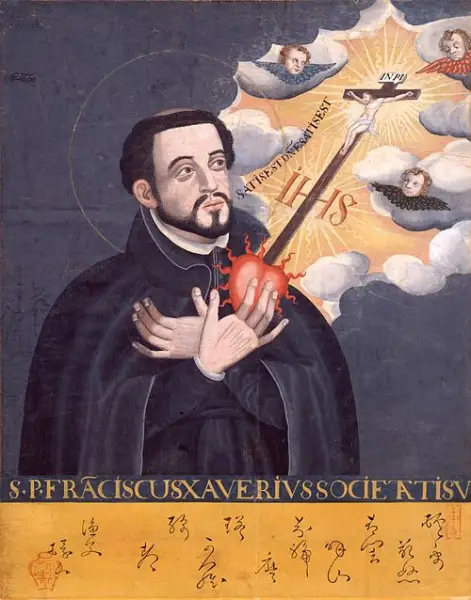
Overview
Francisco de Jasso y Azpilcueta was born on 7 April 1506 in the castle of Javier in the Kingdom of Navarre, to a noble family impoverished by Castile's conquest of the kingdom. Sent to Paris in 1525, he taught Aristotelian philosophy and nursed worldly ambitions until Ignatius of Loyola moved into his lodgings and, phrase by phrase, broke his resistance with the question of what it profits a man to gain the whole world. On 15 August 1534 he joined the seven who vowed poverty, chastity, and a pilgrimage to the Holy Land in the Montmartre crypt; ordained in 1537, he became one of the pillars of the new Society of Jesus. Sailing east as the Portuguese crown's missionary, he labored first at Goa, walking the streets with a bell to call children to catechism, then for nearly three years among the Parava peoples of the Pearl Fishery Coast, building some forty churches before moving on to Malacca and the Maluku Islands. At Malacca in December 1547 he met the Japanese Anjirō, and landing at Kagoshima on 15 August 1549 he pioneered the mission to Japan for over two years. Longing for China, he reached Shangchuan Island off Guangdong in 1552 and died there on 3 December, aged forty-six, with only a Chinese companion beside him.
The Complete Life
Early Life
Francisco de Jasso y Azpilcueta was born on 7 April 1506 in the castle of Javier in the Kingdom of Navarre, the youngest son of a noble family impoverished and politically stranded by Castile's conquest of the kingdom in 1512. His family's ruin made him ambitious: sent to the University of Paris in 1525, he studied at the Collège Sainte-Barbe, taught Aristotelian philosophy, and nursed worldly hopes of preferment. At the same college was a middle-aged ex-soldier, Ignatius of Loyola, who took lodgings near him and set about his conversion phrase by phrase — returning always to the Gospel question of what it costs a man to win the whole world at the price of his soul. By 1534 the resistance was broken. On 15 August of that year Francis knelt with Ignatius and five others in the crypt of the Martyrs at Montmartre, taking vows of poverty and chastity and a pilgrimage to the Holy Land.
§ Early life
Founding the Society, Sent to the East
Ordained a priest on 24 June 1537, Francis became one of the pillars of the new Society of Jesus, whose formal approval by Paul III in 1540 coincided with his own commission. The king of Portugal, John III, asked Rome for missionaries for the East Indies; Ignatius chose Francis, his companion of the Paris days, who left Rome almost at once and never saw either Ignatius or Europe again. He sailed as the Portuguese crown's apostolic nuncio for the East, with the Indies for his province — a field whose boundaries, in his own mind, kept moving eastward until they reached the coast of China.
§ Missionary work
India and the Indies
Francis reached Goa in May 1542 and began as he meant to continue: walking the streets with a bell to call the children to catechism, ministering in the hospitals, and preaching to the Portuguese whose scandalous lives were his first field of reform. For nearly three years he worked among the Parava pearl-fishers of the Fishery Coast, who had been baptized wholesale and instructed scarcely at all; he toured their villages, taught them the creed village by village, and built some forty churches. From 1545 he moved on — Malacca, and the Maluku Islands of eastern Indonesia, months of voyaging in native craft among the Spice Islands, founding Christian communities in Amboina and the Moluccas. He organized the mission around native catechists and simple printed texts, the method the Jesuits would carry everywhere.
§ In India
Japan and the Longing for China
At Malacca in December 1547 he met the Japanese Anjirō, a fugitive who fired his imagination; he landed at Kagoshima on 15 August 1549 and spent more than two years pioneering the mission to Japan — learning the language, translating a catechism, converting the daimyo of Yamaguchi, and coming to the famous conviction that the Japanese were a people so rational that the Church would flourish among them. Japan also taught him that China held the key to Asia: that if China received the faith, Japan would follow. Longing for the forbidden empire, he reached the island of Shangchuan off the Chinese coast in 1552, waiting for a boat to smuggle him into Canton, and died there of fever on 3 December 1552, aged forty-six, alone except for a Chinese companion and a Portuguese youth.
§ Japan
Canonization
On 25 October 1619 Pope Paul V beatified Francis, and Gregory XV canonized him on 12 March 1622, in the same ceremony as Ignatius Loyola and Teresa of Ávila. His body, buried in quicklime on Shangchuan and exhumed incorrupt, was carried to Goa, where it remains in the Basilica of Bom Jesus, while his right arm — the arm that had baptized tens of thousands — was detached in 1614 and sent to Rome, to the Gesù. In 1927 Pius XI named him, with Thérèse of Lisieux, co-patron of foreign missions. His feast is 3 December.
§ Introduction
Legacy
Francis Xavier is the greatest missionary of the modern age and one of the most traveled men of his century — from Navarre to Goa, the Moluccas, Japan and the China coast in ten years. The churches he founded or seeded — in India, Southeast Asia, Japan — trace their origins to him; the Japanese church of the martyrs and the hidden Christians was his foundation; and his attempt on China, though he died at its door, opened the way for Valignano, Ricci and the China mission. He is the patron of the Far East, of India, of Japan and of all foreign missions, and his letters — vivid, self-questioning, hungry for the next frontier — remain the classic literature of missionary vocation.
§ Introduction
Timeline
- 7 Apr 1506
Born at the Castle of Xavier in the Kingdom of Navarre, youngest son of the president of the Royal Council.
§ Early life
- 1515
His father died, leaving nine-year-old Francis in a family stripped of lands after the Castilian conquest of Navarre.
§ Early life
- 1525
Went to Paris to study at the Collège Sainte-Barbe of the University of Paris, where he spent eleven years.
§ Early life
- 1530
Took his Master of Arts degree and afterwards joined the faculty of the Collège de Beauvais, lecturing on Aristotle.
§ Early life
- 15 Aug 1534
Joined Ignatius of Loyola and five companions in the Montmartre crypt, vowing poverty, chastity, obedience, and a mission to the Holy Land.
§ Missionary work
- 24 Jun 1537
Ordained a priest, having begun the study of theology three years earlier.
§ Missionary work
- 15 Mar 1540
Left Rome in the train of the Portuguese ambassador after Pope Paul III approved the Society of Jesus.
§ Missionary work
- Jun 1540
Reached Lisbon, where he and Simão Rodrigues were received by King John III before sailing for the East Indies.
§ Missionary work
- 7 Apr 1541
Sailed from Lisbon on his thirty-fifth birthday, appointed apostolic nuncio to the East.
§ Missionary work
- 6 May 1542
Arrived at Goa, capital of Portuguese India, after thirteen months of travel, and began teaching and hospital work.
§ In India
- Oct 1542
Set sail from Goa for Cape Comorin to serve the Paravas of the Pearl Fishery Coast, to whom he devoted nearly three years.
§ In India
- 1545
Turned eastward from India toward Malacca and planned a missionary journey to Makassar on Celebes.
§ In India
- 1546
Wrote to King John III of Portugal urging measures to strengthen the faith in Goa, later read as proposing the Goan Inquisition.
§ Legacy
- Jan 1546
Left Malacca for the Maluku Islands, preaching for a year and a half at Ambon, Ternate, and Morotai.
§ In India
- 1547
Returned to Ambon shortly after Easter and helped inspire the Portuguese victory at the Battle of Perlis River.
§ Japan
- Dec 1547
Met the Japanese fugitive Anjirō at Malacca, whose accounts opened the way to the Japan mission.
§ Japan
- Jan 1548
Returned to Goa to attend to his duties as superior of the mission there.
§ Japan
- 15 Apr 1549
Departed Goa for Japan with Anjirō, Cosme de Torres, and Juan Fernández.
§ Japan
- 27 Jul 1549
Reached Japan after three months at sea, though no port would at first admit his ship.
§ Japan
- 15 Aug 1549
Went ashore at Kagoshima, principal port of Satsuma province, to begin the first Jesuit mission in Japan.
§ Japan
- Oct 1550
Left Anjirō's family home and moved on to Yamaguchi, later failing to obtain an audience with Emperor Go-Nara at Kyoto.
§ Japan
- Mar 1551
Returned to Yamaguchi, where the local daimyō granted him permission to preach.
§ Japan
- 1552
Back in Goa by early in the year, he planned passage to Ming China on behalf of Portuguese prisoners at Guangzhou.
§ China
- 1552
First buried on a beach at Shangchuan Island in a wooden coffin packed with lime.
§ Burials and relics
- Aug 1552
The Santa Cruz reached Shangchuan Island, fourteen kilometres from the Chinese mainland, where he waited in secret for passage inland.
§ China
- 3 Dec 1552
Died on Shangchuan Island, aged forty-six, with only the Chinese António at his side.
§ China
- Feb 1553
Portuguese merchants exhumed the body and found it whole and without odour, and agreed to carry it to India.
§ Burials and relics
- 22 Mar 1553
His body was taken to the Jesuit church of Our Lady of the Hill in Portuguese Malacca.
§ Burials and relics
- 15 Aug 1553
A group of Jesuits exhumed the body around this date and found it incorrupt, with blood still moist on the shroud.
§ Burials and relics
- 16 Mar 1554
His remains arrived at Goa, where they are still venerated in the Bom Jesus Basilica.
§ Burials and relics
- 1614
His right forearm, used in blessing and baptising his converts, was removed at Superior General Claudio Acquaviva's request.
§ Burials and relics
- 25 Oct 1619
Beatified in Rome by Pope Paul V.
§ Veneration
- 12 Mar 1622
Canonized by Pope Gregory XV in Rome at the same ceremony as Ignatius Loyola.
§ Veneration
- 1927
Pope Pius XI's decree Apostolicorum in Missionibus named him co-patron of all foreign missions, with Thérèse of Lisieux.
§ Veneration
In Their Own Words
All the Portuguese merchants coming from Japan tell me that if I go there I shall do great service for God our Lord, more than with the pagans of India, for they are a very reasonable people.
If you wish to bring forth much fruit, both for yourselves and for your neighbours, and to live consoled, converse with sinners, making them unburden themselves to you. These are the living books by which you are to study.
All the heathen are filled with admiration at the holiness of the law of God, and express the greatest shame at having lived so long in ignorance of the true God. They willingly hear about the mysteries and rules of the Christian religion, and treat me, poor sinner as I am, with the greatest respect.
Following the baptisms, the new Christians return to their homes and come back with their wives and families to be in their turn prepared for baptism. After all had been baptised, I order that the temples of the false Gods be pulled down and idols broken. I know not how to describe in words the joy I feel before the spectacle of pulling down and destroying the idols by the very people who formerly worshipped them.
They are as perverse and wicked a set as can anywhere be found, and I always apply to them the words of the holy David, “From an unholy race and a wicked and crafty man deliver me, O Lord.” They are liars and cheats to the very backbone. Their whole study is how to deceive most cunningly the simplicity and ignorance of the people…All the time I have been here in this country I have only converted one Brahmin…
The Record
- Major works
- Collected letters (extensive missionary correspondence from India, the Indies, and Japan)
- Patron of
- Missionaries and foreign missions·African missions·India·Japan·China·Australia and New Zealand·Navarre, Spain·Navigators·Apostleship of Prayer·Propagation of the Faith
- Symbols
- Cassock and stole·Crucifix
- Canonization
- Beatified by Pope Paul V on 25 October 1619; canonized by Pope Gregory XV on 12 March 1622; named co-patron of foreign missions with St. Thérèse of Lisieux by Pius XI in 1927
Prayer
Bibliography
Show 3 sources
- ↑ Latin : Franciscus Xaverius ; Basque : Frantzisko Xabierkoa ; Navarrese Romance : Francés de Xabier ; French : François Xavier ; Spanish : Francisco Javier ; Portuguese : Francisco Xavier
- ↑ Navarro-Aragonese, called Romance at this time was also a language spoken in the surrounding area. Romance languages are the result of the changes to spoken Latin through the centuries. Hispanic Romance languages were born in the North of
- ↑ For the most recent study of Francis Xavier's canonisation process, see Mormando, Franco (2006). "The Making of the Second Jesuit Saint: The Campaign for the Canonization of Francis Xavier, 1555–1622". In Mormando, F. (ed.). Francis Xavie
Profile text adapted from the Wikipedia article, licensed CC BY-SA 4.0.
Pray with this saint every day
Save St. Francis Xavier to your favorites, read the full profile, and get feast-day reminders in the Saints app.
Get the Saints AppFree on the App Store for iPhone and iPad