
c. 1570-1597·Feast February 6
St. Francisco Blanco
Franciscan Priest and Martyr
Overview
Francisco Blanco was born around 1570 at Ourense in Galicia and first studied with the Jesuits at Monterrei. Drawn to the Franciscans, he made his novitiate at Villalpando after moving to Castile and León. Answering a missionary calling, he crossed to Mexico, where he was ordained to the priesthood, and in 1593 went on to the Philippines. In 1596 he sailed for Japan in the company of his teacher Martin of the Ascension, as part of the Franciscan mission that had recently reached Kyoto under Spanish patronage. Within months the persecuting edict of Toyotomi Hideyoshi fell on the mission. Blanco was seized with his brethren and the Jesuit priests Paul Miki and John Goto, and the group was marched through the winter from Kyoto to Nagasaki. There, on 5 February 1597, he was raised on a cross at Nishizaka Hill and put to death with the Twenty-six Martyrs of Japan, the first great harvest of the Japanese Church. Beatified in 1627 and canonized by Pius IX in 1862, he is remembered in Japan each February, and a skull relic of him is preserved at O Barco de Valdeorras near his Galician birthplace.
The Complete Life
Early Life
Francisco Blanco was born around 1570 at Ourense in Galicia, into a Spain then at the height of its missionary expansion. His first schooling was with the Jesuits at Monterrei; after his family moved into Castile and León he made his novitiate with the Franciscans at Villalpando. Nothing in the record of these years is out of the ordinary — a Galician boy of good family, educated by the two orders then competing for the Catholic world's talent, and drawn by both toward the missions. The Franciscans won him, and the Franciscan overseas enterprise, which ran from Spain through Mexico and Manila to the furthermost coasts of Asia, gave his life its direction. Galicia in the last third of the sixteenth century was sending priests to every branch of the Spanish overseas system, and the mendicant orders recruited there heavily; the choice between the Jesuits, who kept him in school, and the Franciscans, who took him to Asia, was the real fork in Blanco's road.
§ Biography
Conversion and Vocation
Blanco's vocation was explicitly cross-cultural mission. Having taken the Franciscan habit, he crossed to Mexico, where he was ordained to the priesthood, and in 1593 he went on to the Philippines, the Spanish base for the China and Japan missions. In 1596 he sailed for Japan in the company of Martin of the Ascension, his teacher and superior, as part of the Franciscan mission that had recently established itself at Kyoto under Spanish patronage. The friars had gone to Japan ostensibly as ambassadors and supply-runners from Manila; within their first year they had opened a house, a hospital, and a confraternity in the capital, and had begun preaching — which was the act that would condemn them. Mexico in these years was the hinge of the whole Pacific system: the friar who reached New Spain had already left Europe behind, and ordination there rather than in Spain committed him to the overseas provinces for good.
§ Biography
Mission and Ministry
The Franciscan mission in Kyoto lasted barely two years, and Blanco was in it almost from the start. The friars cared for lepers and the poor, which scandalized no one, and preached publicly, which did. Toyotomi Hideyoshi, the imperious regent who had unified Japan, had already grown suspicious of European political influence — a Spanish galleon wrecked off Shikoku in 1596 with her captain allegedly boasting of the conquests that followed missionaries — and in the autumn of that year his patience ended. On 8 December 1596 Blanco was among the Christians seized in Kyoto, and the prisoners, friars, Japanese Jesuit priests, and laymen alike, had their left ears partly cut off and were then paraded through the streets. In January 1597 they were marched the six hundred miles from Kyoto to Nagasaki, a journey of weeks in the winter, intended to break them and to advertise the penalty. The city's Christians numbered in the tens of thousands by the best modern estimates, and the friars' public preaching there was, from Hideyoshi's standpoint, a flagrant breach of the permission under which they had landed.
§ Martyrdom
Trial and Final Years
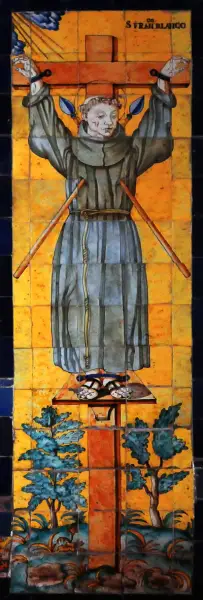
The forced march ended at Nagasaki because that city was the center of Japanese Catholicism and the regime wanted the execution seen there. On 5 February 1597, at Nishizaka Hill above the harbor, the twenty-six prisoners — Franciscan friars from Spain, Mexico, and India, the Japanese Jesuit Paul Miki and his companions, and Japanese laymen and boys — were raised on crosses and put to death with spears driven through their bodies. Blanco was crucified beside his teacher Martin of the Ascension. The bodies were left exposed on the hill. The group was afterwards known as the Twenty-six Martyrs of Japan, the first mass martyrdom of the Japanese church and its founding image. The choice of Nagasaki over Kyoto as the place of execution, and the public mutilation that preceded the march, show the regime thinking about audiences: the punishment was addressed to the Japanese church as a whole, and the twenty-six were made to walk through the country to reach it.
§ Introduction
Canonization
The twenty-six were beatified by Pope Urban VIII on 14 September 1627, thirty years after their deaths and within living memory of witnesses in Japan and Europe, and canonized by Pope Pius IX on 8 June 1862 — the first canonization of Japanese saints. Their joint feast is kept on 5 February. The timing of the canonization mattered: it came in the very years after Japan had been reopened, and when religious freedom was reestablished under the Meiji Restoration after 1868, some thirty thousand Kakure Kirishitan, 'hidden Christians', who had preserved the faith underground for more than two centuries, came forward and were found to have kept the memory of Nishizaka. For Europe the canonization of 1862 came at the moment when the Japanese persecution was being rediscovered as history, and the twenty-six became the subject of a substantial literature in French, Spanish, and Italian within a generation. Their story was already being told in Europe within months of the event, and never stopped being told.
§ Legacy
Legacy
For Japan the twenty-six martyrs are the fixed point of Christian memory: the Twenty-Six Martyrs Museum and Monument was built on Nishizaka Hill in June 1962 to mark the centenary of the canonization, and pilgrimage to the hill is a continuous Japanese Catholic devotion. For Galicia, Blanco is a native saint of Ourense, and a skull relic of him is preserved at O Barco de Valdeorras in his home province. Within the Franciscan order he is counted among the protomartyrs of its Japanese province, killed in the first year of its mission, and his death with Martin of the Ascension, the master who had trained him, has made the pair a standing image of the missionary teacher and pupil dying together. The Martyrs' Museum built in 1962 gathers the documentary and artistic record of the group, and its hillside monument, with the twenty-six in bronze, is one of the most recognizable Catholic images in Asia. Galicia's claim on Blanco remains the relic at O Barco de Valdeorras and the cult of a local boy who reached the farthest mission of his century.
§ Legacy
Timeline
- 1570
Born at Ourense in Galicia around this date.
§ Introduction
- 1593
Left Mexico for the Philippines as a missionary after ordination there.
§ Biography
- 1596
Sailed to Japan in the company of his teacher Martin of the Ascension.
§ Biography
- 8 Dec 1596
Arrested with many Christians in Kyoto and had part of his left ear severed.
§ Martyrdom
- 4 Jan 1597
Sent on a forced march of some 966 kilometres toward Nagasaki.
§ Martyrdom
- 5 Jan 1597
Crucified and speared on Nishizaka Hill, Nagasaki, with twenty-five fellow Christians.
§ Martyrdom
- 14 Sep 1627
Beatified with all the Japanese martyrs by Pope Urban VIII.
§ Legacy
- 8 Jun 1862
Canonized by Pope Pius IX in Rome.
§ Legacy
- Jun 1962
Twenty-Six Martyrs Museum and Monument opened on Nishizaka Hill for the canonization centenary.
§ Legacy
The Record
- Symbols
- Franciscan habit·Crossed spears
- Canonization
- Beatified by Pope Urban VIII in 1627; canonized by Pope Pius IX on 8 June 1862, among the Twenty-six Martyrs of Japan
Prayer
Bibliography
Show 3 sources
- ↑ "Diocese of Orense - Encyclopedia Volume - Catholic Encyclopedia" .
- ↑ "The martyrs of Japan" . www.ewtn.com . Archived from the original on 2000-12-08.
- ↑ Encyclopedia of Japan. Tokyo: Shogakukan. 2012. OCLC 56431036. Retrieved 2012-08-09.
Profile text adapted from the Wikipedia article, licensed CC BY-SA 4.0.
Pray with this saint every day
Save St. Francisco Blanco to your favorites, read the full profile, and get feast-day reminders in the Saints app.
Get the Saints AppFree on the App Store for iPhone and iPad