
c. 780 – 838·Feast July 18
St. Frederick of Utrecht
Murdered ninth-century bishop and patron of the deaf
Overview
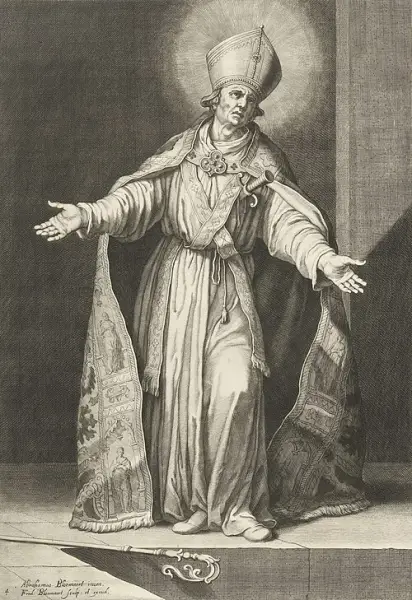
Frederick I, sometimes Latinized as Fridericus Cridiodunus, was Bishop of Utrecht in the first half of the ninth century and one of the early saints of the Dutch church. Born around 780 into a noble Frisian family — later folklore wrongly made him a grandson of the Frisian king Radboud — he was educated at Utrecht by the cathedral clergy under Bishop Ricfried. Ordained a priest, he was charged with evangelizing the remaining heathen populations of the northern Netherlands, preaching at Walcheren and, together with St. Odulfus, in and around Stavoren. Chosen bishop after Ricfried's death in 815/816, he governed the diocese for nearly two decades and was known for piety and learning: he corresponded with Rabanus Maurus, was praised for his knowledge at the synod of Mainz in 829, and has been credited with the authorship of the hagiography Vita S. Bonifacii. His death was violent and its circumstances long debated: church records give 18 July 838, and all sources agree he was murdered. Later writers disagreed about the culprits — the empress Judith, offended by his rebukes, or the hostile inhabitants of Walcheren — with the latter account regarded as the more credible. Canonized soon after his death, he is patron saint of the deaf, and was buried in St. Salvator's Church in Utrecht.
The Complete Life
A Frisian Noble Educated at Utrecht
Frederick was born around 780 into a noble family of Frisia, in the northern lands of the Carolingian world that had only recently been won for Christianity. Sixteenth-century folklore, eager to ennoble him further, mistook him for a grandson of Radboud, the last independent king of the Frisians, but the Church's records claim only his noble birth. As a boy he was sent to be taught at Utrecht by the clergy of the cathedral, among them Bishop Ricfried himself, under whose direction the young Frisian received the education that would fit him for the service of the Church. Upon completing his studies he was ordained a priest and immediately given the hardest assignment the young diocese could offer: the conversion of the remaining heathen in the northern districts of the diocese and in regions beyond its borders. He preached at Walcheren, on the Zeeland coast, and laboured together with St. Odulfus in and around Stavoren, the Frisian port on the Zuiderzee. In these missions he carried into the field the heritage of Boniface, the apostle of Germany whose martyrdom within living memory of his birth had made the Utrecht church a mission station at the edge of Christendom.
§ Frederick of Utrecht
A Learned Bishop on the Frontier
When Bishop Ricfried died in 815/816, Frederick was chosen to succeed him as Bishop of Utrecht, shepherding a diocese that was at once an ancient mission field and a frontier post of the Carolingian empire. He governed it for close to twenty years and earned a reputation for two qualities in particular: piety and erudition. His learning connected him to the chief scholars of his age — he maintained a correspondence with Rabanus Maurus, the head of the school of Fulda and one of the most prolific masters of the ninth century — and his command of doctrine was publicly displayed at the synod of Mainz in 829, where his knowledge and understanding drew praise. To him has also been attributed the authorship of the Vita S. Bonifacii, the hagiographical account of the life of St. Boniface, a fitting literary labour for the bishop of the church Boniface had done so much to plant. Whether or not the attribution stands, it reflects the memory of Frederick as a bishop who could both govern and write, a shepherd of souls and a man of books, holding together in one person the missionary zeal of the eighth century and the scholarly culture of the ninth.
§ Frederick of Utrecht
Murder and the Question of Why
All sources agree that Frederick's end was violent; none fully agree on how it came about. Church records give his death as 18 July 838, though other sources place it anywhere between 834 and 838. Legend describes how two assassins knifed him at the conclusion of the Mass that day, cutting him down at the very instant of sacrifice. As to the perpetrators, medieval writers divided into two camps. Bishop Otbert of Liège, writing in the eleventh century in his Passio Frederici, and William of Malmesbury after him, laid the murder at the command of the empress Judith, second wife of Louis the Pious, allegedly hired in revenge for Frederick's repeated criticism of her dissolute manner of life. Later scholars such as Cesare Baronio and Jean Mabillon preferred a different account: that the inhabitants of Walcheren, hostile to Christianity, sent the assassins in answer to Frederick's missionary preaching among them. Modern judgment sides with the latter, since no contemporary writer records any unchastity in the empress or any such accusation from the bishop, while Walcheren's hostility to the missionaries of Utrecht was well attested. Frederick was buried in St. Salvator's Church in Utrecht, and the Church canonized him shortly after his death. His feast is kept on 18 July, and he has long been invoked as the patron saint of the deaf.
§ Frederick of Utrecht
Timeline
- 780
Born around this year into a noble family of Frisia.
§ Frederick of Utrecht
- 816
Chosen Bishop of Utrecht after the death of Bishop Ricfried in 815/816.
§ Frederick of Utrecht
- 829
Praised for his knowledge and understanding at the synod of Mainz.
§ Frederick of Utrecht
- 18 Jul 838
Met a violent death; legend describes two assailants who knifed him once Mass had been celebrated.
§ Frederick of Utrecht
The Record
- Major works
- Vita S. Bonifacii (attributed)
- Patron of
- patron saint of the deaf
- Canonization
- Canonized shortly after his death (pre-congregation); venerated by the Catholic and Eastern Orthodox Churches.
Prayer
Bibliography
Show 1 sources
- Nieuw Nederlandsch biografisch woordenboek. Deel 2.
Profile text adapted from the Wikipedia article, licensed CC BY-SA 4.0.
Pray with this saint every day
Save St. Frederick of Utrecht to your favorites, read the full profile, and get feast-day reminders in the Saints app.
Get the Saints AppFree on the App Store for iPhone and iPad