
c. 560 - 588·Feast March 18
St. Fridianus
Irish Prince and Bishop of Lucca
Overview
Fridianus, in Italian San Frediano and elsewhere Frigidanus or Frigianu, was an Irish prince of the royal house of Ulster who ended his life as bishop of Lucca in Tuscany. Tradition makes him a son of King Ultach, formed in Irish monasticism and taught by St. Enda and St. Colman before his ordination as a priest. A pilgrimage to Rome changed the direction of that life: passing through Lucca, he chose solitude and settled as a hermit on Mount Pisano, in the mountains between Lucca and Pisa. In 556 Pope John II persuaded him to take up the bishopric of Lucca, which he governed for more than thirty years while returning as often as he could to quiet prayer in the countryside. His episcopate saw Lucca attacked by the Lombards and its cathedral burnt; he rebuilt it. Legend credits him with turning the floods of the river Serchio away from the city by tracing a new course with a rake. He was buried in the church he had built on the site of the present basilica, which took his name and remains a landmark.
The Complete Life
A Prince of Ulster
Fridianus was born in Ulster in the sixth century, a prince by blood: Catholic tradition calls him a son of the king of that province, while the Catholic Encyclopedia describes him as a son of Ultonius, king of Ireland, or perhaps of a king of Ulster. Whatever the precise genealogy, he belonged to the class from which Irish monasticism drew so many of its greatest figures, and he received the formation that class provided. Tradition names St. Enda and St. Colman among his teachers, placing him within the austere school of the Irish desert fathers of the west. There he was trained in the monastic disciplines of prayer, asceticism, and scripture, and in time he was ordained a priest. The record preserves almost nothing of his youth beyond these outlines, and the silence is itself instructive: a prince who became a monk had already renounced the succession his birth promised him. Ireland in the sixth century was sending missionaries and pilgrims across the sea in every direction, and the young priest would follow the oldest of all pilgrim roads, toward the tombs of the apostles at Rome.
§ Biography
Pilgrim, Hermit, and Reluctant Bishop
The decisive journey of his life was a pilgrimage to Rome. Somewhere on the road through Tuscany, at Lucca, the pilgrim decided to abandon the itinerary of the holy places and give himself wholly to God in solitude. He withdrew to Mount Pisano, the mountainous tract lying between Lucca and Pisa, and lived there as a hermit. Such holiness could not long remain hidden. In 556, according to the tradition, Pope John II himself intervened and persuaded the solitary to accept the bishopric of Lucca. Fridianus accepted, but he never allowed the episcopal office to extinguish the eremitical instinct beneath it: again and again he slipped away to the open country for recollection and prayer, shepherding a busy Italian see with the heart of an Irish monk. The people of his diocese learned to read the rhythm of his absences as the habit of a man who prayed before he acted. The combination defined the rest of his life, some thirty years of episcopal service punctuated by retreat. A bishop who kept a hermit's interior life is rare in any century, and it is this, as much as any miracle, that the oldest accounts of him seem designed to honor.
§ Biography
The River That Obeyed a Rake
Fridianus became known for working miracles, and the most famous of them is openly a legend: the taming of the Serchio. The river ran past Lucca and regularly flooded the city, until the flood-plagued townsfolk pleaded with their bishop for deliverance. Taking a rake in hand, Fridianus went down to the water's edge; as the faithful prayed around him, he ordered the river to trail the implement, and to the crowd's astonishment the current swung aside, carving a fresh bed away from the city and its tilled fringes. The story belongs to the imaginative currency of medieval hagiography, but it encodes a bishop's real office: to stand between a threatened people and disaster. His episcopate faced a plainer danger still. During his tenure Lombard armies fell upon Lucca and left the cathedral in ashes; Fridianus raised it from the ruins. He is also thought to have founded a community of eremitical canon priests, a body that endured for centuries and in 1507 was absorbed into the Canons Regular of the Lateran. Founder, rebuilder, and protector: the legend of the rake gathers these roles into one image.
§ Biography
A Tomb That Named a Basilica
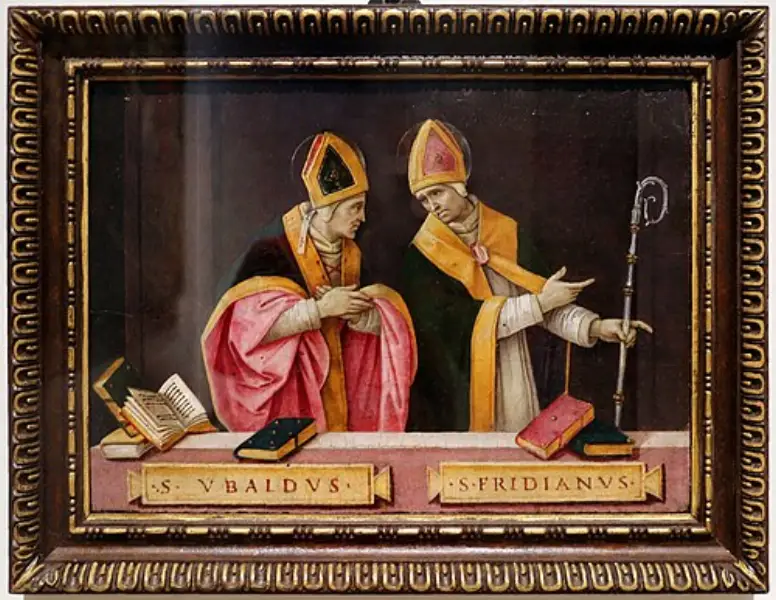
Fridianus built a church on the spot where the Basilica of San Frediano now stands, dedicating it to Vincent of Saragossa, the martyred deacon of Spain. When the bishop died he was buried in that church, and the building was renamed for its two patrons as Ss. Frediano and Vincenzo. The church remains a major landmark of Lucca, regularly visited by pilgrims and travelers, the center of a cult that has never lapsed since the sixth century. Few Italian bishops of the sixth century are still so visibly present in the fabric of their own cities. Churches in Florence are also dedicated to him, and Tuscan artists repeatedly painted his story: Filippo Lippi depicted him changing the course of the Serchio on the predella of the Barbadori Altarpiece, and Filippino Lippi set him beside Saint Ubaldus a generation later. Students of the Irish saints have often confused him with Finnian of Moville, but no formal connection between the two men has ever been established. His feast is kept on March 18, and his emblems in art are the rake and the hoe, the humble tools of the legend in which a river obeyed the prayers of a bishop.
§ Biography
Timeline
- 556
Pope John II persuades the former pilgrim, then a hermit on Mount Pisano, to accept the bishopric of Lucca.
§ Biography
- 588
Dies in the Lombard Kingdom and is buried in the church he built, which is then renamed Ss. Frediano and Vincenzo.
§ Biography
- 1507
The eremitical canons he may have founded are merged with the Canons Regular of the Lateran.
§ Biography
In Their Own Words
Remarkable for sanctity and miracles was St. Fridianus
The Record
- Major works
- Basilica of San Frediano in Lucca, first dedicated to Vincent of Saragossa·Community of eremitical canon priests at Lucca
- Symbols
- rake·hoe
- Canonization
- Pre-congregation; venerated as a saint from antiquity in Lucca and throughout Italy
Prayer
Bibliography
Show 4 sources
- "St. Frediano - Saints & Angels." Catholic Online.
- "Lucca." The Catholic Encyclopedia. New Advent.
- Bentley, James (1993). A calendar of saints: the lives of the principal saints of the Christian Year. London: Little, Brown. ISBN 9780316908139.
- "Saint Frigidian of Lucca." Saints.SQPN.com.
Profile text adapted from the Wikipedia article, licensed CC BY-SA 4.0.
Pray with this saint every day
Save St. Fridianus to your favorites, read the full profile, and get feast-day reminders in the Saints app.
Get the Saints AppFree on the App Store for iPhone and iPad