
died 19 October 727·Feast October 19
St. Frithuswith
Abbess of Oxford, Patron Saint of the University
Overview
Frithuswith, Latinized as Frideswide, died on 19 October 727 and stands among the best-loved of Anglo-Saxon saints. She was a princess, daughter of Dida of Eynsham, a sub-king of Mercia whose lands lay in western Oxfordshire and along the upper Thames, and she became abbess of the monastery she founded at Oxford, the house later incorporated into Christ Church Cathedral. Her Life, preserved in an early twelfth-century manuscript in the hand of John of Worcester, tells how she took a vow of celibacy, refused the suit of King Algar of Leicester, and fled his attempted abduction by ship to Bampton; the king, whose suit the Oxford townsfolk would not betray, was struck blind. Seeking deeper solitude she moved to Binsey, where a spring rose at her prayer, a well whose healing water drew crowds. She returned to Oxford and ruled as abbess until her death. Venerated in the Anglican, Orthodox, and Catholic traditions, she remains the patron of Oxford and its university, her shrine standing today in Christ Church Cathedral.
The Complete Life
Daughter of a Mercian Sub-King
Frithuswith was born in the seventh century into the royal circle of Mercian Oxfordshire. Her father was Dida of Eynsham, a sub-king whose territories took in western Oxfordshire and the upper valley of the Thames; the twelfth-century Life gives her parents the names Didan and Safrida. The upper Thames country in that age was a frontier where Mercian and West Saxon power met, and the family seat at Eynsham stood near the river that carried both trade and invasion. Beyond these facts the sources are a saint's Life rather than a chronicle, and they depict a child marked for God from the beginning. Her story was told and retold: the earliest narrative survives in a manuscript copied in the hand of John of Worcester in the early twelfth century, a longer adaptation is attributed to Robert of Cricklade, prior of St Frideswide's in Oxford, and two Middle English versions found their way into the South English legendaries, each with minor variations of its own. A saint whose legend accumulates rather than erodes is a rare thing, and in Frithuswith's case the accumulation itself testifies to how deeply her cult took root in the city she made her own.
§ Life
A Vow, a King, and a Refusal
While still young, and with her father's help, Frithuswith founded a monastery at Oxford; her parents died soon after, leaving her the work as her inheritance. On that foundation she built a life of consecrated virginity, and it was promptly tested. Algar, king of Leicester, sought her hand in marriage regardless of her vow, and when she refused him he resolved on abduction. The Life tells how she fled into the wilderness and found, by what it calls God's sending, a ship that carried her up the river to Bampton in Oxfordshire. Algar came searching for her in Oxford, but the townsfolk refused to betray where she had gone, and he was struck blind for his pursuit. The story has furnished Oxford with an origin legend as much as a saint's biography: the city defined itself by its loyalty to the fugitive virgin, and the church she founded grew into the cathedral at the heart of its university. Her refusal, retold for centuries, made fidelity to a vow of celibacy the founding act of English Oxford. Later retellings in the South English legendaries embroidered the scene with minor variants of their own, but all of them keep the essential shape: a king's desire, a virgin's refusal, and a city that chose her over its own safety.
§ Life
The Well at Binsey
In time Frithuswith sought a stricter solitude than even an abbey allowed, and withdrew to Binsey, a quiet place across the river from Oxford. The Life relates that to spare her companions the long haul of water from the distant Thames she prayed, and a well sprang up on the spot. Its water was held to have healing properties, and crowds arrived in search of it; a reconstruction raised in the nineteenth century still stands at the church of St Margaret in Binsey, one of the gentlest pilgrim sites in England. The episode belongs to the familiar grammar of hagiology, in which prayer unlocks the landscape, yet it fixed the saint's emblem forever: in later art she appears with a fountain springing near her, a pastoral staff in hand, an ox at her feet. From Binsey she returned at length to Oxford and governed her community as abbess until her death on 19 October 727, closing a life that had fled a king, opened a spring, and raised a monastery out of a princess's vow. Virgin, founder, and abbess, she had turned a royal daughter's life into a civic one, binding her name to the mud and water of the Thames shore.
§ Life
Shrine, Cathedral, and University
The house Frithuswith founded became an important landowner in the region, and in time a shrine was kept there in her honor; the medieval priory of Augustinian canons that succeeded her abbey is claimed as the site of both. Her community's story was troubled, the later history of the monastery a chequered one, but its prominence grew rather than faded. In 1180 Archbishop Richard of Dover raised a fresh shrine for her bones within the monks' church, and King Henry II came in person to see them honorably installed; a century later the priory seal showed her with a lily and wax tablets. Catherine of Aragon, in the last months of a pregnancy, came to pray at the shrine. The year 1440 brought the culminating honor: Archbishop Henry Chichele named her patron saint of Oxford and its university. Dissolution battered the cult: the church became the cathedral of the new diocese in 1546, Queen Mary restored the shrine in 1558, and the Calvinist canon James Calfhill then desecrated it, mixing her remains with those of Catherine Dammartin, wife of the reformer Peter Martyr Vermigli, where they remain commingled today.
§ The priory
Patron of Oxford
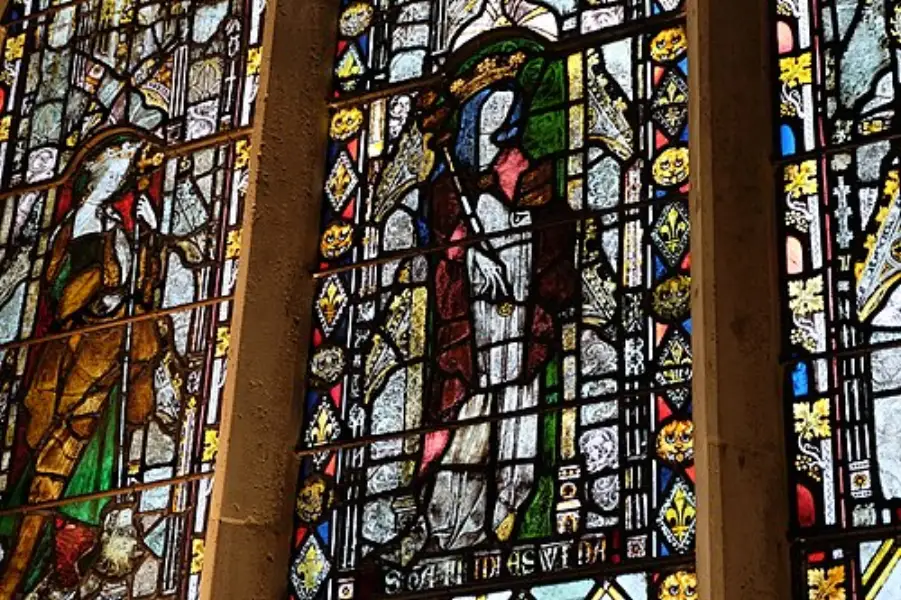
Few English saints remain so completely identified with a single place. Frithuswith is still the patron saint of Oxford and of its university, and a revived tradition of pilgrimage brings visitors to Christ Church, where her shrine stands in a chapel glazed with Edward Burne-Jones's Pre-Raphaelite glass. Her feasts mark the rhythm of her cult: 19 October, the day of her death; 12 February, the translation of her relics; and 15 May, the invention, or finding, of those relics. Her name lives in the city's geography in Frideswide Square and in its parish churches, and her story has reached modern literature, notably in Elizabeth Goudge's Oxford novel Towers in the Mist, which dwells on the strange afterlife of her mixed remains and the piety that gathered around them. An obscure Mercian abbess of the eighth century became, by accident of geography and the loyalty of a city, the heavenly citizen of one of the world's great seats of learning, the saint of scholars who never wrote a book, venerated for the vow she kept and the well she asked for.
§ In modern tradition
Timeline
- 19 Oct 727
Dies at Oxford as abbess of the monastery she founded.
§ Introduction
- 1002
Her abbey, by then an important landowner, is destroyed during the St. Brice's Day massacre.
§ The priory
- 1180
Archbishop Richard of Dover moves her relics to a newly built shrine in the monastery church, and King Henry II is present at the ceremony.
§ The priory
- 1440
Archbishop Henry Chichele officially declares her patron saint of Oxford and of the University of Oxford.
§ The priory
- 1546
The monastery church becomes the cathedral church of the diocese of Oxford, as it remains.
§ The priory
- 1558
Queen Mary reinstates her shrine, which the Calvinist canon James Calfhill then desecrates, mingling her remains with those of Catherine Dammartin.
§ The priory
The Record
- Major works
- Monastery at Oxford, later St Frideswide's Priory and now part of Christ Church Cathedral·Well at Binsey, which her Life says sprang up in answer to her prayer
- Patron of
- Oxford, England·University of Oxford
- Symbols
- pastoral staff·a fountain·the ox
- Canonization
- Pre-congregation; declared patron saint of Oxford and the University of Oxford by Archbishop Henry Chichele in 1440
Prayer
Bibliography
Show 6 sources
- Blair, John. "Frithuswith [St Frithuswith, Frideswide] (d. 727)." Oxford Dictionary of National Biography (online ed.). Oxford University Press.
- Blair, John (1987). "Saint Frideswide reconsidered." Oxoniensia 52: 71-127.
- Blair, John (1988). "St Frideswide's monastery: problems and possibilities." Oxoniensia 53: 221-258.
- Hunt, William (1889). "Frideswide." In Stephen, Leslie (ed.). Dictionary of National Biography, Vol. 20. London: Smith, Elder & Co.
- White, Carolinne, ed. (2024). "Two Twelfth-Century Lives of St Frideswide." The Cambridge Anthology of British Medieval Latin. Cambridge University Press.
- Kesselring, K. J. (2021). "The Case of Catherine Dammartin: Friends, Fellows, and the Survival of Celibacy in England's Protestant Universities." Renaissance and Reformation 44(1): 87-108.
Profile text adapted from the Wikipedia article, licensed CC BY-SA 4.0.
Pray with this saint every day
Save St. Frithuswith to your favorites, read the full profile, and get feast-day reminders in the Saints app.
Get the Saints AppFree on the App Store for iPhone and iPad