
died 259·Feast January 21
St. Fructuosus
Bishop and Martyr of Tarragona
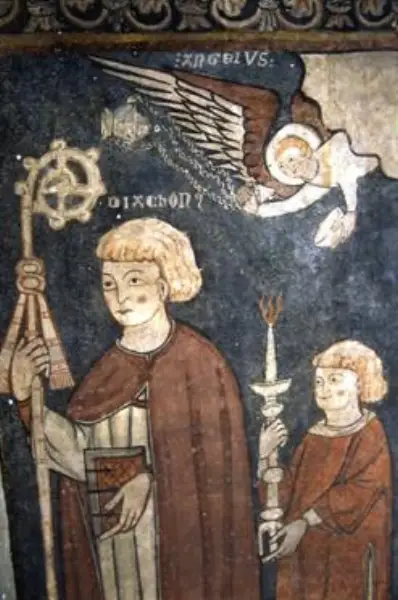
Overview
Fructuosus of Tarragona, San Fructuoso in Spanish and Sant Fructuos in Catalan, died in 259 as bishop and martyr, and his name stands at the head of the early history of Christianity in Hispania. Arrested during the persecution of the emperor Valerian, the praeses Aemilianus put him on trial with his two deacons, Augurius and Eulogius, and all three died by fire in the arena at Tarraco. The Acta of their martyrdom, the earliest such document from Spain, record a man of composure and fastidious faith: questioned whether he was still bishop, he answered simply, and received the chilling reply that he had been. Led to execution on a Friday morning he refused a drink that would have broken the day's fast. Near the amphitheatre gate he promised the Christians who pressed close that his heart held the entire Church, east and west alike, then died with his deacons, arms outstretched in prayer amid the flames. Prudentius sang of him, Augustine quoted him at length, and the episcopal list of Tarragona still begins with his name, the first shepherd the Spanish church can name.
The Complete Life
A Bishop and His Two Deacons
Christianity had been planted in Tarraco, the great port and military capital of Roman Hispania, long enough by the mid-third century for the city to have a bishop, and Fructuosus stands as the first name in its episcopal record. In 259 the persecution of the emperor Valerian reached the province, and the bishop was arrested together with his two deacons, Augurius and Eulogius; the sources preserve the homely detail that the three were just going to bed when the officers came. Brought to examination before the praeses Aemilianus, they affirmed their belief in the God of Christianity without qualification. The exchange that followed has become one of the most famous sentences in Spanish hagiography: asked 'Are you the bishop?', Fructuosus answered 'I am', and the magistrate replied 'Fuisti', 'You were', a bureaucrat's grammar of damnation that stripped him of his office in advance of the sentence. The sentence was death by fire. What the state intended as erasure became, instead, the founding document of the Spanish Church's memory of its own heroes, a text copied and sung for a thousand years.
§ Acta
The Friday of the Fast
The Acta record the martyrdom's last hours with a realism that later ages found deeply moving. Led out on a Friday at ten in the morning, wearied by imprisonment and in need of strength, Fructuosus refused a drink offered him, because the hour for breaking the day's fast had not yet come; Alban Butler, retelling the scene in the eighteenth century, saw in the refusal the discipline of a man who would not let even death interrupt his obedience. Officers were posted to prevent disturbance as the procession moved to the amphitheatre, but they were not entirely successful: near the gate some Christians managed to reach the bishop, and one asked for his prayers. His reply rang out over the crowd: his heart, he told them, held the entire Church, east and west alike, and he added words of consolation and encouragement to those assembled. Within the arena the flames rose and enveloped the three, who stretched out their arms in the ancient posture of prayer and so died, bishop and deacons together, in the amphitheatre of Tarraco. The Friday fast he would not break was the weekly discipline of the whole early Church, and his small refusal has made him, ever since, the particular friend of everyone who keeps one.
§ Acta
The Earliest Acta of Spain
The account of the bishop's trial and death is the earliest Hispanic Acta known, and its literary quality drew praise from the beginning: it is marked, in the judgment of scholars, by a realistic simplicity that contrasts favorably with many Acta of Diocletian's later persecution. The fourth-century poet Prudentius referred to the martyrdom in a hymn, and Augustine of Hippo both praised the text and quoted it extensively, carrying the Tarragona martyr into the universal Church's memory. From the earliest period the bishop's name opened the historical list of the see of Tarragona. His cult spread with the Christian calendar: his feast is kept on 21 January, and he is invoked as a patron of those undertaking a fast, an office earned on his last Friday morning. Across the Pyrenees his memory settled into the landscape too, at the abbey of San Fruttuoso on the Italian Riviera, dedicated in his honor. He is venerated in the Catholic, Orthodox, Lutheran, and Anglican traditions alike. His memory belongs to the whole of the peninsula, and it was from Tarragona's amphitheatre, more than from any other single place, that the Spanish Church learned to date its own beginnings.
§ Acta
Timeline
- 259
Seized at night in Tarragona along with his deacons Augurius and Eulogius amid the anti-Christian measures of Emperor Valerian.
§ Acta
- 259
Interrogated by the praeses Aemilianus, affirmed his belief in the Christian God, and was condemned to death by fire.
§ Acta
- 259
Put to death in the amphitheatre of Tarraco, dying in the flames with arms outstretched in prayer beside his two deacons.
§ Acta
In Their Own Words
I am bound to bear in mind the whole universal Church from east to west.
Fuisti
The Record
- Patron of
- those undertaking a fast
- Canonization
- Pre-congregation; honoured as a martyr by the Church from the earliest centuries of Spanish Christianity
Prayer
Bibliography
Show 3 sources
- Wace, Henry. A Dictionary of Christian Biography and Literature, s.v. "Fructuosus".
- Butler, Alban (1839). The Moveable Feasts, Fasts, and Other Annual Observances of the Catholic Church. James Duffy, p. 155.
- Attwater, Donald, and Catherine Rachel John. The Penguin Dictionary of Saints, 3rd edition. New York: Penguin Books, 1993. ISBN 0-14-051312-4.
Profile text adapted from the Wikipedia article, licensed CC BY-SA 4.0.
Pray with this saint every day
Save St. Fructuosus to your favorites, read the full profile, and get feast-day reminders in the Saints app.
Get the Saints AppFree on the App Store for iPhone and iPad