
c. 600 - 665·Feast April 16
St. Fructuosus of Braga
Monastic Founder, Bishop of Dumio and Archbishop of Braga
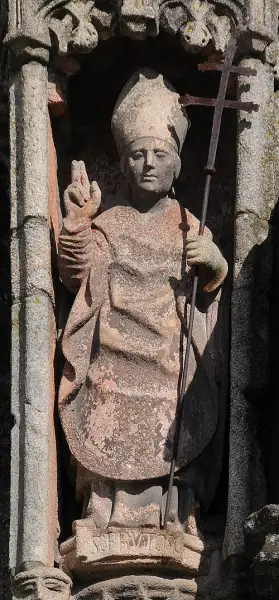
Overview
Fructuosus of Braga, born around 600 and dead on 16 April 665, was the son of a Visigothic dux of the Bierzo region who abandoned the career his birth promised him for the monastic life, and became the greatest founder of monasteries in seventh-century Iberia. Instructed first by the bishop of Palencia and then formed as a hermit in a Galician desert, he gathered pupils so numerous that the monastery of Complutum arose around them, and in time nine other houses followed, among them a nunnery under the abbess Benedicta and foundations as far south as Baetica and the island of Cadiz. His rule at Compludo was famously severe. Promoted to the episcopate, he succeeded Riccimer as bishop of Dumio in 654, defended political prisoners before two kings, planned a forbidden voyage to the Levant, and received the archdiocese of Braga in 656. He dressed so poorly that he was once mistaken for a slave and beaten by a peasant. His anonymous Vita is one of the chief sources for the history of the Visigothic kingdom, and his relics, carried to Compostela in 1102, returned to Braga in 1966.
The Complete Life
A Governor's Son of the Bierzo
Fructuosus was born around the year 600 into the military aristocracy of the Visigothic kingdom: his father was a dux, a duke in the old Roman-Visigothic sense, holding command in the mountainous Bierzo region of the northwest. As a boy he accompanied his father on official journeys across the family's estates, an education in administration and in the hard country of northern Iberia that would shape the rest of his life. The death of his parents released him from the succession such a birth implied. His first step was intellectual and spiritual rather than eremitical: he sought out the Bishop of Palencia for instruction, submitting his considerable talents to a master in another part of the peninsula. Only after that formation did he withdraw to the desert of Galicia as a hermit. The sequence, aristocratic upbringing, formal theological training, then ascetic flight, was the classic itinerary of Iberian holiness, and in Fructuosus it produced a man equally at home before a council of bishops, in a king's audience chamber, and in the silence of a cell he had built himself.
§ Life
The Desert That Filled with Disciples
The hermit's plan failed in the most fruitful way possible: the disciples came. Pupils collected about Fructuosus until, almost unbidden, the monastery of Complutum rose in the El Bierzo country around the teacher who had wanted only solitude. He presided over the house at first himself, then appointed an abbot and retired once more into the desert, a pattern of founding and withdrawal that he would repeat for the rest of his life. In the course of time he established nine further monasteries, among them a house for women under the abbess Benedicta. Some stood in Gallaecia, the old Roman province of the northwest; others he pushed farther south into the peninsula, though the identification of several sites remains uncertain. He founded the monastery of Rufiana, the Monasterium Rufianense, in El Bierzo, and houses known as Visoniense and Peonense, which scholars have speculated may correspond to San Pedro de Montes, San Fiz de Visona, and San Juan de Poyo. In far Baetica he established a monastery on the Island of Cadiz and a nunnery called Nono, nine miles from the sea.
§ Abbot
The Severe Rule of Compludo
The monastery at Compludo became known, and feared, for the unusual severity of its Rule. Under Fructuosus's discipline monks were required to reveal to their superiors every thought, vision, and dream that visited them; they were subjected to inspections at bedtime throughout the night; they were forbidden even to look at one another. Punishments matched the rigor of the observance: the lash, and confinement inside the house on rations of six ounces of daily bread, served for three months or stretched to six. Modern readers recoil at such a system, but it belonged to a penitential culture that believed the unexamined soul was lost, and that community life required a transparency almost military in its completeness. Against this severity must be set the other side of the founder's character: the man who demanded such nakedness of soul from his monks pleaded with two Visigothic kings for the bodily freedom of political prisoners, and wrote to Recceswinth at least twice on their behalf. Rigor toward himself and his disciples, mercy toward the captives of others: both were Fructuosus.
§ Abbot
Councils, Prison, and the See of Braga
Fructuosus's relations with the kings of his time were never easy. At the Eighth Council of Toledo in 653, which he attended in place of Bishop Riccimer of Dumio, he raised again the cause of the political prisoners languishing from Chintila's reign, some of whom remained confined into the reign of Erwig. On Riccimer's death in 654 he succeeded to the see of Dumio. In 656 he planned a voyage to the Levant, monastic pilgrimage to the Holy Land; but the new laws of King Chindasvinth forbade leaving the kingdom without royal permission, and one of the few disciples entrusted with the secret betrayed him. He was arrested and imprisoned. That December he attended the Tenth Council of Toledo, which voided the dead Riccimer's will, judged that its manumissions and distributions had impoverished the see, and charged Fructuosus to correct the damage with moderation toward the enslaved. At the same council Archbishop Potamius of Braga, convicted of a licentious life, was sent to a monastery, and on the first of December 656 Fructuosus received his archdiocese, wearing it, characteristically, in the dress of a poor monk.
§ Bishop
A Vita, a Stag, and Returned Bones
The chroniclers tell one last story of his poverty: Fructuosus dressed so poorly that he was once mistaken for a slave, and a peasant beat him, from which he was delivered only by a miracle. His Vita, written by an anonymous monastic disciple, from the sixteenth century until the mid-twentieth wrongly ascribed to Valerio of Bierzo, is counted among the chief sources for the history of the Visigothic age. He died at Braga on 16 April 665, and his feast is kept on that day. His relics rested for a time in the Cathedral of Braga, were carried off to the great shrine of Santiago de Compostela in 1102, and were returned to Braga in 1966, a small homecoming after eight and a half centuries, and a quiet vindication of a city's loyalty to its own bishop. In art he is depicted as a monk attended by a stag, a creature that, so the story runs, clung to him after he rescued it from huntsmen, the hunter of the fable turned protector. Venerated by Catholics and Eastern Orthodox alike, he remains the great monastic saint of Portugal's oldest archdiocese.
§ Bishop
Timeline
- 600
Born around this year in the Visigothic Kingdom, son of a dux in the Bierzo region, whom he accompanied as a boy.
§ Introduction
- 652
Writes a second letter to King Recceswinth pleading for the release of political prisoners held since the reign of King Chintila.
§ Bishop
- 653
Attends the Eighth Council of Toledo in place of Bishop Riccimer of Dumio and raises the cause of the political prisoners again.
§ Bishop
- 654
Succeeds Riccimer as Bishop of Dumio.
§ Bishop
- 656
Arrested and imprisoned after a disciple betrays his plan to sail for the Levant without royal permission, forbidden by the new laws of King Chindasvinth.
§ Bishop
- 1 Dec 656
At the Tenth Council of Toledo he receives the archdiocese of Braga, vacated when Archbishop Potamius is remanded to a monastery for licentiousness.
§ Bishop
- 16 Apr 665
Dies at Braga, aged about sixty-five.
§ Bishop
- 1102
His relics are transferred from the Cathedral of Braga to the Shrine of Santiago de Compostela.
§ Bishop
- 1966
The relics are returned from Compostela to their original place in the Cathedral of Braga.
§ Bishop
The Record
- Major works
- Monastery of Complutum (Compludo) in El Bierzo·The unusually severe Rule of the monastery of Compludo·Monastery of Rufiana (Monasterium Rufianense) in El Bierzo·Monasteries of Visoniense and Peonense·Monastery on the Island of Cadiz and the nunnery of Nono in Baetica·Letters to King Recceswinth on behalf of political prisoners
- Symbols
- Monk with a stag
- Canonization
- Pre-congregation; venerated as a confessor from earliest times, with a feast on 16 April
Prayer
Bibliography
Show 7 sources
- Meier, Gabriel. "St. Fructuosus of Braga." The Catholic Encyclopedia, Vol. 6. New York: Robert Appleton Company, 1909.
- Butler, Alban. "Saint Fructuosus, Archbishop of Braga, Confessor." Lives of the Fathers, Martyrs, and Principal Saints, 1866.
- Collins, Roger. Early Medieval Spain. New York: St Martin's Press, 1995, p. 84.
- Collins, Roger. Visigothic Spain, 409-711. Wiley-Blackwell Publishing, 2004, p. 170.
- von Hefele, Karl Joseph (1895). A History of the Councils of the Church: From the Original Documents, Vol. IV. Edinburgh: T. & T. Clark, pp. 474-475.
- Thompson, E. A. The Goths in Spain. Clarendon Press: Oxford, 1969.
- Iberian Fathers. Writings of Braulio of Saragossa, Fructuosus of Braga, translated by Claude W. Barlow. Catholic University of America Press, 1969.
Profile text adapted from the Wikipedia article, licensed CC BY-SA 4.0.
Pray with this saint every day
Save St. Fructuosus of Braga to your favorites, read the full profile, and get feast-day reminders in the Saints app.
Get the Saints AppFree on the App Store for iPhone and iPad