
c. 642 – 715·Feast October 25
St. Fructus
Hermit of the Duratón Gorges and Patron of Segovia
Overview
Fructus, in Spanish San Frutos, Frutos, Fructos, or Fruitos, belonged to the eremitical movement of eighth-century Castile; he came into the world about the year 642, the child of a distinguished Segovian house. After the death of his parents he and his two siblings, Valentine and Engratia, sold the family possessions and distributed the proceeds to the poor, then withdrew from the turbulence of the age to the rocky country near Sepúlveda, today known as the Hoces del Duratón. There each settled in a separate cave, pursuing solitude and prayer within reach of one another. Tradition relates that Valentine and Engratia suffered martyrdom around 715 at the hands of advancing Moorish forces, while Fructus closed his seventy-three years with a peaceful death in that same year. A celebrated legend tells how he protected villagers fleeing the Moors, drawing a line in the earth that swallowed the soldiers who crossed it, at the rock fissure called La Cuchillada. The three siblings are venerated together as patrons of Segovia, where their relics were translated in the eleventh century and rest enshrined in the cathedral. Their feast is kept on 25 October, marked in Segovia by the Eve procession known as the Paso de la Hoja.
The Complete Life
A Noble House of Segovia
Fructus was born in the seventh century, around the year 642, into a noble family of Segovia, the old Castilian city crowned by its Roman aqueduct. With him in the family were two siblings who would share his path entirely: a brother named Valentine and a sister named Engratia, whose name must not be confused with that of the fourth-century Portuguese martyr Engratia of a much earlier generation. The family was prosperous and well placed, and the children grew up amid the possessions and standing that nobility conferred. But the Spain of their maturity was disintegrating around them: the Visigothic kingdom was collapsing, and the turbulent times that followed weighed on thoughtful Christians across the plateau. When their parents died, the three siblings made a decision that renounced their inheritance in the most literal sense. They sold the family possessions, gave the proceeds to the poor, and freed themselves from both property and city. In doing so they chose the pattern that Christian monasticism had pioneered in the East and the West alike, the total divestment that leaves a disciple nothing to defend and everything to seek. Segovia would remember them as its greatest children.
§ Saint Fructus
Caves Above the Duratón
Seeking escape from the city and the disorders of the age, the three siblings established themselves in the rocky terrain near the village of Sepúlveda, the dramatic country of river gorges now known as the Hoces del Duratón. There they lived not as a small community under one roof but deliberately apart, each occupying a separate cave that guaranteed complete solitude. The arrangement expressed a precise understanding of the eremitical vocation: they were companions in renunciation but solitary in prayer, near enough to one another for mutual support, far enough for the silence in which they sought God. The site they chose was severe, limestone cliffs dropping to the bending river, a landscape that sheltered them and tested them at once. From these caves the name of Fructus passed into the geography and devotion of Castile: the hermitage of San Frutos that grew at the place of his retreat still stands on the promontory above the gorge, and the surrounding park remains a place of pilgrimage. In choosing the wilderness above Sepúlveda, the three siblings planted a memory that outlasted the kingdom that was falling around their youth.
§ Saint Fructus
The Line That Could Not Be Crossed
The most beloved story of Fructus belongs to the years of the Moorish advance. Some locals, wishing to join the hermit in his retreat toward the end of his life, travelled to his hermitage, with Moorish troops hard on their heels all the way to the hermit's threshold. Fructus's first response was to preach conversion to the Muslim soldiers; they would not listen. He then drew a line across the earth and asked that the troops not cross it. They ignored the plea and moved to cross, and the ground miraculously opened to swallow them, leaving the fissure in the rock that is still called La Cuchillada. From that moment, the legend says, the Moors no longer troubled Fructus. Whatever form the episode originally took, the story expresses the conviction of the people of the frontier that their hermit was their shield: the man who had renounced all property spent his solitude defending those who had none of his holiness to protect them. The narrative joins the two halves of his life, the contemplative silence of the caves and the protection of neighbours at the moment of invasion, and it fixed his local identity as the protector of the Segovians, the role in which his devotion has flourished ever since.
§ Legends
The Deaths of the Three Siblings
Tradition holds that the era of Moorish incursions claimed two of the three siblings as martyrs. Valentine and Engratia were killed around the year 715 by the advancing forces, sealing their renunciation with blood, though the circumstances of their passion are not recorded. Fructus himself died in the same year, but of natural causes, at the age of seventy-three, having reached an old age extraordinary for the century of his birth. His relics, together with those of his brother and sister, were conserved at the hermitage of San Frutos from the eighth century onward, a shrine in the wilderness that outlasted the political storms of the frontier. The region around the hermitage passed through repeated conquest: seized by Fernán González, annexed by Al-Mansur Ibn Abi Aamir in 984, recovered for Christendom by Sancho García of Castile in 1011, and repopulated by Alfonso VI in 1076, by which decade the Benedictines had built a church in Fructus's honour with an adjoining monastery. In the eleventh century the relics were finally translated from the gorge to Segovia Cathedral, where they remain enshrined.
§ Veneration
Patron of Segovia
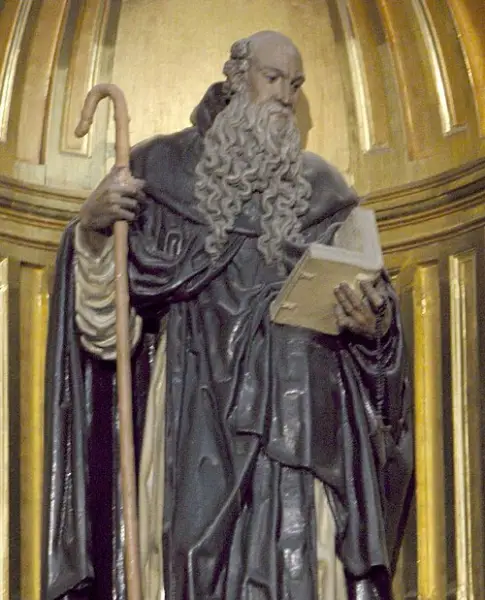
Fructus, Valentine, and Engratia share the patronage of Segovia, whose cathedral keeps their relics enshrined, and they are honoured both in the Roman Catholic Church and by Western Rite Orthodox communities, their common feast falling on 25 October. The celebration in the city is distinctive: on the night of 24 October a procession known as the Paso de la Hoja, the 'Turn of the Page', winds through the streets in his honour. The feast itself is kept with music and contests, and the faithful also celebrate it at the park of the Hoces del Río Duratón, accompanying a statue of the saint through the landscape of his retreat. In the cathedral a sculpture of Fructus occupies a niche, showing him holding a book. Local legend identifies it as the 'Book of Life': when the saint turns to its last page, the world will end. The legend gives his vigil over the city an eschatological depth, the hermit of the Duratón standing as keeper of history's final boundary, just as in life he drew the line the invaders could not cross.
§ Veneration
Timeline
- 642
Born around this year into a noble family of Segovia
§ Saint Fructus
- 715
His siblings Valentine and Engratia were martyred around this year, according to tradition, by advancing Moorish forces
§ Saint Fructus
- 715
Breathed his last peacefully that same year, having lived seventy-three years
§ Saint Fructus
- 984
The region of his hermitage, earlier conquered by Fernán González, was annexed by Al-Mansur Ibn Abi Aamir
§ Veneration
- 1011
The area returned to Christian control through the efforts of Sancho García of Castile
§ Veneration
- 1076
The district was repopulated under Alfonso VI of Castile, and by the 1070s the Benedictines had raised a church and monastery in his honour there
§ Veneration
The Record
- Major works
- Hermitage of San Frutos in the Hoces del Duratón
- Patron of
- Patron saint of Segovia
- Symbols
- Book (the 'Book of Life' of local legend, held in the cathedral sculpture)
- Canonization
- Pre-congregation; venerated as a saint by the Catholic Church and the Eastern Orthodox Church
Prayer
Bibliography
Show 3 sources
- Patron Saints Index: Saint Fructos
- San Frutos, protector de los segovianos
- Asociación Cultural Villaseca (PORTAL)
Profile text adapted from the Wikipedia article, licensed CC BY-SA 4.0.
Pray with this saint every day
Save St. Fructus to your favorites, read the full profile, and get feast-day reminders in the Saints app.
Get the Saints AppFree on the App Store for iPhone and iPad