
died c. 383·Feast December 27 (Ethiopian and Eritrean Orthodox); also July 20 (Catholic), November 30 (Eastern Orthodox), December 18 (Coptic Orthodox)
St. Frumentius
Apostle of Ethiopia and First Bishop of Axum
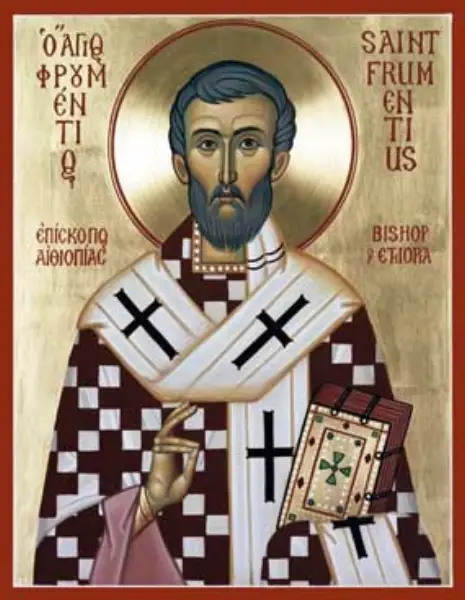
Overview
Frumentius, remembered in Ethiopia as Abuna, 'Our Father', and Aba Selama, 'Father of Peace', was a Phoenician from Tyre who became the first bishop of Axum and brought Christianity to the Kingdom of Aksum. As a boy, around 316, he sailed with his brother Edesius in the retinue of their kinsman Meropius; when the ship's crew was massacred at a Red Sea harbor, the two boys alone were spared and carried off as slaves to the king of Axum. Their ability raised them to confidential office, and when the dying king freed them, the widowed queen begged them to stay and help rear the young heir Ezana. Frumentius used his position to plant the faith, encouraging Christian merchants to worship openly and converting some of the people. He then traveled to Alexandria, where Patriarch Athanasius, judging him the man the mission needed, consecrated him bishop, traditionally in 328. Returning to Ethiopia, he established his see at Axum, baptized King Ezana, founded the country's first monastery, and in about 356 withstood an imperial demand for his replacement, dying there around 383.
The Complete Life
A Voyage from Tyre
Frumentius was a native of Phoenicia, born at Tyre on the Lebanese coast, a city that lived by its merchants and the ships they sent out. While still children, he and his brother Edesius accompanied their uncle or kinsman Meropius, a philosopher of Tyre, on a voyage toward 'India', the vague geography of the ancient Red Sea trade. On the return journey the ship put in at one of the harbors along the Red Sea coast, and there disaster struck: the local people massacred the entire crew, sparing only the two boys. Captives rather than corpses, the brothers were taken inland and presented as slaves to the King of Axum. The fourth-century historian Tyrannius Rufinus preserves the whole narrative, citing Edesius himself as his authority, which gives the story an unusual documentary pedigree for a saint's Life. From the wreck of a merchant voyage, one of antiquity's commonest tragedies, came the improbable chain of events that would carry the Gospel over the mountains of Ethiopia and bind two churches, Alexandrian and Ethiopian, together for the next sixteen centuries. The boys were nephews of the traveler, members of his own household, and their kidnapping reduced a respectable Tyrian family to grief and the Axumite court to an unexpected acquisition of two educated children.
§ Biography
Slaves Raised to the King's Right Hand
Captivity at the Axumite court proved, strangely, a promotion. The brothers' talents were recognized and trusted: Edesius was made cupbearer to the king, and Frumentius his secretary and treasurer, offices of confidence at the very center of the kingdom. Shortly before his death the king freed both captives, giving them leave to go where they would. The widowed queen begged them not to leave, asking them to share in raising the young heir Ezana and to lend their hands to the government of the kingdom during the prince's minority. Two enslaved foreigners had become, in practice, regents of Axum. Two enslaved foreigners thus became regents in all but name for the king of Axum. Frumentius used the position for missionary work with deliberate patience: his first care was for the Christian traders living in the land, whom he urged to worship openly, and for whom he found spots where they could assemble for prayer according to the Roman Rite; only afterward did he turn to winning the people of the country itself. The seed sown in the schoolroom of a prince would soon flower in the king himself.
§ Biography
To Alexandria and Back as Bishop
When Ezana came of age, Edesius went home to Tyre, where he was ordained a priest; Frumentius went only as far as Alexandria, carrying the conversion of Ethiopia on his shoulders. He found Athanasius, the great patriarch of Alexandria, and laid the request before him: send a bishop and missionary priests to Axum. Athanasius's own account records his conclusion that no one was better suited to the task than the petitioner himself, and he consecrated Frumentius bishop, traditionally in the year 328, though other datings put the event between 340 and 346. Back in Ethiopia Frumentius erected his episcopal see at Axum and baptized King Ezana, who raised churches across the land and carried the faith to every corner of his kingdom. The conversion of a royal house had become, in a single generation, the conversion of a nation. Frumentius founded the first monastery of Ethiopia, Dabba Selama in Dogu'a Tembien, and became the first Abuna, the title of the head of the Ethiopian Church. The appointment began the enduring tradition that the Patriarch of Alexandria appoints the bishops of Ethiopia.
§ Biography
Revealer of Light, Father of Peace
The church Frumentius planted survived its first political test. Around 356 the emperor Constantius II, an Arian, wrote to King Ezana and his brother Saizana demanding that Frumentius be replaced by Theophilos the Indian, a bishop of the emperor's own sympathies; Athanasius, the great opponent of Arianism, had ordained the man, and the emperor wanted the appointment undone. The king refused the request, and the Ethiopian Church kept its first bishop, the man whom Alexandria had chosen and whom no emperor could recall. Ethiopian tradition credits Frumentius with the first Ge'ez rendering of the New Testament and a hand in developing the Ge'ez script from a purely consonantal abjad into a syllabic abugida, the writing system of the whole literary civilization that followed. The people gave him the names Kesate Birhan, 'Revealer of Light', and Abba Salama, 'Father of Peace'. He died around 383. The Ethiopian and Eritrean churches keep his feast on 18 Tahsas and 26 Hamle of their own calendar; the Coptic church on 18 December, the Eastern Orthodox on 30 November, and the Catholic Church on 20 July.
§ Feast date
Timeline
- 316
As a boy, captured with his brother Edesius when the crew of Meropius' ship is massacred at a Red Sea harbor; both are enslaved to the King of Axum.
§ Biography
- 328
Consecrated bishop by Patriarch Athanasius of Alexandria (other accounts date the consecration between 340 and 346).
§ Biography
- 356
Emperor Constantius II writes demanding his replacement by the Arian Theophilos the Indian; King Ezana refuses the request.
§ Biography
- 383
Dies in the Kingdom of Aksum, honored as Kesate Birhan, Revealer of Light, and Abba Salama, Father of Peace.
§ Introduction
The Record
- Major works
- Episcopal see established at Axum·Monastery of Dabba Selama in Dogu'a Tembien, the first monastery of Ethiopia·First Ge'ez translation of the New Testament (by Ethiopian tradition)·Development of the Ge'ez script from abjad into an abugida (by Ethiopian tradition)
- Patron of
- Kingdom of Aksum and its contemporary territories·St Frumentius Theological College in Ethiopia
- Canonization
- Pre-congregation; venerated by the Oriental Orthodox, Eastern Orthodox, Catholic, and Anglican churches
Prayer
Bibliography
Show 6 sources
- Adejumobi, Saheed A. (2007). The History of Ethiopia. Greenwood Publishing Group, p. 171. ISBN 978-0-313-32273-0.
- Butler, Alban; Burns, Paul (1995). Butler's Lives of the Saints. A&C Black, p. 191. ISBN 0-86012-259-X.
- Chisholm, Hugh, ed. (1911). "Frumentius." Encyclopaedia Britannica, Vol. 11 (11th ed.). Cambridge University Press, p. 270.
- Mullen, Roderic L. (2004). The Expansion of Christianity: A Gazetteer of Its First Three Centuries. Brill, p. 331. ISBN 978-90-47-40232-9.
- Munro-Hay, Stuart (2002). Ethiopia, the Unknown Land. IB Tauris, p. 20.
- Villa, Massimo (2017). "Frumentius in the Ethiopic sources: Mythopoeia and text-critical considerations." Rassegna di Studi Etiopici 1(3): 87-111.
Profile text adapted from the Wikipedia article, licensed CC BY-SA 4.0.
Pray with this saint every day
Save St. Frumentius to your favorites, read the full profile, and get feast-day reminders in the Saints app.
Get the Saints AppFree on the App Store for iPhone and iPad