
c. 960 – 10 April 1028·Feast April 10
St. Fulbert of Chartres
Bishop, teacher, and promoter of Mary's Nativity
Overview
Fulbert of Chartres led the see of Chartres from 1006 until his death in 1028 and taught in its cathedral school. Born of humble stock, probably in northern France at some point between 952 and 970, he studied at Rheims in the 980s, where the future king Robert II the Pious numbered among his fellow students, and he may have been formed by Gerbert of Aurillac, the scholar who became Pope Sylvester II. By the mid-990s he had joined the cathedral school at Chartres as schoolmaster or assistant, taking on minor ecclesiastical duties without ever becoming a monk. He was made a deacon in 1004 and raised to the episcopate two years later. His letters, sermons, hymns, and roughly two dozen poems made him one of the notable churchmen of his generation, and his promotion of the feast of Mary's Nativity on September 8 helped spread devotion to the Virgin across Europe. When fire destroyed the cathedral in 1020 he labored to raise funds for its reconstruction. He died on 10 April 1028. Rome never formally canonized him, yet allowed Chartres and Poitiers to keep his feast, and his name entered the Martyrologium Romanum of 2004.
The Complete Life
Humble Origins and a Rheims Education
Nothing certain can be established about when or where Fulbert first saw the light of day. Students of his career have proposed birth years ranging from 952 to 970, and while most authorities point to northern France, perhaps the region of Picardy, a minority tradition prefers a town in the north of Italy. On one point the sources harmonize: he came into the world of modest condition, without rank or wealth to recommend him. Whatever his origins, his talents carried him to the cathedral school of Rheims in the 980s, then among the foremost centers of learning in the Latin West. There his companions included the future Robert II, called the Pious, who would reign over the Franks as king. Tradition also claims Gerbert of Aurillac, the most celebrated scholar of the age and the future Pope Sylvester II, as Fulbert's master, though this discipleship has been contested and cannot be regarded as settled. From Rheims Fulbert absorbed the classical and theological curriculum that would sustain a lifetime of teaching. In the early to mid-990s he appeared at Chartres, where his role is described variously as that of schoolmaster or of assistant, and he accepted minor offices in the cathedral while remaining outside monastic life.
§ Life
From Deacon to Bishop of Chartres
Fulbert's advance through the orders of the Church followed the rhythm of the cathedral rather than the cloister. He took up residence at Chartres in the course of the 990s, instructing students and discharging small ecclesiastical responsibilities, yet he never received the monastic habit. In 1004 he was numbered among the deacons, and two years later, in 1006, the succession of the see brought him to its head as Bishop of Chartres. He would govern that diocese until the end of his life, a period of more than twenty years during which the school of Chartres flourished under his care. Contemporaries were struck by his character, describing him as possessing a saintly nature, and that description was repeated by those who came after him. His reputation for holiness outlived him and gave rise to an unusual liturgical situation: although the Church never placed him on the canon of saints through formal canonization, the Apostolic See granted the dioceses of Chartres and Poitiers permission to celebrate his memory each year on 10 April, the day of his death. The Roman Martyrology revised in 2004 accordingly records him on that date, and the Eastern churches likewise honor him.
§ Life
Champion of the Feast of Mary's Nativity
The turning of the millennium stirred dread of the world's end among Christians, and Fulbert met that fear with a pastoral strategy centered on the Virgin. Chartres already possessed a treasured relic of her, the Sancta Camisia, the holy tunic said to have been worn by Mary either at the Annunciation or at the birth of Christ; an earlier bishop, Gauscelinus, had borne it against the Norman invaders in 911. Fulbert built upon this inheritance, elaborating the theme of Mary's miracles, above all those in which she stood between sinners and the judgment of God, so that the faithful might commend themselves to her intercession as the apocalypse seemed to draw near. He himself claimed a place in this treasury of wonders, for when grave illness brought him to death's door, Mary was said to have restored him with a drop of milk in reward for his devotion. His culminating aim was the establishment of a special feast in honor of her Nativity. To win the people to it he composed the sermon Approbate Consuetudinis, marshaling her miracles and her lineage from King David, expounded through the symbolism of the Tree of Jesse. The sermon, its chants, and its variants shaped liturgical practice across Europe for centuries.
§ Theological contributions
Rebuilding the House of Mary
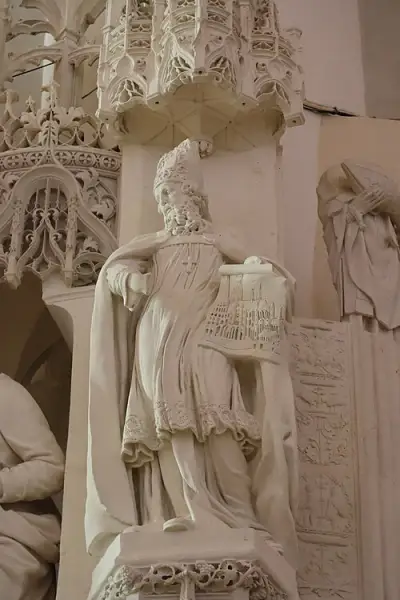
In 1020 disaster struck the heart of Fulbert's diocese: fire reduced the cathedral of Chartres to ruin. The bishop, already advanced in years, devoted the strength that remained to him to the work of restoration, traveling and corresponding to gather the funds the project demanded. He did not live to see the walls raised, for the rebuilding reached completion only in 1037, nine years beyond his death. The church he sponsored endured until 1194, when another blaze left little standing besides the crypt, part of the west facade, and two towers; the crypt he had built was retained in every subsequent reconstruction, and upon that ground rose the Gothic cathedral admired today. Fulbert's fingerprints remain legible in that great building, for the program he championed shaped its imagery. The sculpture surrounding the three portals unfolds the life of Mary, who stands at the center of the Royal Portal, and among the stained glass windows one displays the Tree of Jesse, tracing her descent and that of the Holy Family in direct echo of his teaching on the feast of her Nativity. The bishop who preached her birth thus received, in stone and glass, a lasting monument.
§ Architectural contributions
Seeds of the Gregorian Reform
Beyond his Marian devotion, Fulbert exercised a quieter but profound influence on the history of the Church: ideas that would flower in the Gregorian reform of the eleventh century took root in his circle at Chartres. The age permitted secular rulers to fill vacant abbeys and bishoprics at pleasure, and Fulbert, together with students such as Abbot Albert of Marmoutier, insisted in their writings that the right of election belonged to the clergy and people of the diocese concerned. They grounded this claim in the decrees of the First Council of Nicaea in 325 and of the Council of Antioch. The same current of thought held that the discipline of clergy belonged to the Church rather than the state, and it condemned simony, the purchase of ecclesiastical office, together with the immoral lives of unworthy clerics. When Pope Gregory VII promulgated the reforms bearing his name, several of their governing ideas had already been articulated by Fulbert and disseminated by the pupils he had trained. His letters, the bulk of his authenticated writings, circulated widely and illuminate the age, ranging from the famous statement of feudal obligations addressed to Duke William V of Aquitaine to correspondence on episcopal appointment, excommunication, obedience, and the small courtesies of daily life.
§ Ecclesiastical reform
Timeline
- 911
His bishop predecessor Gauscelinus wielded the Sancta Camisia relic of Mary to ward off invading Normans.
§ Theological contributions
- 980
Placed by several sources at the cathedral school of Rheims in the 980s, a fellow student of the future King Robert II.
§ Life
- 990
Arrived in the early to mid-990s at the cathedral school of Chartres as schoolmaster or assistant.
§ Life
- 1004
Ordained a deacon while serving in the cathedral community of Chartres
§ Life
- 1006
Appointed Bishop of Chartres, an office he would hold for over two decades
§ Life
- 1020
Chartres Cathedral burned, and he threw his energies into fundraising for its rebuilding
§ Architectural contributions
- 10 Apr 1028
Died at Chartres on 10 April, the year disputed as 1028 or 1029, with most sources settling on 1028
§ Life
- 1037
The reconstruction he had set in motion was finished, nine years after his passing
§ Architectural contributions
- 1194
Fire left the cathedral almost entirely in ruins; Fulbert's crypt was carried forward into the Gothic building
§ Architectural contributions
- 2004
His feast on 10 April was included in the Martyrologium Romanum edition of 2004.
§ Life
In Their Own Words
You, a child of poor parents, Christ took up to raise as his own; and undeserving as you were, he so nourished and blessed you that the world marvels at the gifts he bestowed. For he saw to it that as a boy you had understanding masters; and while you were still in your prime, he raised you to the episcopate. Kings, bishops, and people have praised you, as a wise and faithful servant of the Lord, who rightly favoured you. But alas, that you have sinned by being unwise and unfaithful is plain to see. For it is shameful to remember how badly you have offended him and his saints, who have seen your wicked ways; and however harsh the penance you undertake, it is hardly enough to make amends. Yet the Lord still waits in his loving-kindness and lets you go on living, so that if you should come to your senses, you may atone for your negligence by zeal, your guilt by good works.
The Record
- Major works
- Letters to Duke William V of Aquitaine on the duties of feudal lord and vassal·Sermon Approbate Consuetudinis on the feast of Mary's Nativity·Hymn Chorus Novae Jerusalem for Easter·About twenty-four poems, including an ode to the nightingale·Hymns composed in honor of the Virgin Mary
- Canonization
- Never formally canonized; Rome permitted the dioceses of Chartres and Poitiers to celebrate his feast on 10 April
Prayer
Bibliography
Show 5 sources
- Behrends, Frederick, ed. (1976). The Letters and Poems of Fulbert of Chartres. Oxford: The Clarendon Press.
- Fassler, Margot (2000). "Mary's Nativity, Fulbert of Chartres, and the Stirps Jesse: Liturgical Innovation Circa 1000 and its Afterlife". Speculum. 75: 389–434.
- Mac Kinney, Loren C. (1957). Bishop Fulbert and Education at The School of Chartres. Notre Dame: The Mediaeval Institute University of Notre Dame.
- Ott, Michael (1909). "Fulbert of Chartres". The Catholic Encyclopedia. Vol. 6. New York: Robert Appleton.
- Ziezulewicz, William (1991). "The School of Chartres and Reform Influences Before the Pontificate of Leo IX". The Catholic Historical Review. 77: 383–402.
Profile text adapted from the Wikipedia article, licensed CC BY-SA 4.0.
Pray with this saint every day
Save St. Fulbert of Chartres to your favorites, read the full profile, and get feast-day reminders in the Saints app.
Get the Saints AppFree on the App Store for iPhone and iPad