
died 13 February 1006·Feast February 13
St. Fulcran
Bishop of Lodève and builder of churches
Overview
Fulcran served as bishop of Lodève in the south of France for more than half a century, from his consecration in 949 until his death on 13 February 1006. According to the account left by Bernard Guidonis, a later bishop of the same see who died in 1331, Fulcran belonged to a distinguished family and gave himself to the service of the Church while still young, becoming a priest and leading from his youth a pure and holy life. When Bishop Theoderich died in 949, Fulcran was chosen to succeed him despite his own reluctance, and the Archbishop of Narbonne consecrated him on 4 February of that year. As bishop he labored tirelessly to uphold the moral life of his diocese, watching over its clergy and religious communities in particular. He rebuilt numerous churches and monasteries, among them the cathedral of Lodève, originally dedicated to Saint Genesius of Arles and later placed under his own patronage, and the church of the Holy Saviour with its attached Benedictine monastery. The poor and the sick held the first place in his charity, and he founded hospitals and enriched those already standing. After his death he was buried in the cathedral and immediately honored as a saint.
The Complete Life
A Youth Consecrated to God
Almost everything known of Fulcran's beginnings comes through the biography written by Bernard Guidonis, himself a bishop of Lodève, who died in 1331 and thus wrote nearly three centuries after his predecessor. According to this account, Fulcran issued from a family of standing and distinction in the region. What set him apart, however, was not his lineage but the precocity of his dedication: while still a boy or young man he consecrated himself to the service of the Church. He advanced to the priesthood and, in the words of his chronicler, led from his earliest years a life of purity and holiness that marked him out among his contemporaries. No details survive of his education, his ordination, or the parishes and duties he may have held before episcopal office found him. The silence of the sources nevertheless underlines the pattern the biographer wished to impress upon his readers: a man whose whole adult life was shaped by religious purpose long before any dignity was conferred upon him. When God's call came through the voice of the Church, it would find him already prepared, though not without resistance on his part.
§ Life
An Unwilling Bishop Made Willing
In 949 the see of Lodève fell vacant with the death of its bishop, Theoderich. The choice of the clergy and people settled on Fulcran, yet the sources record that he accepted the dignity not gladly but in spite of his own unwillingness, a reluctance that itself testifies to his humility. Whatever his inner resistance, obedience prevailed, and on 4 February of that same year the Archbishop of Narbonne consecrated him as Bishop of Lodève. The ceremony bound him to a diocese he would serve with extraordinary constancy, for his episcopate stretched across more than half a century, until his death in 1006. Few bishops of the tenth century governed a single church for so long. The length of his tenure gave his pastoral ideals time to take root: generation after generation of clergy, monks, and laypeople came to maturity under a shepherd who had been formed in holiness from his youth. The account of his consecration also situates Lodève within the ecclesiastical province of Narbonne, showing the ordinary structures by which the Church of southern France preserved order in an age of fragmentation and danger.
§ Life
Shepherd, Builder, and Father of the Poor
Fulcran's long episcopate was spent in the unglamorous works that make a diocese truly live. He labored without weariness, the sources say, to conserve and strengthen the moral life of his flock, directing his vigilance above all toward the clergy and the religious orders, whose example either sanctified or scandalized the people entrusted to them. His love of God took visible form in stone: he raised from ruin many churches and monasteries across his diocese. Foremost among these enterprises stood the cathedral of Lodève itself, first dedicated to Saint Genesius of Arles and, in later generations, placed under the invocation of Fulcran himself, its rebuilder. He likewise restored the church of the Holy Saviour, joining to it a monastery of Benedictine monks so that the liturgy and learning of the religious life might flourish beside his cathedral. Yet his charity found its truest objects among the suffering. The poor and the sick were the special objects of his care, and to provide for them he founded hospitals and bestowed endowments on those already in existence. In these works the stern moralist and the merciful father appear as one man, seeking the good of body and soul alike.
§ Life
Honored from the Hour of His Death
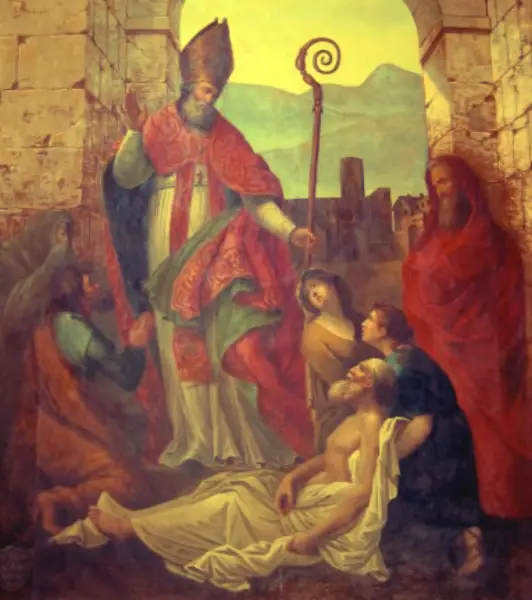
Fulcran died on 13 February 1006, closing an episcopate of more than fifty years. His people needed no formal process to recognize his sanctity: he was buried in the cathedral he had rebuilt and honored as a saint from that time forward. His body was preserved intact for centuries as an object of veneration, until the wars of religion brought desecration, for Huguenot hands gave his body to the flames in 1572, and only small fragments of his relics could be snatched from the fire. Even this loss did not extinguish his cult. The diocese honors him as its second patron, and his feast falls each year on 13 February, the day of his death. The city itself has never forgotten him: every May, for a full week, Lodève celebrates the Fête de Saint Fulcran, a festival filled with processions, a carnival, and popular rejoicing that unites civic and religious memory. Paintings of later centuries, such as François Matet's depictions of the miracle of the saint and of the desecration of his body, keep before the eyes of the faithful both the power and the cost of his enduring presence among them.
§ Veneration
Timeline
- 4 Feb 949
Consecrated Bishop of Lodève by the Archbishop of Narbonne after the death of Bishop Theoderich
§ Life
- 13 Feb 1006
Died after governing the diocese for over half a century
§ Life
The Record
- Major works
- Rebuilding of Lodève Cathedral·Church of Saint-Sauveur with its attached Benedictine monastery·Hospitals for the poor and sick of the diocese·Restoration of numerous churches and monasteries throughout Lodève
- Patron of
- Second patron of the Diocese of Lodève
- Canonization
- Pre-congregation; honored as a saint immediately after his death by the people and clergy of Lodève
Prayer
Bibliography
Show 3 sources
- Kirsch, Johann Peter. "St. Fulcran." The Catholic Encyclopedia. Vol. 6. New York: Robert Appleton Company, 1909.
- Monks of Ramsgate. "Fulcran". Book of Saints 1921. CatholicSaints.Info, 6 May 2013.
- Herbermann, Charles, ed. (1913). "St. Fulcran". Catholic Encyclopedia. New York: Robert Appleton Company.
Profile text adapted from the Wikipedia article, licensed CC BY-SA 4.0.
Pray with this saint every day
Save St. Fulcran to your favorites, read the full profile, and get feast-day reminders in the Saints app.
Get the Saints AppFree on the App Store for iPhone and iPad