
6th century – c. 630·Feast January 14
St. Fulgentius of Cartagena
Visigothic bishop of Ecija from a holy family
Overview
Fulgentius of Cartagena, honored in Spain as San Fulgencio, was born at Cartagena in the sixth century and died around the year 630. He belonged to one of the most remarkable families in the history of the Iberian Church: his brothers Leander and Isidore successively held the archbishopric of Seville, and his sister was the virgin Florentina. Their father, Severianus, a Roman who settled first at Cartagena, is described by later and doubtful tradition as an imperial prefect. Like his brothers and sister, Fulgentius gave his life over to God's service. His brother Leander, in the little book on the religious life he composed for Florentina, mentions sending Fulgentius back to Cartagena and confesses regret and fear for his safety there. Probably through Leander's influence, Fulgentius was raised to the bishopric of Astigi, the modern Ecija, in the ecclesiastical province of Seville, an election that must have occurred between 590 and 600. In 610 he subscribed the decree of King Gundemar establishing the province of Toledo, and in 619 he took part in person in the Second Synod of Seville. Isidore addressed to him, with the title of his lord and the servant of God, the dedication of his book on the offices of the Church, and Fulgentius's memory has been honored in Spain ever since.
The Complete Life
Born into a Family of Saints
Cartagena, the ancient Carthago Nova on the southeastern coast of Hispania, gave Fulgentius birth in the course of the sixth century. His family was Roman and of consequence: his father Severianus made his first home in the city, and later tradition, though regarded as unreliable, credited him with the office of imperial prefect. Whatever the precise rank of his father, the spiritual distinction of the household is beyond dispute. Three of the children would be raised to the altars. The eldest, Leander, became Archbishop of Seville and a leading figure in the Visigothic kingdom, famed for converting the king Hermenegild and for presiding over the council that brought the Goths from Arianism to the Catholic faith. The youngest brother, Isidore, succeeded to the same see and composed the encyclopedic works that made him the most learned man of his age. Between them stood Fulgentius, and their sister Florentina, or Florentius as she is sometimes called, consecrated herself as a virgin to whom Leander addressed his treatise on the ascetical life. From such a home Fulgentius went forth to the service of the Church, carrying with him the faith and learning of a household devoted entirely to God.
§ Biography
Called to the See of Astigi
The records of Fulgentius's life are sparse, for he appears only occasionally in the writings of his contemporaries, and no biography of him has survived. One precious glimpse comes from Leander himself, who in the Libellus he wrote for their sister Florentina on the religious life confesses that he sent Fulgentius back to his native Cartagena, a decision he now regretted, fearing what harm might befall him there, and begs Florentina to pray for their brother. The anxiety is understandable: Cartagena at that time lay under the rule of the Byzantines, and the fortunes of Catholics in contested territory were precarious. Providence, however, had a different path in view. Through the influence of Leander, who had been raised to the archbishopric of Seville in 584 and exercised great weight in the affairs of the Visigothic kingdom, Fulgentius was chosen Bishop of Astigi, the present Ecija, the principal see of its district within the province of Seville. Since Pegasius is attested as bishop of Astigi as late as 590, and Leander died in 600, Fulgentius's election must be placed between those two years. Thus the son of Cartagena became a bishop in the heart of Andalusia.
§ Biography
A Bishop in the Councils of the Kingdom
Though his episcopate is documented only in outline, the occasions on which Fulgentius appears show him taking his place among the bishops who shaped the Spanish Church in a decisive era. In 610 he set his signature to the decree of King Gundemar by which a new ecclesiastical province of Toledo was erected, its territory carved from the diocese of Cartagena, which then lay within lands governed by the Byzantines. The measure reorganized the map of the Spanish Church in response to the political frontier, and Fulgentius's subscription places him among its witnesses. Nine years later, in 619, his own metropolitan, Isidore of Seville, assembled the bishops of Baetica for the Second Synod of Seville, and Fulgentius attended in person, his name standing among the signatures to the acts. Before that council came a controversy of his own: a dispute with the Bishop of Córdoba concerning a church claimed as a parish by each of their dioceses. The synod referred the matter to a commission, which, reasoning from the principles of Roman law, determined that thirty years of undisturbed possession established a legal title. The scholar's work of his house was not forgotten either, for Isidore, at Fulgentius's own request, composed his account of the origins and authors of the liturgy, De ecclesiasticis officiis, and dedicated it to him as his lord and the servant of God.
§ Biography
Veneration and Relics
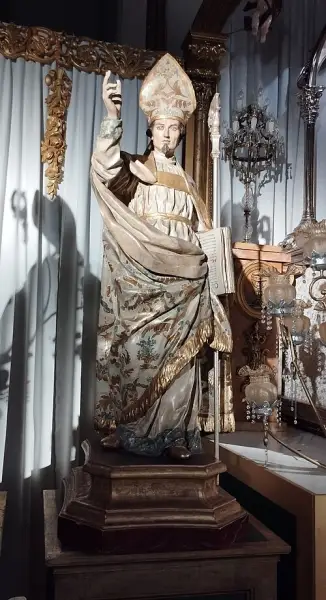
Fulgentius, together with his sister and his brothers, was reverenced as a saint by the people of Hispania, and his feast came to be kept on different days in different places; the Acta Sanctorum of the Bollandists assigns him 14 January. Medieval writers frequently confused him with Fulgentius of Ruspe, the African bishop, and several works were attributed to him of which no trace now remains, a testament to the esteem in which his name was held even when his true writings had been lost. His mortal remains became the object of devotion and, in time, of pious preservation. Tradition relates that long after his death, when danger threatened, part of his bones was carried for safety, together with those of his sister Florentina, into the Sierra de Guadalupe, the rugged mountains of Estremadura. There, in the fourteenth century, they were discovered in the village of Berzocana, an event that confirmed the continuity of his cult. The other portion of his relics rests in the cathedral of Murcia within the diocese of Cartagena, the church of his birthplace, where he is honored as the patron of the diocese. A statue by the eighteenth-century sculptor Francisco Salzillo portrays him in the principal church of Cartagena to this day.
§ Veneration
Timeline
- 590
Chosen Bishop of Astigi (Écija) sometime between 590 and 600, probably through the influence of his brother Leander of Seville
§ Biography
- 610
Signed the decree of King Gundemar that created the province of Toledo from territory separated from Byzantine-held Cartagena
§ Biography
- 619
Attended in person the Second Synod of Seville, which settled a dispute with the Bishop of Córdoba over a parish church
§ Biography
- 630
Died at Astigi around this year; by 633 a certain Marcianus had succeeded him as bishop
§ Biography
- 1300
During the fourteenth century, relics of Fulgentius and his sister Florentina were discovered at Berzocana in the Guadalupe mountains
§ Veneration
The Record
- Patron of
- Patron of the Diocese of Cartagena
- Canonization
- Pre-congregation; reverenced as a saint like his brother and sister from early times
Prayer
Bibliography
Show 3 sources
- Kirsch, Johann Peter. "St. Fulgentius." The Catholic Encyclopedia. Vol. 6. New York: Robert Appleton Company, 1909.
- Borrelli, Antonio. "San Fulgencio of Astigi", Santi e Beati, March 30 2004.
- Herbermann, Charles, ed. (1913). "St. Fulgentius". Catholic Encyclopedia. New York: Robert Appleton Company.
Profile text adapted from the Wikipedia article, licensed CC BY-SA 4.0.
Pray with this saint every day
Save St. Fulgentius of Cartagena to your favorites, read the full profile, and get feast-day reminders in the Saints app.
Get the Saints AppFree on the App Store for iPhone and iPad