
c. 462/467 – 527 or 533·Feast January 1
St. Fulgentius of Ruspe
African bishop and theologian against Arianism
Overview
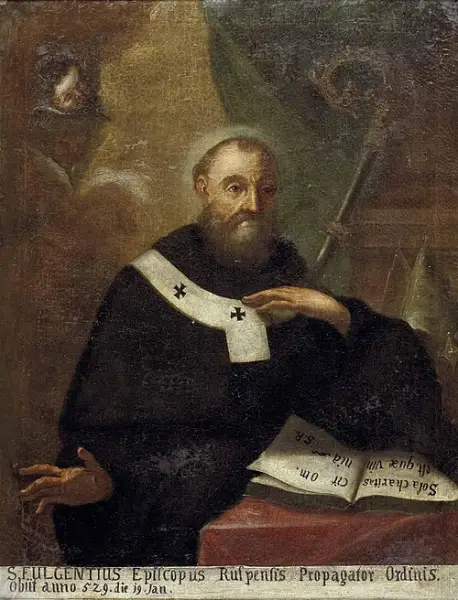
Fabius Claudius Gordianus Fulgentius, who shepherded the North African see of Ruspe in the land that today forms Tunisia, stands among the principal theologians of the African Church in the generations after Augustine. Born into a senatorial family of Thelepte around the year 462, he lost his father Claudius young and was educated by his mother Mariana, mastering Greek so thoroughly that he could speak it like a native and committing the whole of Homer to memory. Distinguished service as procurator of Byzacena could not satisfy him; a sermon of Augustine on the brevity of life turned his heart to the monastery. A pilgrimage to the hermits of Egypt was abandoned when he learned how monophysitism had infected the monasticism there, and after trials under the directors Faustus and Felix, including arrest and torture at the hands of an Arian priest, he founded a monastery of his own. Called in 502 to the episcopal throne of Ruspe, he was exiled to Sardinia alongside roughly sixty brother bishops who confessed the Catholic creed, victims of the Arian ruler Thrasamund. From Cagliari he governed a monastery and wrote against Arian error; recalled for debate, he produced his Answer to Ten Objections and the Three Books to King Thrasamund. Restored to his see in 523 under the Catholic king Hilderic, he died on 1 January, remembered as 527 or 533.
The Complete Life
A Senatorial House Under the Vandals
The future bishop entered the world in 462 at Thelepte, known in modern times as Medinet-el-Kedima, in the African province of Byzacena. His family belonged to the senatorial class that had governed Roman Africa for generations, but the Vandal conquest had stripped it of much. Gordianus, his grandfather, had sat in the senate of Carthage until the invader Genseric stripped him of his estates and drove him across the sea to Italy; after the old man died, his two sons came home to find Arian priests installed in their Carthage house, and managed to win back only a portion of the family property in Byzacena. Into this diminished inheritance Fulgentius was born. His father Claudius died while the boy was still young, and his education fell to his mother Mariana, who taught him both Greek and Latin. He proved so gifted in the former that he came to speak it like a native, and his biographer records the astonishing claim that at an early age he learned the entire works of Homer by heart. His competence in managing the family estates won him wide public respect and led to appointment as procurator, or tax collector, of Byzacena. Yet the administration of another's wealth, and soon of the public revenue, left him cold.
§ Biography
From Procurator to Monk
The world held no lasting charm for the young procurator. Weary of material concerns and drawn on by his reading, Fulgentius encountered a sermon of Augustine of Hippo on Psalm 36, treating of the transitory character of earthly existence, and the words settled his resolve to become a monk. His first resolve was the most austere imaginable: in about 499 he would seek out the desert fathers of the Thebaid in Egypt, where monastic life had begun. Learning from Eulalius, Bishop of Syracuse, that monophysite error had taken hold among the Egyptian monks, he gave up the journey and returned to African soil. He next offered himself to Faustus, exiled from his own see by Huneric, who had meanwhile established a monastery in Byzacena. Faustus at first tried to turn him away, judging his frail body unfit for the rigors of the cloister, but relented and admitted him on trial. When his mother Mariana, who had never been told of his intention, learned what had happened, she hurried to the monastery gates and protested that a Church charged with protecting widows should not rob her of her only son. Her plea failed against his quiet persistence, and his vocation stood confirmed.
§ Biography
Exile, Disputation, and the Defense of the Faith
Renewed Arian aggression soon drove Fulgentius from his first monastery to another, where Abbot Felix entrusted him with the temporal administration while keeping the spiritual care himself. In 499, during another persecution, the two fled to Sicca Veneria, where a local Arian priest, discovering that they preached the orthodox Nicene faith, had them arrested and tortured. In 500 Fulgentius made his way to Rome, praying at the tombs of the apostles; there he heard the address delivered to the people by King Theodoric, an experience that deepened his contempt for earthly grandeur. Back in Byzacena he built a monastery and withdrew to a solitary cell, declining repeated offers of dioceses vacated by the Arian king Thrasamund, who had ordered that only Arians might fill them. In 502, however, persuasion prevailed and he accepted the see of Ruspe. The Catholic bishops of Africa did not long enjoy their new colleague: Fulgentius was banished to Sardinia with some sixty others who refused the Arian position, Pope Symmachus sending them annual supplies of food and money. At Cagliari he turned a house into a monastery and resolved to write for the instruction of the African Christians. Summoned in 515 to debate his Arian replacement before Thrasamund, he answered the king's ten objections so effectively that all his future statements were restricted to oral delivery; he replied with the Three Books to King Thrasamund, winning even the king's respect, though renewed complaints banished him again in 520.
§ Bishop of Ruspe
A Theologian of Augustine's School
As a writer Fulgentius belongs unmistakably to the school of Augustine, whose doctrine he transmitted to a later and more perilous age. His work displays an exact knowledge of Greek, and his polemic was aimed chiefly at the two great errors that troubled the Church of his day: Arianism, the faith of the Vandal kings, which denied the full divinity of the Son, and Pelagianism, which corrupted the doctrine of grace. The letter he composed to Peter on the faith sets out with crystalline firmness the teaching that the Holy Spirit proceeds from the Father and the Son, grounding the Filioque in the words of Christ himself about the Spirit of Truth. In his treatise against Fabianus he unfolds the mystery of the Eucharist, presenting communion in Christ's body and blood received under the forms of bread and wine as the summons to die to the world. Some of his letters and eight of his sermons survive. During the Middle Ages his identity was confused with that of Fabius Planciades Fulgentius, and the famous Mythologies were ascribed to him, an attribution now doubted. His theology of the Holy Spirit drew the admiration of the Russian Orthodox theologian Sylvester Malevansky, who defended Fulgentius's pneumatology while giving it an Eastern interpretation.
§ Doctrine
Return to Ruspe and a Holy Death
The death of Thrasamund in 523 changed the fortunes of the African Catholics. His son and successor Hilderic professed the Catholic faith, and Fulgentius was permitted to come home to Ruspe after some twenty years of exile. He found his old diocese disordered by the long Arian occupation and set himself to reform the abuses that had crept in during his absence, laboring to bring the people back to the Catholic position. His preaching proved irresistible: the power and effectiveness of his words were such that his archbishop, Boniface of Carthage, wept openly whenever he heard Fulgentius preach, and gave public thanks to God for bestowing such a preacher on his church. Differences of precedence with Quodvultdeus were dissolved by Fulgentius's modest concessions, showing that the controversialist knew how to be a peacemaker. Wearied at last by years of labor, he withdrew to a monastery on the isle of Circinia, known today as Kerkenna; but his flock's needs recalled him, and he served the see of Ruspe until his death, which came on 1 January, dated by different authorities in 527 or 533. The day of his passing became the day of his feast.
§ Bishop of Ruspe
Memory and Cult of the Bishop of Ruspe
The Church of East and West has never ceased to number Fulgentius among her saints. His principal feast falls on 1 January, the anniversary of his death, and the Augustinian Order keeps a second commemoration on 3 January, honoring him as one of the great bishops formed in Augustine's tradition. He is venerated in the Latin Catholic Church, the Eastern Catholic churches, and the Eastern Orthodox Church, where his name appears in the calendar of the saints. The story of his life, the Vita Fulgentii, generally ascribed to Ferrandus of Carthage though more recently attributed to Redemptus, a monk of Thelepte, remains precious to historians as a record of how social elites moved between Africa, Italy, Sicily, and Sardinia under the pressure of Vandal rule, and of how an episcopal monastic household was built up in a persecuted church. Devotion followed his relics across the centuries: in 1903 they were transferred to Bouvines in France, carrying the memory of the African bishop into the church of a land he never saw. He is numbered among the Church Fathers who are saints of the Catholic Church, and his writings continue to be read and translated as durable monuments of Augustinian theology in the age of the Vandal kingdom.
§ Veneration
Timeline
- 462
Born at Thelepte in Byzacena into a senatorial family of Carthage
§ Biography
- 499
Set out for the hermits of the Thebaid in Egypt but abandoned the journey after learning of monophysite influence on Egyptian monasticism
§ Biography
- 499
Fled with Abbot Felix to Sicca Veneria during a new wave of Arian persecution
§ Biography
- 500
Made a pilgrimage to Rome, praying at the tombs of the apostles and hearing King Theodoric address the people
§ Biography
- 500
Returned to Byzacena and built a monastery, living himself in an isolated cell
§ Biography
- 502
Persuaded to accept the bishopric of Ruspe, and soon banished to Sardinia with about sixty other Catholic bishops
§ Bishop of Ruspe
- 515
Summoned from Sardinia by Thrasamund to contend in public disputation against the Arian intruder holding his see
§ Bishop of Ruspe
- 520
Banished again to Sardinia after complaints from the Arian clergy of Carthage
§ Bishop of Ruspe
- 523
Ruspe reopened to him once Thrasamund died and his heir Hilderic, a Catholic, took the throne
§ Bishop of Ruspe
- 1 Jan 527
Died at Ruspe on 1 January; sources give the year as 527 or 533
§ Veneration
- 1903
His relics were transferred to Bouvines in France
§ Veneration
In Their Own Words
Hold most firmly and never doubt that the same Holy Spirit, who is the one Spirit of the Father and the Son, proceeds from the Father and the Son. For the Son says, 'When the Spirit of Truth comes, who has proceeded from the Father,' where he taught that the Spirit is his, because he is the Truth.
Indeed our sharing in the Lord's body and blood when we eat his bread and drink his cup teaches us that we should die to the world.
The Record
- Major works
- An Answer to Ten Objections·Three Books to King Thrasamund·Letter to Peter on the Faith·Treatise against Fabianus·Letters and eight sermons that survive
- Symbols
- Bishop's vestments·Book
- Canonization
- Pre-congregation; venerated as a saint since antiquity by Catholics and Orthodox alike
Prayer
Bibliography
Show 5 sources
- "Saint Fulgentius of Ruspe". West Coast Augustinians, Province of St. Augustine. Archived from the original on 2007-10-08.
- "CATHOLIC ENCYCLOPEDIA: Saint Fulgentius". www.newadvent.org.
- Burns, Paul. Butler's Lives of the Saints: New Full Edition. Collegeville, MN: The Liturgical Press, 1995. ISBN 0-8146-2377-8.
- Fairbairn, Donald, ed. Fulgentius of Ruspe and the Scythian Monks: Correspondence on Christology and Grace. Vol 126 of The Fathers of the Church. Washington D.C.: Catholic University of America Press, 2013.
- "Fulgentius" in The Oxford Dictionary of the Christian Church. F. L. Cross and E. A. Livingstone, eds. London: Oxford University Press, 1974.
Profile text adapted from the Wikipedia article, licensed CC BY-SA 4.0.
Pray with this saint every day
Save St. Fulgentius of Ruspe to your favorites, read the full profile, and get feast-day reminders in the Saints app.
Get the Saints AppFree on the App Store for iPhone and iPad