
710 – 784·Feast July 16
St. Fulrad
Abbot of Saint-Denis and counselor of kings
Overview
Fulrad, abbot of Saint-Denis from about 750 until his death in 784, was one of the quiet architects of the Carolingian order in Europe. Born in Alsace in 710, he entered the abbey of Saint-Denis and was elected its abbot in 750, enlarging its patrimony with his own inheritance and recovering lands seized earlier by Charles Martel. Under his government new monasteries rose in Alsace-Lorraine and Alemannia, their relics drawing pilgrims and their revenues serving the royal abbey. His talents found their widest field in the service of the Frankish monarchy: as arch-chaplain and trusted counselor he served first Pepin the Short and then Charlemagne. It was Fulrad whom Pepin sent to Pope Zachary to secure the apostolic approval for deposing the last Merovingian and assuming the crown in 751, and Fulrad who afterward carried the keys of the surrendered cities and laid them with the royal charter on the tomb of Saint Peter. He oversaw the construction of the new basilica of Saint-Denis, begun in 754 and consecrated in 775 in the presence of Charlemagne, the first great Carolingian church and the future royal mausoleum of France. He died on 16 July 784, eleven years before the imperial coronation his diplomacy had prepared.
The Complete Life
From Alsace to the Royal Abbey
Fulrad was born in 710 in Alsace, a border land of the Frankish kingdom where Roman roads, ancient monasteries, and new aristocratic families met. Of his parents and childhood the surviving records tell little beyond the fact of his inheritance, which would one day matter greatly to the abbey he governed. As a young man he joined the abbey of Saint-Denis, outside Paris, the sanctuary of the apostle of Gaul and a church with special ties to the Frankish monarchy. There he was formed in the monastic life and in the administration of a great and politically sensitive house. In 750 the community chose him as its abbot, and the office opened before him opportunities unmatched by any of his predecessors. He enlarged the abbey's endowment by adding the inheritance received from his own parents, and he succeeded in retaking lands that Charles Martel had seized from Saint-Denis in the hard days of the previous generation. Historians judge these acquisitions more than private gain, seeing in them the deliberate consolidation of a royal abbey at the precise moment when the family of Charles Martel was preparing to exchange the mayor's office for the throne itself.
§ Biography
Arch-Chaplain of the New Dynasty
Fulrad never accepted episcopal consecration, yet he climbed to the summit of the ecclesiastical hierarchy through a different path: service at the king's side as capellanus, first to Pepin III and then to Charlemagne as their arch-chaplain, and finally as counselor to both. The royal chapel was the administrative and spiritual heart of the Frankish court, and its head traveled with the king, celebrated the liturgy of the palace, and conducted the most delicate negotiations with Rome. Fulrad held the office under two kings and won the confidence of both, a rarity in an age of faction. His contemporaries recognized that his personal property was, in effect, at the service of the monastery he led, and that his reach as a leader extended through the monasteries he founded in Alsace-Lorraine and Alemannia, houses enriched with relics that made them centers of pilgrimage. To provide pastoral care for these distant communities he obtained from Pope Stephen II the appointment of a cloister bishop who could serve where the abbot could not reside. He also advised the Frankish bishops and acted almost as a quasi-bishop among them, exercising a role in the church of the Franks that no title fully captures but that all acknowledged.
§ Biography
The Embassy That Made a King
The most consequential act of Fulrad's life took place in 750, when Pepin dispatched him to Rome on a mission of world-historical weight: to win over Pope Zachary to the plan of changing the government of the Franks. The Merovingian kings had long reigned without power, while the mayors of the palace ruled; Pepin wished to know whether he might assume the crown itself. Fulrad carried the question and returned with the answer, preserved in summary in the Codex Carolinus: the pope judged it better to call the man who held the royal power king rather than the one who did not. Armed with this judgment, Pepin in 751 forced the last Merovingian, Childeric, into a monastery and made himself king. The partnership continued after the coronation. When Pepin crossed the Alps against the Lombards in 755, he ordered a charter drawn up granting the lands of the Lombard king and the donations of Saint Peter to the Roman see, towns including Ravenna, San Marino, Gubbio, and northern Umbria. Each city welcomed Fulrad as its new master, and it was he who placed the keys of the ceded cities, together with the charter drawn in Pepin's name, upon the tomb of Saint Peter. He stood by the dying king too: Pepin, fallen ill at Saintes during the Aquitaine campaign, traveled to Saint-Denis to be buried there at his own request, beside the saint and under the care of his arch-chaplain.
§ Fulrad and Pippin III
Servant of Charlemagne and Builder of the Basilica
Under Charlemagne, Fulrad remained arch-chaplain, counselor, and the king's most seasoned expert on Italian affairs. He stood at the emperor's side through the Saxon wars and the negotiations with Pope Hadrian, and when the papal Donation required a royal envoy to act with the king's power in Italy, the Missus whom Charlemagne dispatched was Fulrad himself. From autumn 774 through the following summer he supported the king at court, where charters flowed in favor of Saint-Denis, including the valuable royal villa of Herbrechtingen; the emperor was building up the abbey as a base that could supply armies on campaign, relying on his arch-chaplain rather than on the uncertain loyalty of local officials. Above all Fulrad gave the dynasty its architectural monument. The new basilica of Saint-Denis, begun in 754 under his oversight, was completed under Charlemagne and consecrated in 775 in the royal presence: an edifice of about eighty meters, its nave divided by rows of marble columns, with a transept, apse, strong Byzantine influence, and an interior lit by twelve hundred and fifty lamps on the great feasts. There Fulrad and the first Carolingians replaced the old Merovingian church, and there the kings of France would lie for centuries. He died on 16 July 784, and Charlemagne entrusted his work to Angilram, Bishop of Metz, and Hildebald of Cologne.
§ Fulrad and Charlemagne
Testament and Memory
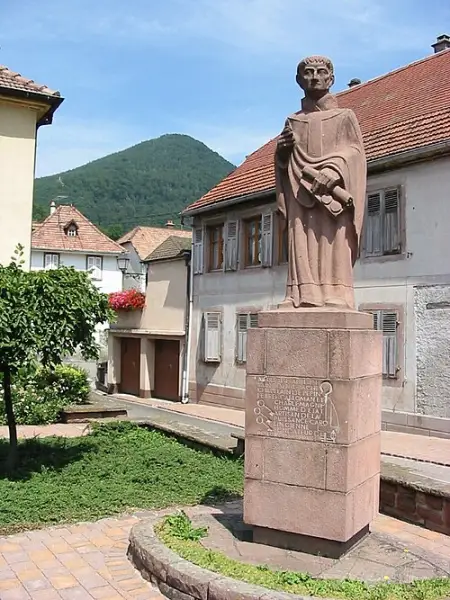
Fulrad's most intimate surviving document, his testament, remains a quarry for historians of early Carolingian society. In it the abbot surveys the places he possessed and describes in detail the religious, political, and economic character of each, identifying individuals and tracing their lineage. The lands he placed under the royal abbey served as a defense against the eastern nobility, yet they were also economically vital, opening to Saint-Denis the riches of regions beyond its heartland. Alain Stoclet, the modern editor of the evidence on Fulrad, devoted an entire chapter to the genealogical and prosopographical material preserved in the document. The historian's judgment is larger still: Fulrad is counted among the few Neustrian figures who attached themselves to the rising Carolingian dynasty and helped to develop the growing kingdom of Francia. By motivating the Franks to side with the papacy rather than the Byzantines, he set in train the diplomacy that ended with Charlemagne's imperial coronation in 800, an outcome he did not live to see, for he died eleven years before it. His basilica endured until Abbot Suger rebuilt it in the twelfth century, and in the rebuilding, completed in 1144, Gothic architecture was born. The Church of East and West honors him on 16 July, and his statue still watches over Lièpvre, one of the monasteries he founded.
§ Francia
Timeline
- 710
Born at Alsace in the Frankish realm
§ Biography
- 750
Elected Abbot of Saint-Denis and sent on the mission to Pope Zachary concerning the Frankish royal succession
§ Biography
- 751
Pepin deposed Childeric, confined him to a monastery, and made himself King of the Franks after Fulrad's embassy to Rome
§ Fulrad and Pippin III
- 754
Construction of the new basilica of Saint-Denis began under his direction
§ New Basilica of Saint-Denis
- 755
Received Pepin's charter of ceded cities and laid its keys on the tomb of Saint Peter
§ Fulrad and Pippin III
- 774
Stayed at Charlemagne's side at court from autumn 774 through summer 775, winning numerous charters for Saint-Denis.
§ Fulrad and the exchange between Charlemagne and Pope Hadrian
- 775
The new basilica of Saint-Denis was consecrated in the presence of Charlemagne
§ New Basilica of Saint-Denis
- 16 Jul 784
Died on 16 July; Charlemagne named Angilram of Metz and Hildebald of Cologne to carry on his work
§ Death and successors
- 1137
Abbot Suger commissioned the rebuilding of Fulrad's church of Saint-Denis, completed in 1144.
§ New Basilica of Saint-Denis
In Their Own Words
it was better to call the person who has the royal power king rather than he who does not have it
The Record
- Major works
- Fulrad's Testament, a survey of the abbey's lands and early Carolingian society·Founding of monasteries in Alsace-Lorraine and Alemannia·New basilica of Saint-Denis, begun in 754 and consecrated in 775
- Symbols
- Abbot's habit·Model of the basilica of Saint-Denis
- Canonization
- Pre-congregation; venerated from ancient times in East and West, with his feast on 16 July
Prayer
Bibliography
Show 5 sources
- Bachrach, Bernard. Charlemagne's Early Campaigns 769-777. Netherlands: IDC Publishers, 2013.
- Bolgia, Claudia, McKitterick, Rosamond and Osborne, John. Rome Across Time and Space Cultural Transmission and the Exchange of Ideas, c. 500-1400. New York: Cambridge University Press, 2011.
- Boussard, Jacques. The Civilization of Charlemagne. Toronto: McGraw Hill Book Company, 1968.
- McKitterick, Rosamond. Charlemagne The Formation of a European Identity. United States of America: Cambridge University Press, 2008.
- Crosby, Sumner McKnight. The Royal Abbey of Saint-Denis from Its Beginnings to the Death of Suger, 475–1151. Yale University Press, 1987.
Profile text adapted from the Wikipedia article, licensed CC BY-SA 4.0.
Pray with this saint every day
Save St. Fulrad to your favorites, read the full profile, and get feast-day reminders in the Saints app.
Get the Saints AppFree on the App Store for iPhone and iPad