
c. 597 – 650·Feast January 16
St. Fursey
Irish Monk, Visionary and Missionary of East Anglia
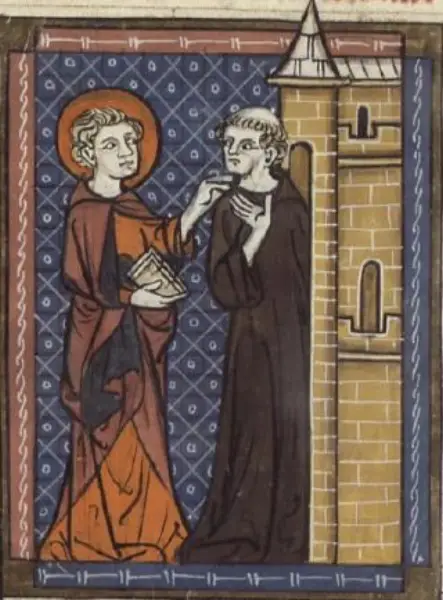
Overview
Fursey, also called Fursa, Fursy, Forseus, or Furseus, was an Irish monk who died in 650 after doing much to plant Christianity across the British Isles, especially in East Anglia. Born around 597 in the region of modern Connacht, the son of Fintan and the Christian Gelges, daughter of the king of Connacht, he was baptised by his great-uncle St Brendan and educated in the monastery of Inisquin on Lough Corrib. Renowned for austerity and sanctity, he became famous above all for a series of ecstatic visions of angels, demons, and the fires of purgatory, recounted across medieval literature. After founding Killursa in County Galway he fulfilled twelve years of preaching in Ireland, then crossed to Anglo-Saxon England in the 630s, becoming the first recorded Irish missionary there. King Sigeberht gave him land at Cnobheresburg, the Roman fort at Burgh Castle in Norfolk, where he laboured among Picts and Saxons. He left his brother Foillan as abbot and moved to Gaul, arriving in 648, founded Lagny near Paris, and died at Mézerolles about 650. Buried at Péronne, he became that city's patron and one of the Four Comely Saints of Ireland.
The Complete Life
A King's Grandson on Lough Corrib
Fursey was born around 597 in the region of modern Connacht, into a family that joined the old royal order of Ireland to the new Christian faith. His father was Fintan, grandson of Finlog, a pagan king of the district; Gelges, his mother, was a Christian and a daughter of Aed-Finn, who reigned over Connacht. The Hy-Bruin were probably his people, and his baptism fell to St Brendan the Traveller, his father's uncle, who then governed a monastery on the Island of Oirbsen, today's Inisquin in Lough Corrib. Brendan's monks educated the boy, and when he came of age he entered the monastery of Inisquin under Abbot St Meldan, his soul-friend in the Irish fashion, devoting himself there to the religious life. His sanctity was recognised early. A legend from those years tells how, at his prayer, the infant twins of a chieftain of King Brendinus's kin were brought back from death to life. In time he raised a monastery that was his own foundation at Killursa near Headford, in what is now County Galway, and the parish of Headford still numbers him among its patrons. Formation under Brendan and Meldan prepared him for the visions and missions that would carry his name across two seas.
§ Early life
The Visions That Made Him Famous
Fursey practised a striking austerity, wearing thin clothing through every season of the Irish year. Aspirants gathered in numbers to live under his rule, and hoping to win relatives also for his monastery, he set out with monks toward Munster; near his father's home he was stricken with what seemed a mortal illness. From the ninth hour of the day until cock-crow he lay in trance, and in that state came the first of the ecstasies that made him famous throughout medieval literature. He saw the state of humanity in sin and the beauty of virtue, and heard the angelic choirs singing that the saints go from virtue to virtue and the God of gods appears in Sion. Two angels, restoring him to his body, charged him to labour more zealously for the Lord. Three nights later the rapture returned: three angels bore him heavenward, contending six times with demons for his soul, and he beheld the fires of hell and heard the fourfold Trisagion. Among the perfected spirits he recognised Meldan and Beoan, who instructed him on the duties of clergy and monks and the gravity of pride and hidden sins. A demon hurled a burning sinner against him as he passed back through the fire, scarring his body for life.
§ Visions
Twelve Years of Apostolic Labour
Twelve months after the second rapture came a third, in which the angel stayed with him a whole day, prepared him for preaching, and prescribed twelve years of apostolic labour. Fursey discharged this commission faithfully in Ireland. In the years that followed he established Rathmat, a monastery on the Lough Corrib shoreline, generally equated by modern scholars with Killursa in the deanery of Annadown; Foillan and Ultan, his brothers, came to share its common life. He himself appears to have relinquished the administration of the house, giving himself instead to preaching throughout the land and frequently exorcising evil spirits, the mark of a ministry exercised in power rather than office. When the twelve years were complete he stripped himself of every earthly possession and retired for a season to a lonely islet in the sea, the eremitical pause between one mission and another. This pattern, of vision issuing in preaching, preaching issuing in foundation, and foundation renounced for solitude, is the grammar of his whole life. His spirituality joined the contemplative fire of the Irish monastery to an unquiet apostolic drive, and its testimony would soon cross from Connacht to the Anglo-Saxon kingdoms and to Gaul.
§ Visions
To East Anglia and Neustria
No Irish missionary to the Anglo-Saxons is recorded before Fursey, who reached East Anglia in the 630s together with Foillan and Ultan, not long before Aidan established his house on Holy Island. The kingdom's conversion, begun under Raedwald and interrupted by the martyrdom of Eorpwald, was advancing under Sigeberht, a Christian king who had set up East Anglia's earliest see at Dommoc by 633, filling it with the Burgundian Felix. Sigeberht welcomed Fursey and his brethren, who carried the relics of Saints Meldan and Beoan, and granted him land at Cnobheresburg, an abandoned Roman fort traditionally identified with Burgh Castle in Norfolk. There Fursey laboured for years converting Picts and Saxons, and after Sigeberht's death in battle against Penda of Mercia, King Anna and his nobles further endowed the monastery, where three miracles of Fursey are recorded. After a year's anchorite retirement with Ultan, and with war looming, he left Foillan as abbot and moved to Gaul around 644, arriving in France in 648. Restoring Duke Hayson's dead son near Mézerolles, converting robbers and the inhospitable, obtaining reprieve for six criminals at Péronne, he chose a wooded site on the Marne at Lagny, near Paris, and built there a monastery with three chapels, drawing many Irish disciples to his rule.
§ Mission to East Anglia
Death at Mézerolles and Burial at Péronne
Sensing that death was drawing near, Fursey journeyed to see Foillan and Ultan once more; his brothers had meanwhile re-gathered the scattered monks of Cnobheresburg. He died about the year 650 at Mézerolles while on the journey, and the village was for a time called Forsheim, the house of Fursey. His body was laid to rest at Péronne in a church Earconwald raised for that very purpose, and the city has never ceased to call him its patron. The moving of his remains was attended by remarkable events: for a full month the corpse awaited the church's dedication without burial, while pilgrims gathered from every quarter, incorrupt and breathing a sweet odour, before being laid near the altar. Four years later, on 9 February, Saints Eligius, Bishop of Noyon, and Cuthbert, Bishop of Cambrai, moved the remains to a new chapel built east of the main altar, beside the relics of Meldan and Beoan that Fursey himself had placed there long before. Péronne grew into a great centre of his devotion, and the image of the saint with two oxen at his feet commemorates the prodigy by which, according to legend, the mayor of the palace Erchinoald's claim upon his body was made good.
§ Death
Comely Saint of Two Shores
Fursey's visions entered medieval literature as among the earliest and most influential accounts of the afterlife, shaping centuries of imagination about purgatory and hell. In art he is shown with two oxen at his feet, drawing water from the ground at Lagny by a touch of his staff, caught up amid angelic sights, or staring into the fires of the world to come. Whether he bore episcopal orders is a debated question; the office of chorepiscopus may have been his. A litany attributed to him survives among the manuscripts of Trinity College Dublin, and an Irish prophecy is credited to him. He is numbered among the Four Comely Saints of Ireland, and the feast of 16 January is kept in his honour; Orthodox Christians commemorate him on 29 January. His cult lives on in the parishes of Headford and Péronne, in the many Picardy churches dedicated to him, and in an ecumenical fellowship of Christians who honour him as their Father in the Faith. Literature has kept his name current in its own way, from James Joyce's list of Irish heroes in Ulysses to Mervyn Wall's comic novel of the unfortunate Fursey, a testimony to how deeply this visionary monk settled into the memory of two islands and a continent.
§ Iconography and veneration
Timeline
- 597
Born around this year in the region of modern-day Connacht, son of Fintan and Gelges, and baptised by St Brendan the Traveller
§ Early life
- 630
Crossed to East Anglia in the company of Foillan and Ultan during the 630s; no Irish missionary to the Anglo-Saxons is recorded before him
§ Mission to East Anglia
- 633
Sigeberht's East Anglian see had been set up at Dommoc by this year, with Felix as its bishop, in the Christian kingdom that welcomed Fursey's mission
§ Mission to East Anglia
- 644
Left his brother Foillan as abbot of Cnobheresburg as war threatened, and set out for France, reaching Lagny around this year
§ Mission to East Anglia
- 648
Arrived in France; near Mézerolles in Ponthieu he raised to life the only son of Duke Hayson, and Erchinoald received him joyfully at Péronne
§ Mission in Neustria
- 650
Died about this year at Mézerolles while travelling; his body lay incorrupt for thirty days before burial at Péronne
§ Death
- 9 Feb 654
Saint Eligius, Bishop of Noyon, and Cuthbert, Bishop of Cambrai, translated his remains to a new chapel east of the main altar of the church at Péronne
§ Death
In Their Own Words
Because thou didst receive the mantle of this man when dying in his sin the fire consuming him hath scarred thy body also.
The Record
- Major works
- Monastery of Killursa (Rathmat) outside Headford, County Galway·Monastery of Cnobheresburg at Burgh Castle, Norfolk·Monastery and three chapels at Lagny on the Marne·Litany attributed to him, among the manuscripts of Trinity College Dublin
- Patron of
- Patron saint of the Parish of Headford·Patron of Péronne·One of the Four Comely Saints
- Symbols
- Two oxen at his feet·Beholding a vision of angels·Gazing at the flames of purgatory and hell
- Canonization
- Pre-congregation; venerated in the Roman Catholic and Eastern Orthodox churches
Prayer
Bibliography
Show 7 sources
- Ann Williams, Alfred P. Smyth and D. P. Kirby (1991). A Biographical Dictionary of Dark Age Britain. Seaby. ISBN 1-85264-047-2.
- Attwater, Donald and Catherine Rachel John. The Penguin Dictionary of Saints. 3rd edition. New York: Penguin Books, 1993. ISBN 0-14-051312-4.
- Buckley, Ann. 'Nobilitate vigens Furseus'. The Medieval Office of St Fursey. Norwich: Fursey Pilgrims, 2014. ISBN 0 9544773 6 7.
- Dahl, L. H., The Roman Camp and the Irish Saint at Burgh Castle (Jarrold, London 1913).
- Plunkett, S. J., Suffolk in Anglo-Saxon Times (Tempus, Stroud 2005). ISBN 0-7524-3139-0.
- Rackham, O., Transitus Beati Fursei - A Translation of the 8th Century Manuscript Life of Saint Fursey (Fursey Pilgrims, Norwich 2007).
- Herbermann, Charles, ed. (1913). "St. Fursey". Catholic Encyclopedia. New York: Robert Appleton Company.
Profile text adapted from the Wikipedia article, licensed CC BY-SA 4.0.
Pray with this saint every day
Save St. Fursey to your favorites, read the full profile, and get feast-day reminders in the Saints app.
Get the Saints AppFree on the App Store for iPhone and iPad