
1745 – 1817·Feast October 2
St. Fyodor Ushakov
Admiral of the Russian Black Sea Fleet
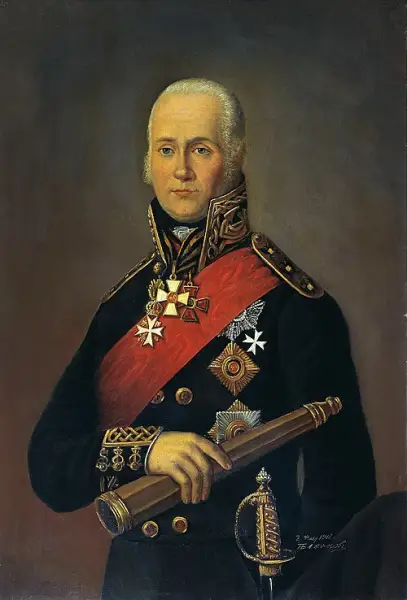
Overview
Fyodor Fyodorovich Ushakov rose from a modest provincial gentry family to become the most celebrated admiral of the Imperial Russian Navy. Entering service in Saint Petersburg in 1761, he trained in the Baltic Fleet before transferring to the Don Flotilla, and later commanded Catherine the Great's own yacht. After Russia annexed the Crimea he oversaw the building of the naval base at Sevastopol and the docks at Kherson. In the wars against the Ottoman Empire he won at Fidonisi, the Kerch Strait, Tendra and Cape Kaliakra, pioneering maneuvering tactics that concentrated fire on enemy flagships. Elevated to full admiral in 1798, he led a Russian-Ottoman squadron through the Mediterranean, took the Ionian Islands after the siege of Corfu, and helped found the Septinsular Republic before blockading French positions in Italy and assaulting Naples and Rome. Across forty-three commanded battles he never lost a ship or an engagement. Recalled in 1800 and undervalued by Tsar Alexander I, he resigned in 1807 and retired to Sanaksar Monastery, where he died in 1817. The Russian Orthodox Church glorified him as a saint in 2001, and he is honored as patron of the Russian Navy and of the country's nuclear-armed strategic bombers.
The Complete Life
A Gentry Childhood in Burnakovo
Fyodor Ushakov first saw light at Burnakovo, a village of the Yaroslavl province within Moscow Gubernia, on 24 February 1745, to parents of the lesser nobility that had never been formally confirmed in its rank. His father, Fyodor Ignatyevich Ushakov, had been, before leaving the service, a sergeant in the imperial guards' Preobrazhensky Regiment. When the young man later filed his statement of background with the military authorities, he was candid about the family's uncertain standing: they belonged to the serving gentry in fact, yet he could show no coat-of-arms and held no royal patent to any landed estate, nor any document by which noble rank might be proven. This ambiguity followed him through life. Only in 1798, by then a vice-admiral commanding the Black Sea Fleet, did he petition for official recognition of his nobility together with a heraldic arms and a genealogical record. His coat-of-arms entered the General All-Russian Book of Heraldry in 1807, and in 1815 he and his family were inscribed in the section devoted to ancient nobility in the Yaroslavl genealogical book. The long struggle for recognition of a family that had served the state faithfully for generations gives a distinctive texture to his early story: rank mattered to the empire, but Ushakov's own standing would ultimately rest on deeds at sea rather than on paper.
§ Life and naval career
Entering the Navy
On 15 February 1761 the sixteen-year-old Ushakov signed up for the Imperial Russian Navy at Saint Petersburg, beginning the long apprenticeship of a professional sea officer. He completed his training and was assigned to a galley of the Baltic Fleet, where he learned the demanding craft of oared and sailing warfare in northern waters. His abilities soon drew wider assignments. In 1768 he was transferred to the Don Flotilla at Taganrog and took part in the Russo-Turkish War of 1768 to 1774, gaining his first experience of the Black Sea theater in which his greatest triumphs would later be won. Between the wars he was entrusted with the command of Empress Catherine the Great's own yacht, a mark of personal confidence from the sovereign, and he was active in shielding Russian merchant shipping in the Mediterranean during the period of the First League of Armed Neutrality. When the Russian Empire conquered the Crimean Khanate in 1783, Ushakov was placed in charge of constructing the new naval base at Sevastopol and the docks at Kherson, work that required both engineering judgment and administrative talent. These years built the foundation of a career defined less by court favor than by competence, discipline, and an unusual gift for organizing men and ships for war.
§ Life and naval career
Victories Against the Ottomans and the French
The Russo-Turkish War of 1787 to 1792 made Ushakov's reputation. Fighting under Marko Voinovich's leadership he helped defeat the Ottoman fleet at Fidonisi in 1788, and then, in command, he won at the Kerch Strait and at Tendra in 1790 and at Cape Kaliakra in 1791. In each action he displayed the ingenuity of his new tactical ideas, closing with the enemy decisively and concentrating his gunfire against their flagships. In 1798 he was raised to full admiral and given a squadron ordered to the Mediterranean by way of Constantinople, where it joined an Ottoman force for the war against the French Republic. The combined fleet conquered the Ionian Islands, which France had recently acquired from Venice, and the campaign culminated in the siege of Corfu, after which Ushakov showed genuine statesmanship in helping to establish the Septinsular Republic. His squadron then blockaded the French-held Italian ports of Genoa and Ancona, and landing parties stormed Naples and Rome, where the local populations welcomed the Russians as liberators. Tsar Paul next directed him, as Grand Master of the Order of St. John, toward Malta, whose siege Nelson's British fleet was helping to press; the rendezvous there proved brief, for recall home soon followed.
§ Life and naval career
Discipline, Duty, and Devotion
The record of Ushakov's life shows a man who treated his profession as a form of service rather than self-advancement. He placed great value on the sea and gunnery training of his officers and crews, championing the principles of training taught by Generalissimo Suvorov, and his tactical innovations stood among the first successful transitions of naval warfare from rigid line tactics to maneuvering concepts. His distinguishing methods included unified marching and battle formations, resolute closing with the enemy, concentration of effort against flagships, maintenance of reserve squadrons, aimed artillery fire combined with skillful maneuvering, and relentless pursuit of a beaten foe until its destruction or capture. Yet the same rigor marked his private conduct. After resigning in 1807 he withdrew to the Sanaksar Monastery, embracing the disciplined rhythm of monastic life. When the Patriotic War of 1812 brought a request that he lead the local militia, he declined only because failing health made it impossible, and he gave his savings to the national cause instead. The Church's later veneration of him recognized in this combination of professional excellence and personal humility the portrait of a righteous warrior, and his relics now rest at Sanaksar Monastery as a focus of pilgrimage and prayer.
§ Tactics
Retirement at Sanaksar
Ushakov's return to Russia in 1800, with his fleet, coincided with a change of sovereigns. The new emperor, Alexander I, did not value the admiral's victories as his predecessor had, and the hero of the Mediterranean found himself without fresh commands. He resigned his command in 1807 and withdrew to the Sanaksar Monastery, in what is today the republic of Mordovia, near the community where he would eventually be buried. The retirement was not entirely peaceful in spirit, for the wars of the era followed him: in 1812, with Napoleon's armies invading, the authorities asked the old admiral to take command of the local militia, and he refused only on the grounds of his broken health, choosing instead to donate his savings to the war effort. He lived out his remaining years in the monastery's shadow and died on 14 October 1817 at Alekseevka in Tambov Governorate, aged seventy-two. His body was laid to rest at Sanaksar Abbey, and that grave, quiet for nearly two centuries, would later become one of the most honored shrines of the Russian Navy, drawing sailors, veterans, and pilgrims to the tomb of the commander who never lost a battle.
§ Life and naval career
Glorification of a Righteous Warrior
On 7 August 2001 the Russian Orthodox Church formally glorified Fyodor Ushakov as a saint, enrolling him among the righteous warriors of the Church and proclaiming him the fleet's heavenly guardian. The saint's remains were given enshrinement at Sanaksar Monastery near Temnikov, and the state corporation Rostec carried out a project to bring them from Mordovia for veneration. Three feast days mark his memory in the Church calendar: 2 October, the anniversary of his death; 23 July, the day of his glorification; and 23 May, when he is commemorated among the saints of Yaroslavl and Rostov. Devotion to him continued to grow in the decades after his glorification. In 2005, in the Cathedral of St. Theodore Ushakov at Saransk in Mordovia, Patriarch Alexius II proclaimed Saint Feodor Ushakov the patron saint of Russia's nuclear-armed strategic bombers, extending his heavenly intercession from the surface fleet to the strategic forces of the modern age. He is depicted in iconography in admiral's attire with a telescope, a scroll, and his medals, and he stands among the eight patron figures shown in the Cathedral of the Resurrection of Christ at Patriot Park near Moscow.
§ Veneration
An Unbeaten Record and an Enduring Name
Across the forty-three naval actions he directed, Ushakov never lost a ship, and no battle he fought ended in defeat — a record that has kept his name alive long after his death. Several warships of the Russian and Soviet fleets have carried his name. The Order of Ushakov was created on 3 March 1944 by decree of the USSR Supreme Soviet's Presidium, to honor navy officers who achieved outstanding victories over numerically superior enemies; unlike many Soviet decorations it survived the dissolution of the Soviet Union and remains among the highest military awards of the Russian Federation. The Ushakov Medal, created at the same time for servicemen who risked their lives in naval theaters, was presented in May 2014 to nineteen surviving British sailors of the Arctic convoys at a ceremony aboard HMS Belfast. The Ushakov Baltic Higher Naval School in Kaliningrad bears his name, as does the minor planet 3010 Ushakov, discovered in 1978 by the Soviet astronomer Lyudmila Ivanovna Chernykh. Two Soviet films of 1953, Attack from the Sea and Admiral Ushakov, both starring Ivan Pereverzev, carried his story to a mass audience, and in 2013 a bust was raised in Messina, Italy, honoring Russian aid to the survivors of that city's 1908 earthquake.
§ Legacy
Timeline
- 24 Feb 1745
Born at Burnakovo, a village of the Yaroslavl province, into the lesser nobility.
§ Life and naval career
- 15 Feb 1761
Signed up for the Imperial Russian Navy in Saint Petersburg; after training he served in the Baltic Fleet.
§ Life and naval career
- 1768
Transferred to the Don Flotilla at Taganrog and served in the Russo-Turkish War of 1768-1774.
§ Life and naval career
- 1783
Personally supervised construction of the naval base at Sevastopol and dock building at Kherson after the conquest of the Crimea.
§ Life and naval career
- 1788
Fought at the Battle of Fidonisi, where the Ottoman fleet was defeated during the Russo-Turkish War.
§ Life and naval career
- 1790
Defeated the Ottomans at the Kerch Strait and again at Tendra, demonstrating his innovative tactical doctrines.
§ Life and naval career
- 1791
Won the Battle of Cape Kaliakra, completing his series of victories over the Ottoman navy.
§ Life and naval career
- 1798
Elevated to full admiral and entrusted with a squadron bound for the Mediterranean and the War of the Second Coalition.
§ Life and naval career
- 1799
His forces besieged and captured Corfu, conquered the Ionian Islands, and went on to assault Naples and Rome.
§ Life and naval career
- 1800
Recalled home with his fleet; the young emperor Alexander I showed little regard for his triumphs.
§ Life and naval career
- 1807
Resigned command and withdrew to the Sanaksar Monastery in what is now Mordovia.
§ Life and naval career
- 1812
Declined leadership of the local militia during the Patriotic War because of poor health, but gave his savings to the effort.
§ Life and naval career
- 1815
He and his family were entered into the ancient-nobility section of the Yaroslavl genealogical book.
§ Life and naval career
- 14 Oct 1817
Died at Alekseevka in Tambov Governorate at the age of seventy-two; buried at Sanaksar Monastery.
§ Life and naval career
- 7 Aug 2001
Glorified as a saint by the Russian Orthodox Church and proclaimed patron of the Russian Navy.
§ Veneration
- 2005
Patriarch Alexius II declared him patron saint of Russia's nuclear-armed strategic bombers at the Saransk cathedral bearing his name.
§ Veneration
The Record
- Major works
- Development of maneuvering naval tactics stressing concentrated fire on enemy flagships·Oversight of the Sevastopol naval base and Kherson docks·Diplomatic role in establishing the Septinsular Republic
- Patron of
- Russian Navy·nuclear-armed strategic bombers
- Symbols
- admiral attire·telescope·scroll·medals
- Canonization
- Glorified by the Russian Orthodox Church on 7 August 2001 at Sanaksar Monastery, Temnikov.
Prayer
Bibliography
Show 9 sources
- "Сто великих полководцев – История.РФ" [A hundred great military commanders]. 100.histrf.ru. Russian Military Historical Society. Archived from the original on 25 March 2023. Retrieved 30 July 2023.
- Скрицкий, Н. В. (2016). 100 великих адмиралов [100 Great Admirals] (in Russian). Вече. pp. 134–137. ISBN 978-5-4444-8659-7.
- Ovchinnikov, V. D. (2012). "Адмирал Ф.Ф. Ушаков: архивные документы против легенд". Herald of an Archivist (2).
- Tarle, Y. V. Адмирал Ушаков на Средиземном море (1798–1800) [Admiral Ushakov at the Mediterranean Sea]. pp. 191, 205, 207–208.
- John Naughton (22 May 2014). "Arctic Convoy veterans honoured by Russia on HMS Belfast". Daily Telegraph. Archived from the original on 28 June 2014. Retrieved 23 May 2014.
- Dictionary of Minor Planet Names – p.247
- "L'intervento dei marinai russi dopo il terremoto 1908: le celebrazioni". Tempostretto. 20 September 2018. Retrieved 12 August 2025.
- "Александр Назаров: биография топ-менеджера Ростеха". global38.ru. Retrieved 22 March 2023.
- "5 июня 2022 – Православный Церковный календарь". azbyka.ru (in Russian). Retrieved 4 August 2021.
Profile text adapted from the Wikipedia article, licensed CC BY-SA 4.0.
Pray with this saint every day
Save St. Fyodor Ushakov to your favorites, read the full profile, and get feast-day reminders in the Saints app.
Get the Saints AppFree on the App Store for iPhone and iPad