
1610-1649·Feast March 17 (with the Canadian Martyrs on October 19)
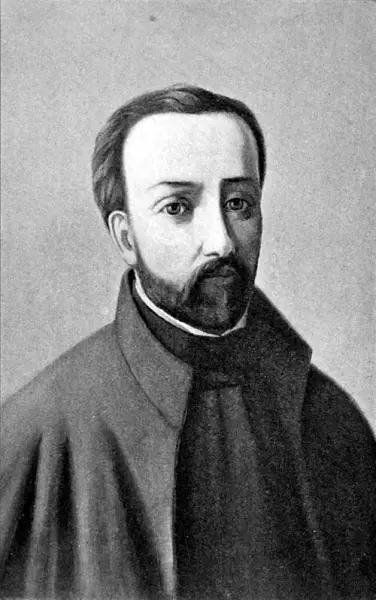
St. Gabriel Lalemant
Priest, Missionary and Martyr (Jesuit)
Overview
Gabriel Lalemant was born in Paris on 3 October 1610, the son of a lawyer; five of the family's six children entered religious life, and two of his uncles served the Jesuits in Canada — Charles as first superior of the missions, Jérôme as vicar-general of Quebec. Gabriel joined the Jesuits in 1630, vowed himself to the foreign missions in 1632, taught at Moulins, studied theology at Bourges, and was ordained there in 1638. Poor health led his superiors to refuse, again and again, his requests for New France, until his uncle Jérôme, now head of the Canadian mission, interceded for him. He reached Quebec in September 1646, spent his first two years in and around the town and at Trois-Rivières learning the Wendat language — a fellow missionary called him a man of extremely frail constitution — and in September 1648 was at last sent to Wendake as assistant to Jean de Brébeuf at Sainte-Marie among the Hurons. That February he took over from Noël Chabanel at Saint-Louis mission. The next month some 1,200 Haudenosaunee attacked Saint-Ignace while most Wendat warriors were away. Lalemant and Brébeuf stayed with the eighty defenders of Saint-Louis, were captured, and were tortured to death at Saint-Ignace — Brébeuf on 16 March 1649, Lalemant the following day, at thirty-eight. His body was recovered and carried back to Sainte-Marie; his relics now rest at the Martyrs' Shrine at Midland, Ontario.
The Complete Life
Early Life
Gabriel Lalemant was born in Paris on 3 October 1610, to a French lawyer and his wife, and the third of six children, of whom five embraced religious life, a proportion that says much about the piety of the Parisian bourgeoisie in that generation. The Jesuits were a family affair: two of his uncles belonged to the Society in New France — Charles Lalemant, first superior of the Canadian missions, and Jérôme, later vicar-general of Quebec and later the order's superior general. Gabriel grew up, in effect, with the Canadian mission as family property. He joined the Jesuits himself in 1630, and in 1632, while still a novice-sized scholastic, took the vow to devote himself to the foreign missions.
§ Life
Conversion and Vocation
The vow was easier than the permission. Lalemant's repeated requests for New France were refused by his superiors, partly on account of his poor health — a frail constitution that a fellow missionary, François-Joseph Bressani, later described as extreme. He spent the 1630s in the ordinary Jesuit circuit: teaching in the Moulins collège between 1632 and 1635, studying theology at Bourges from 1635 to 1639, ordination there in 1638, and then professor of philosophy back at Moulins. Meanwhile the Canada for which he had vowed himself went on without him. Eventually his uncle Jérôme, by then in charge of the Canadian mission, stepped in for him, and the door opened. He was thirty-six when he finally sailed.
§ Life
Mission and Ministry
Lalemant arrived at Quebec in September 1646 and spent his first months studying the Wendat language and customs. For two years he worked in and around Quebec and at Trois-Rivières, the great trading post — the settled edge of the mission, though by any other standard still a frontier. In September 1648 he was at last sent into Wendake, the Wendat homeland, as assistant to Jean de Brébeuf, the giant of the Huron mission, and posted to Sainte-Marie among the Hurons, the fortified base of the whole enterprise. In February 1649 he took over from Noël Chabanel at Saint Louis. He had been a missionary among the Wendat for five months, and in the New World just over two years, when the war came to Saint Louis.
§ Life
Trial and Final Years
In March 1649, with most of the Wendat warriors absent, twelve hundred Haudenosaunee — Iroquois of the Mohawk nation — attacked the settlement of Saint Ignace. A handful of survivors fled to warn Saint Louis, whose eighty warriors fought to delay the attackers so that the elderly, women, and children could flee. The two priests, Lalemant and Brébeuf, stayed with the warriors and were captured, taken to Saint Ignace, and tortured there with the elaborateness the Iroquois reserved for captives of standing. Brébeuf died under it on 16 March 1649; Lalemant, whose frail body was expected to fail first, survived until the next day, 17 March, aged thirty-eight. After the war party withdrew on 19 March, seven Frenchmen went to Saint Ignace, retrieved the bodies of the Jesuits and the Wendat dead, and carried them back to Sainte-Marie for burial.
§ Life
Canonization
The bones of the martyrs, carried away when Sainte-Marie itself was abandoned and burned that same year, became objects of veneration in Canada and France, and the Jesuit Relations spread the story of the deaths through Catholic Europe. Lalemant was among the eight Jesuit martyrs of North America beatified in 1925 and canonized by Pius XI on 29 June 1930. His relics rest with the others at the Martyrs' Shrine at Midland, Ontario, built on the ground of Sainte-Marie among the Hurons. His feast is kept on 26 September in Canada and 17 March in the United States. The eight who died in the Wendat missions — Brébeuf and Lalemant with Isaac Jogues and companions, killed in the 1640s — are honored together as the Canadian Martyrs, patrons of Canada.
§ Life
Legacy
Lalemant's legacy is bound up with the paradox of his death: the sickliest of the eight, who spent decades being refused the mission on grounds of health, endured torture longer than Brébeuf. The Relation of his death made that point for its seventeenth-century readers, and the point has kept its force — vocation is not measured by constitution. He is remembered with the Canadian Martyrs as a group, and of them he is the one who best illustrates the cost of delay: a lifetime asking to be sent, two years of service, five months among the Wendat, and eternity.
§ Life
Timeline
- 3 Oct 1610
Born in Paris on 3 October, son of a lawyer
§ Introduction
- 1630
Joins the Jesuits
§ Life
- 1632
Vows himself to the foreign missions; teaches at Moulins
§ Life
- 1638
Ordained at Bourges
§ Life
- Sep 1646
Arrives at Quebec in September after years of refused requests
§ Life
- Sep 1648
Sent in September to Wendake as assistant to Jean de Brébeuf
§ Life
- Feb 1649
Takes over from Noël Chabanel at Saint-Louis mission in February
§ Life
- 17 Mar 1649
Captured and tortured to death at Saint-Ignace on 17 March
§ Introduction
- 29 Jun 1930
Canonized among the eight Canadian Martyrs by Pope Pius XI
§ Introduction
The Record
- Symbols
- Martyr's palm
- Canonization
- Canonized with the seven other Canadian Martyrs by Pope Pius XI in 1930
Prayer
Bibliography
Show 6 sources
- 1 2 3 "Biography – LALEMANT, GABRIEL – Volume I (1000–1700) – Dictionary of Canadian Biography" . Retrieved 22 August 2018 .
- ↑ Campbell, T.J., Pioneer priests of North America, 1642–1710 , Vol. 2, Fordham University Press, 1910, p. 176
- 1 2 ".: The Jesuit Singapore Website :" . jesuit.org.sg . Archived from the original on 2 September 2018 . Retrieved 22 August 2018 .
- 1 2 MacDougall, Angus. "Gabriel Lalemont" [ permanent dead link ] , Wyandot official website
- ↑ "CATHOLIC ENCYCLOPEDIA: Gabriel Lalemant" . newadvent.org . Retrieved 22 August 2018 .
- ↑ Hegarty, Denis. "Excavation at Ste. Marie" (PDF) . Archived from the original (PDF) on 17 January 2022 . Retrieved 15 July 2018 .
Profile text adapted from the Wikipedia article, licensed CC BY-SA 4.0.
Pray with this saint every day
Save St. Gabriel Lalemant to your favorites, read the full profile, and get feast-day reminders in the Saints app.
Get the Saints AppFree on the App Store for iPhone and iPad