
c. 573 – 648·Feast December 23
St. Gabriel of Beth Qustan
Bishop of Tur Abdin and Abbot of Qartmin
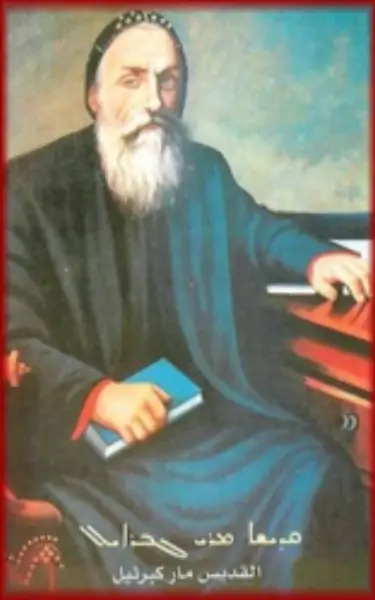
Overview
Gabriel of Beth Qustan, remembered in the Syriac tradition as Mor Gabriel and also called Saint Gabriel of Qartmin, served as Bishop of Tur Abdin until his death in 648 and gave his name to the great monastery that still bears it. Born around 573 or 574 in the village of Beth Qustan, he entered the Monastery of Qartmin as a young man of about fifteen, was ordained deacon near 594, elected head of the brothers around 612, and ordained priest about six years later. On 1 May 634 he succeeded Daniel Uzoyo as Abbot of Qartmin and Archbishop of Dara, and after 644 he became Bishop of Tur Abdin with archiepiscopal authority. In the aftermath of the Muslim conquest of Mesopotamia in 639 he is credited with settling the terms of the Syriac Orthodox community's standing across Tur Abdin with the conquerors, and may even have met the Caliph Umar himself. His hagiography credits him with raising the dead, among them a widowed mother's son at Sighun and the father of the Cross monastery by Hah. At his burial in 648 there gathered 2700 priests and altar servers and a company of bishops. Venerated as a saint by the Oriental Orthodox Church, he became patron of Qartmin, which by the end of the fifteenth century was known as the Monastery of Saint Gabriel; his feast is kept on 23 December.
The Complete Life
A Son of Beth Qustan
Gabriel was born around the year 573 or 574 in the village of Beth Qustan, in the hill country of Tur Abdin then belonging to the Eastern Roman Empire. The village lay within the living memory of the region's founding monks, and like many sons of the Syriac villages he was drawn while still young to the great Monastery of Qartmin, the spiritual center of the Tur Abdin plateau. Around 588 or 589, in his mid-teens, he received the monastic habit there and began the long formation of a Syriac monk: the cycles of prayer, the discipline of obedience, and the study of the scriptures in his own tongue. His progress in the community was steady and marked by the church's order of ministries. Around 593 or 594, after some five years in the habit, he was ordained a deacon; around 612 or 613 his brothers elected him head of the monastery, an early recognition of a gifts for governance that would define his later career; and around 618 or 619 he was ordained to the priesthood. The path from village boy to priest of Qartmin spanned roughly thirty years of monastic life, and it prepared him for responsibilities that would eventually reach from his monastery to the entire church of Tur Abdin.
§ Biography
Abbot and Archbishop of Dara
On 1 May 634 Gabriel was raised to the highest offices of his church in the region, becoming Abbot of the Monastery of Qartmin and Archbishop of Dara, succeeding Daniel Uzoyo in both dignities. The combination of abbatial and episcopal authority reflected the pattern of the Syriac East, where the great monasteries were also the centers of episcopal administration. His tenure fell in one of the most convulsive decades of the region's history. In 639 the Muslim conquest of Mesopotamia reached the lands under his care, and the Christian communities of Tur Abdin passed under a new political order. The sources credit Gabriel with striking the settlement that would govern Syriac Orthodox life across Tur Abdin under the new masters, winning for his people a recognized place within the new dispensation; it is even possible that he met with the Caliph Umar himself, an encounter preserved in the tradition of the church he led. After 644 he became Bishop of Tur Abdin with authority equal to that of an archbishop, completing a career in which one man held, in succession or together, the offices of monk, deacon, priest, abbot, archbishop of Dara and bishop of the whole mountain region.
§ Biography
Miracles of the Raising of the Dead
The hagiographic tradition of Tur Abdin remembers Gabriel above all as a bishop through whom the boundary between the living and the dead was twice crossed. Several miracles of resurrection are attributed to his time as bishop: he brought a widowed mother's son back from death at Sighun, called a boy of Olin out of the grave, and returned life to his friend, the father of the Cross monastery by Hah. A further story tells of his old age, when he was seventy: he sent men to transport a great stone from Beth Debe to the Monastery of Qartmin, but they were forced to leave it by the roadside because of its size. Gabriel ordered the people of the monastery to come and help move it, and at his word the dead rose from their graves to join the work, and the stone was brought to the Dome of Theodora at the monastery. The bishop, moved by what he had done, begged the dead for their forgiveness. The story catches the double character of his cult, power and humility bound together: the saint who commands the graves is also the servant who apologizes to them. In the same spirit his negotiations with the conquerors of 639 preserved the church of Tur Abdin, so that the lives of the living were guarded with the same care he showed for the dead.
§ Biography
A Life Ordered by the Monastery
Behind the miracles and the diplomacy, the life of Gabriel displays the spiritual architecture of Syriac monasticism. From his entrance at Qartmin around 588 to his death sixty years later, every stage of his life followed the order of the community: the years of probation as a young monk, ordination as deacon when the community saw fit, election by the brothers as their head, priesthood, and finally the abbatial office. His authority was always rooted in the monastery; even as archbishop of Dara and bishop of Tur Abdin he remained Abbot of Qartmin, and the monk's virtues of obedience, stability and ceaseless prayer are what his hagiography presupposes in the man who could command the dead. The famous story of the stone at Beth Debe, in which he begged forgiveness of those he had raised, discloses the interior disposition the tradition admired: the power of a saint joined to the humility of a monk who knows that even holy commands must be tempered by reverence for those they touch. His care for the widow's son at Sighun and the boy of Olin shows the same pastoral instinct reaching beyond the monastery walls into the villages of the plain, while his dealings with the Caliph's officers show the same charity extended to the church's new rulers. It is this fusion of monastic discipline and public responsibility that his cult has handed on.
§ Biography
A Funeral of 2700 Priests
Gabriel died on 23 December 648, having served as bishop of Tur Abdin in his final years with the authority of an archbishop. The account of his funeral conveys the stature he had attained across the Syriac church: 2700 priests and altar boys attended, and the procession of bishops included Iwannis of Amida, Ignatius of Mayperqat, Gregory of Arzon, Basil of Jazira, Polycarp of Beth Araboye, Dioscorus of Singara and Haburo, Epiphanius of Nisibis, Sisinnius of Dara, John of Kfar Tutho, and Jacob of Sawro, an assembly of the episcopate of the whole region. Even at his burial the tradition records a raising of the dead: a ten-year-old boy died at the funeral and was soon restored to life, and in later memory this child was identified with Simeon of the Olives, who would himself grow into one of the celebrated saints of early Islamic North Mesopotamia. The story made the bishop's tomb a place where death was understood to be defeated, and it tied Gabriel's intercession to the next generation of holiness. He was buried with his people at Qartmin, the monastery he had entered as a boy and ruled as abbot, and there his body waited for the extraordinary events of the following century.
§ Biography
Veneration at Qartmin and Hah
Gabriel was venerated as a saint of the Oriental Orthodox Church from an early period, without the formal processes of later centuries. The decisive testimony to the power of his cult came in 774, more than a century after his death, when a plague struck the region and the monks of the Monastery of Qartmin exhumed his remains, believing that the presence of their holy bishop would drive the pestilence away. In the course of this translation his right hand was removed and taken to the village of Hah, near the Monastery of the Cross whose abbot he had raised, while his body was reburied with honor in a bronze coffin. The event fixed his patronage over the community: Qartmin acknowledged him as its patron, and before the fifteenth century closed the house was so completely identified with him that it became known simply as the Monastery of Saint Gabriel, the name it carries in Turkish Mesopotamia to this day as a living center of the Syriac Orthodox Church. His feast is kept on 23 December, the anniversary of his death, and his cult stands among the oldest continuous local saints' cults of Tur Abdin, binding the modern monastery to the bishop who defended its church in the first generation of Islamic rule.
§ Biography
The Monastery of Saint Gabriel
The most enduring monument to Gabriel is the monastery that took his name. The Monastery of Qartmin, founded centuries before his birth, had shaped his whole life; after his death his relics returned the gift, and the transformation of Qartmin into the Monastery of Saint Gabriel by the end of the fifteenth century made the abbot the school's lasting identity. His memory also spread to the places touched by his miracles: his right hand rested at Hah, scene of his raising of the Cross monastery's abbot, while the boy restored to life at the funeral grew into Simeon of the Olives, bishop and builder, whose own cult in North Mesopotamia carried the story of Gabriel's tomb into new generations. Historians of the Syriac church remember him as a figure of the transition age, the bishop who stood between the Byzantine past and the Islamic future of Tur Abdin and obtained terms under which his church could survive. In the hagiography of the region he remains the friend of the dead and the defender of the living, the man who moved a stone too heavy for the living alone. The Oriental Orthodox Church keeps his memory on 23 December each year, and the scholars who have reconstructed his life, notably through the studies of Palmer and Johnson, have confirmed how deeply his cult is woven into the documented history of the Tigris frontier.
§ Biography
Timeline
- 573
Born in the village of Beth Qustan, around 573-574.
§ Biography
- 588
Became a monk at the Monastery of Qartmin, around 588-589.
§ Biography
- 593
Ordained a deacon, around 593-594.
§ Biography
- 612
Elected head of the brothers at the Monastery of Qartmin, around 612-613.
§ Biography
- 618
Ordained a priest, around 618-619.
§ Biography
- 1 May 634
Became Abbot of the Monastery of Qartmin and Archbishop of Dara, succeeding Daniel Uzoyo.
§ Biography
- 639
After the Muslim conquest of Mesopotamia, likely negotiated the rights of the Syriac Orthodox Church in Tur Abdin with the conquerors, and may have met the Caliph Umar.
§ Biography
- 644
Became Bishop of Tur Abdin with authority equal to an archbishop, after 644.
§ Biography
- 23 Dec 648
Died on 23 December; 2700 priests and altar servers joined his funeral procession, with bishops of Amida, Mayperqat, Nisibis, Dara and other sees in attendance.
§ Biography
- 774
During a plague, the monks of Qartmin exhumed his remains to ward off the pestilence; his right hand was taken to Hah and his body reburied in a bronze coffin.
§ Biography
The Record
- Patron of
- Monastery of Saint Gabriel (Qartmin)·Tur Abdin
- Canonization
- Pre-congregation saint of the Syriac Oriental Orthodox tradition, venerated since his death in 648.
Prayer
Bibliography
Show 4 sources
- Palmer, Andrew (1990). Monk and Mason on the Tigris Frontier: The Early History of Tur 'Abdin. Cambridge University Press. ISBN 9780521360265.
- Johnson, Dale A. (2008). Tracts on the Mountain of the Servants. Lulu.com. ISBN 9781435739918.
- Brunner, Kyle B. (2021). "Appendix 1. Simeon at the funeral of Mor Gabriel". The Life of Simeon of the Olives: An Entrepreneurial Saint of Early Islamic North Mesopotamia. Gorgias Press LLC. pp. 165-168. ISBN 978-1-4632-4346-3. Retrieved 6 March 2025.
- Syriac Orthodox Church of Antioch - Archdiocese of the Western U.S.
Profile text adapted from the Wikipedia article, licensed CC BY-SA 4.0.
Pray with this saint every day
Save St. Gabriel of Beth Qustan to your favorites, read the full profile, and get feast-day reminders in the Saints app.
Get the Saints AppFree on the App Store for iPhone and iPad