
1684 – 1690·Feast April 20
St. Gabriel of Białystok
Child Martyr Venerated in the Orthodox Church
Overview
Gabriel of Białystok, also called Gabriel of Zabłudów, is a child saint of the Eastern Orthodox Church who died at the age of six in 1690. According to the tradition preserved by his venerators, the boy was kidnapped from his home village of Zwierki while his parents worked in the fields, taken to Białystok, killed, and his body returned and abandoned in a field; the boy's body was buried at Zwierki and found incorrupt when the grave was accidentally opened in 1720. His relics were moved to Zabłudów in 1746 and to the Monastery of the Holy Trinity in Slutsk in 1755, and his cult, fed by reputed healings at his grave, spread through the Russian Empire, leading to his beatification and canonization in 1820. His veneration is entangled with a grave history: the accusation attached to his death, repeated in placards and books, was a classic blood libel against Jews, and modern authorities, including Jewish organizations and the United States State Department, have warned that the cult can be exploited to foment antisemitism. Many Orthodox bodies have therefore framed his memory carefully; the Orthodox Church in America commemorates him as a child martyr while naming his assailants only as 'evil people', stressing evil that is possible to anyone regardless of ethnicity or creed. He is honored as patron of children and of sick children, his feast kept on 20 April of the Julian calendar.
The Complete Life
A Child of Zwierki
Gabriel was born on 2 April 1684 in the village of Zwierki, some thirteen kilometers from Zabłudów in the Grodno Uezd of the Grand Duchy of Lithuania, a village that lies in Poland today. His parents, Peter and Anastasia Govdel, were pious Orthodox Christians, and the boy was raised in the faith of the eastern villages of the old Commonwealth, where Orthodox and Catholic and Jewish neighbors lived side by side. Of his short life the sources preserve almost nothing beyond the circumstances of his death, which came before he had reached his seventh year. According to the tradition cherished by the faithful, the six-year-old was kidnapped from his home during the Jewish Passover, at a season when his parents were at work in a nearby field and the child was left at home. The tale that grew around his fate accused Shutko, a Jewish arendator of Zverki, of carrying the boy off to Białystok, torturing and killing him over nine days, and returning the body to be dumped in a local field. Whatever the historical truth of that accusation, which many authors, especially from the Jewish community, regard as a medieval blood libel attached to a real child's grave, the village memory kept the boy himself, and it was at his grave that his cult began.
§ Biography
Death and a Grave Found Incorrupt
Gabriel died in 1690 at the age of six, and his body was buried at Zverki, in that part of the local cemetery where the children who died in times of plague would later be laid. There the story might have ended, one small grave among many, had it not been for an event in 1720. During a funeral held that year the boy's grave was accidentally unearthed, and his remains were found to be incorrupt, a sign that the faithful read as testimony to his holiness. The body was transferred to the crypt of the Orthodox church at Zverki, and from that quiet crypt his cult began its long growth, nourished above all by the healings that the faithful attributed to his grave. The movement of his relics over the following centuries traces the devotion of the region: to Zabłudów in 1746, onward through various places, and in 1755 to the Monastery of the Holy Trinity at Slutsk in the Minsk Guberniya. At that translation a notice on public display asserted that a Jew bore guilt for the child's death, tying the boy's cult to the old and poisonous accusation, even as the simple veneration of a suffering child continued to spread among the Orthodox people of Belarus, Poland and the wider Russian Empire.
§ Relics and canonisation
Canonization and the Wanderings of the Relics
The cult of the child of Zverki grew so strong within the Russian Empire that the Church formally raised him to the altar: he was beatified on 13 March 1820 and canonized on 13 September of the same year, and he came to be honored as the patron saint of children and especially of sick children. His feast is kept on 20 April of the Julian calendar, corresponding to 3 May on the Gregorian. The twentieth century carried his relics through trials that mirrored those of the Church itself: in the 1930s the Soviet authorities placed them in the Minsk Museum of Atheism, an exhibit arrayed against the faith; in 1944 they went to Grodno, remaining there across the long decades that followed. In 1992, with the revival of religious life in the post-Soviet lands, the relics were moved to Białystok, the city bound to the boy's story, where they remain the focus of pilgrimages. The Orthodox Church in America, within the communion of Russian Orthodoxy, has continued to commemorate Gabriel of Białystok as a child martyr and saint, and the Great Synaxaristes of the Greek Church likewise records him among the martyrs of 20 April.
§ Relics and canonisation
A Cult Guarded Against Hatred
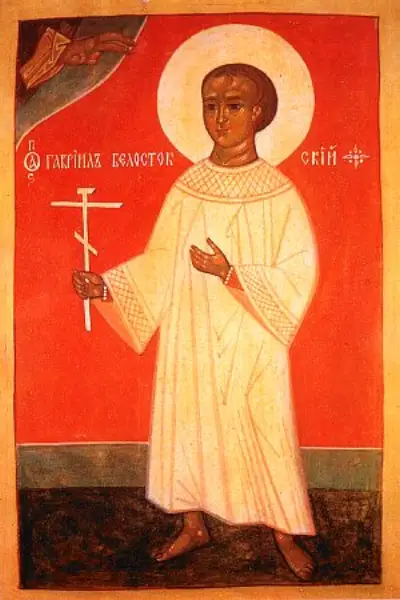
Because the tradition of Gabriel's death accused Jews of ritual murder, his veneration has carried a heavy modern burden, and the Church's handling of his memory has become part of his story. In 1997 the Euro-Asiatic Jewish Congress's first deputy, Yakov Basin, brought a warning that year before the Union of Councils for Soviet Jews: modern tellings of ritual murder, he wrote, were digging the medieval canard of ritual blood back up, noting how the libel had been bolstered in 1844 by Vladimir Dal's book on the subject. That same year, on 27 July, a film depicting the legend aired on Belarusian television and was criticized by Leonid Stonov as an exploitation of the blood libel, and and State Department reporting from the United States on religious freedom, passed on to the UNHCR, named the cult's Belarusian revival among the expressions of antisemitism in the country. Against this the Orthodox Churches have increasingly framed the commemoration with care: the Orthodox Church in America, continuing his veneration as a child martyr, uses the kontakion of his feast to name those who attacked him only as 'evil people', a wording that stresses what fallen human nature is capable of, whatever its ethnicity or creed. Gabriel stands in the calendar among the child saints, his icon showing him in white robes with a martyr's cross, remembered best when his memory protects the little ones rather than poisoning the relations of peoples.
§ Blood libel concerns
Timeline
- 2 Apr 1684
Born in the village of Zwierki, about 13 km from Zabłudów, to the pious Orthodox couple Peter and Anastasia Govdel.
§ Biography
- 20 Apr 1690
Died at the age of six; by tradition he was kidnapped during the Jewish Passover and killed, and his body was found in a field near Zwierki.
§ Biography
- 1720
At a funeral in 1720 the grave was opened by chance; the body within proved incorrupt, and the remains were moved to the crypt of Zwierki's Orthodox church.
§ Relics and canonisation
- 1746
Relics transferred to Zabłudów and afterwards to various locations.
§ Relics and canonisation
- 1755
Relics transferred to the Holy Trinity monastery at Slutsk in the Minsk Guberniya; a notice posted there asserted Jewish guilt for the boy's death.
§ Relics and canonisation
- 13 Mar 1820
Beatified as the cult of the child saint spread throughout the Russian Empire.
§ Relics and canonisation
- 13 Sep 1820
Canonized; from then on honored as the patron of children.
§ Relics and canonisation
- 1844
Vladimir Dal's book on the alleged ritual murder of Christian children further bolstered the blood-libel accusation attached to his death.
§ Blood libel concerns
- 1944
Relics, which had spent the 1930s in the Minsk Museum of Atheism, were moved to Grodno, where they remained until 1992.
§ Relics and canonisation
- 1992
Relics moved to Białystok, where they remain the focus of pilgrimages.
§ Relics and canonisation
- 27 Jul 1997
A film depicting the legend of his death aired on Belarusian television and was criticized as an exploitation of the blood libel.
§ Blood libel concerns
In Their Own Words
Contemporary accounts, which claim that Jews murdered a boy in a ritual manner in order to use his blood, are resurrecting the medieval canard that Jews use the blood of Christian babies for their ritual purposes during pre-Passover days.
The Record
- Patron of
- children·sick children
- Symbols
- martyr's cross·white robes
- Canonization
- Beatified 13 March 1820 and canonized 13 September 1820; venerated in the Eastern Orthodox Church.
Prayer
Bibliography
Show 10 sources
- Great Synaxaristes: Ὁ Ἅγιος Γαβριὴλ ὁ Μάρτυρας. 20 Απριλίου. ΜΕΓΑΣ ΣΥΝΑΞΑΡΙΣΤΗΣ (in Greek).
- "Childmartyr Gabriel of Bialystok". Orthodox Church in America (OCA). Retrieved 3 May 2021.
- "April 20/May 3". Orthodox Calendar (PRAVOSLAVIE.RU).
- "Святой Гавриил". church.by. Archived from the original on 7 February 2012. Retrieved 2025-07-25.
- Petrovska, Anna. "Prawosławne uroczystości ku czci Męczennika Gabriela w Zwierkach". Polskie Radio Białystok. Retrieved 3 May 2021.
- Basin, Dr. Yakov (August 10, 1997). "Blood Libel Accusation Revived". UCSJ Position Paper. Belarus - Chronicle of Antisemitism. April-December, 1997.
- Stonov, Leonid (2 September 1997). "Неужели новое на постсоветском пространстве - это только незабытое старое?" [Is the New in the Post-Soviet Space Only the Forgotten Old?]. Vestnik (in Russian). 19 (173).
- Belarus. International Religious Freedom Report 2006. Released by the Bureau of Democracy, Human Rights, and Labor.
- Prokurat, Michael, ed. (1996). The A to Z of the Orthodox Church. Lanham, Maryland: Scarecrow Press. p. 217. ISBN 978-0-8108-7602-6.
- Харкевич, Я.; Черепица, В. Н. (2005). "Гавриил Белостокский". Православная энциклопедия — Т. X: Второзаконие — Георгий. Православная энциклопедия. pp. 200-202. ISBN 5-89572-016-1.
Profile text adapted from the Wikipedia article, licensed CC BY-SA 4.0.
Pray with this saint every day
Save St. Gabriel of Białystok to your favorites, read the full profile, and get feast-day reminders in the Saints app.
Get the Saints AppFree on the App Store for iPhone and iPad