
1750-1815·Feast September 14
St. Gabriel Taurin Dufresse
Bishop and Martyr
Overview
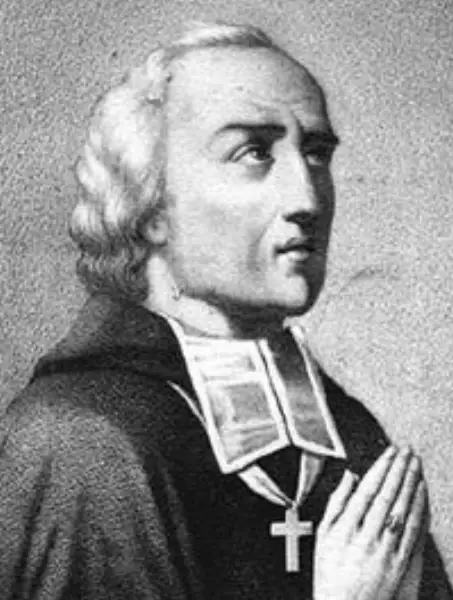
Born at Ville-de-Lezoux near Clermont in 1750, Gabriel-Taurin Dufresse studied at Riom, at Louis-le-Grand in Paris and finally at the Saint-Sulpice seminary, where a teacher's stories of the East turned his heart toward the Paris Foreign Missions Society. Ordained a priest of that society in September 1774, he sailed for China the next year and reached Sichuan in 1776 after months of overland travel. When persecution broke out in late 1784 he escaped arrest, then surrendered himself at the coadjutor bishop's request to calm the panic, and was carried a prisoner to Beijing before being released in November 1785 — famously, one of his guards on that march was so moved by him that he asked for baptism: the future martyr Augustine Zhao Rong. Barred from returning directly, Dufresse worked his way back via Canton, Manila and Macau, reaching Sichuan again in January 1789. Consecrated titular bishop of Thabraca and coadjutor, he became Vicar Apostolic of Se-Ciuen (Sichuan) in 1801, and two years later convened at Chongqingzhou the Synod of Szechwan, the first Catholic synod held in China, whose decisions Rome praised as a model for the other missions. New edicts forced him into hiding from 1805; betrayed by an informer, he was seized on 18 May 1815 and beheaded at Chengdu on 14 September 1815, his head displayed on a pole and his body exposed for three days before local Christians buried it.
The Complete Life
Early Life
Gabriel-Taurin Dufresse was born at Ville-de-Lezoux in the diocese of Clermont, France, on 8 December 1750. After the parochial school in his village came the college at Riom, and then Paris, where his studies led him first to Louis le Grand and afterwards to the seminary of Saint Sulpice. At the college one of his teachers, the Abbe Jean-Didier de Saint Martin, who later left for China himself, told him of the Paris Foreign Missions Society. In July 1774 Dufresse entered the Society's seminary as a deacon, and on 17 September that same year — aged only twenty-three — he received priestly ordination. He was sent out as a missionary to Sichuan in western China in December 1775, and left Macau for the interior in 1776, reaching the province after more than three months of travel.
§ Early life
Mission and Ministry
Once he had learned enough Chinese, Bishop Pottier sent Dufresse to the north of the province. Late in 1784 a persecution aimed at Christians erupted; seized by the authorities, he got away to the house of a sympathetic Christian family, where a note reached him from Monsignor de Saint-Martin, the coadjutor bishop, asking that he surrender himself so the unrest might be calmed. He complied, reaching Chentu on 27 February 1785, and after some weeks in prison was moved to Beijing together with de Saint-Martin and two more missionaries, Delpon and Devaux; harsh interrogations followed until his release on 9 November 1785. Barred from Sichuan, he made his way by Canton, the Philippines, and a long stay in Manila back to Macau, and thence under very difficult conditions back to Sichuan, arriving on 14 January 1789. He resumed the full missionary round, baptizing children and adults, receiving catechumens, hearing thousands of confessions, and visiting the communities; after four years he was named provost, and then titular bishop of Thabraca and coadjutor vicar apostolic, succeeding as Vicar Apostolic of Se-Ciuen on 15 November 1801.
§ Sichuan
Trial and Final Years
In September 1803, now a bishop, Dufresse convened the Synod of Szechwan at Chongqingzhou — the first Catholic synod ever held on Chinese soil; Rome warmly approved its decisions, which were held up as a model for the missions elsewhere. From 1805 onward, however, edicts of proscription reappeared at the instigation of local scholars; the Viceroy of Szechwan issued new decrees and Dufresse resumed a hunted, wandering life. A native Christian betrayed him to the authorities, and his arrest followed on 18 May 1815, with a death sentence passed. He was beheaded at Chengdu on 14 September 1815. As a public warning his head was set atop a pole and the body left on display for three days before local Christians laid it to rest; four years afterwards a Chinese priest called Lin, having obtained the head from monks who had preserved it, transferred the remains to the Catholic cemetery, recovering the head through monks who had kept it.
§ Death and burial
Canonization
Bishop Perocheau dispatched Dufresse's relics to Hong Kong in 1856; a year later they were carried to Paris, where they now lie in the crypt of the Foreign Missions' seminary church. On 2 July 1899 Pope Leo XIII pronounced him venerable, and he was raised to the altars as blessed on 27 May 1900. On 1 October 2000 Pope John Paul II canonized him among the 120 Martyr Saints of China, a date that fell on the feast of Therese of Lisieux, patroness of the missions. His feast day is 14 September, the anniversary of his beheading, which he shares with the feast of the Exaltation of the Holy Cross.
§ Veneration
Legacy
Dufresse's most durable legacy is the church of Sichuan itself, the largest Chinese Catholic community of his era, which he governed for fourteen years and regulated through the first synod held on Chinese soil. His influence ran through the people he made: among the prisoners in his 1785 convoy was a guard converted by his patience, the future Augustine Zhao Rong, the first Chinese-born diocesan priest and a martyr of 1815, and Joseph Yuan, likewise converted in that persecution, ordained, and strangled in 1817. Two of the three men connected by that convoy are now saints of the same canonized group of 120, a genealogy unique in the history of the missions.
§ Sichuan
Timeline
- 8 Dec 1750
Born at Ville-de-Lezoux in the Diocese of Clermont, Kingdom of France.
§ Early life
- Jul 1774
Entered the Paris Foreign Missions Society seminary as a deacon.
§ Early life
- 17 Sep 1774
Ordained a Catholic priest.
§ Early life
- Dec 1775
Sent out as a missionary to Sichuan in western China.
§ Sichuan
- 1776
Left Macau for the interior and reached Szechwan after a journey of more than three months.
§ Sichuan
- 27 Feb 1785
Surrendered at Tchen-Tou during the anti-Christian persecution and was imprisoned before transfer to Peking.
§ Sichuan
- 9 Nov 1785
Set free after painful interrogations in Peking; a guard converted during the prisoner convoy, becoming Augustine Zhao Rong.
§ Sichuan
- 14 Jan 1789
Regained Sichuan by way of Canton, Manila and Macau after being barred from a direct return.
§ Sichuan
- 24 Jul 1798
Appointed titular bishop of Thabraca and coadjutor Vicar Apostolic of Se-Ciuen.
§ Introduction
- 25 Jul 1800
Received episcopal consecration from Bishop Jean-Didier de Saint Martin.
§ Introduction
- 15 Nov 1801
Succeeded de Saint Martin as Vicar Apostolic of Se-Ciuen.
§ Introduction
- Sep 1803
Convened the Synod of Szechwan at Chongqingzhou, the first Catholic synod celebrated in China.
§ Bishop
- 18 May 1815
Betrayed by a native Christian, arrested and condemned to death amid renewed proscription edicts.
§ Death and burial
- 14 Sep 1815
Beheaded at Chengdu; his head was fixed to a pole and his body exposed for three days.
§ Death and burial
- 1819
A Chinese priest named Lin moved his remains to the Catholic cemetery four years after the execution.
§ Death and burial
- 1856
His relics were dispatched to the Foreign Missions procurator in Hong Kong by Bishop Jacques-Léonard Pérocheau.
§ Veneration
- 1857
Bishop Pellegrin carried the relics to Paris, where they rest in the seminary church crypt of the Foreign Missions.
§ Veneration
- 2 Jul 1899
Declared venerable by Pope Leo XIII.
§ Veneration
- 27 May 1900
Beatified by Pope Leo XIII.
§ Veneration
- 1 Oct 2000
Canonized by Pope John Paul II among the 120 Martyrs of China, on the feast of Thérèse of Lisieux.
§ Veneration
The Record
- Major works
- Convened the Synod of Szechwan (1803), the first Catholic synod celebrated in China
- Canonization
- Declared venerable by Pope Leo XIII on 2 July 1899 and beatified by him on 27 May 1900; canonized by Pope John Paul II on 1 October 2000 among the 120 Martyrs of China
Prayer
Bibliography
Show 8 sources
- ↑ "Sts. Augustine Zhao Rong, priest and Companions, Chinese Martyrs" . Vatican News . Retrieved 22 April 2026 .
- ↑ "},"date":{"wt":""},"website":{"wt":"Catholic Ireland"},"publisher":{"wt":""},"access-date":{"wt":"22 April 2026"},"quote":{"wt":""}},"i":0}}]}' id="mwew"/> "Jul 9 - St Augustine Zhao Rong (d. 1815) & many other Chinese martyrs" . Catholi
- ↑ "},"date":{"wt":""},"website":{"wt":"EWTN"},"publisher":{"wt":""},"access-date":{"wt":"22 April 2026"},"quote":{"wt":""}},"i":0}}]}' id="mwhQ"/> "Sts. Augustine Zhao Rong and Companions" . EWTN . Retrieved 22 April 2026 .
- 1 2 "Saint Louis Gabriel Taurin Dufresse, M.E.P." Catholic-Hierarchy.org . David M. Cheney . Retrieved 5 December 2014 .
- ↑ "},"website":{"wt":"[[Paris Foreign Missions Society|mepasie.org]]"},"language":{"wt":"fr"},"access-date":{"wt":"24 August 2022"},"archive-url":{"wt":"https://web.archive.org/web/20110815012317/http://www.mepasie.org/rubriques/haut/pays-d
- ↑ Henri Cordier (1913). "Martyrs in China" . In Herbermann, Charles (ed.). Catholic Encyclopedia . New York: Robert Appleton Company.
- ↑ "Canonized Martyrs of China" . The Hagiography Circle . Retrieved 5 December 2014 .
- ↑ "Saint Jean-Gabriel-Taurin Dufresse" . saints.sqpn.com . Retrieved 5 December 2014 .
Profile text adapted from the Wikipedia article, licensed CC BY-SA 4.0.
Pray with this saint every day
Save St. Gabriel Taurin Dufresse to your favorites, read the full profile, and get feast-day reminders in the Saints app.
Get the Saints AppFree on the App Store for iPhone and iPad