
1929 – 1995·Feast October 20
St. Gabriel (Urgebadze) of Georgia
Confessor and Fool for Christ of Samtavro
Overview
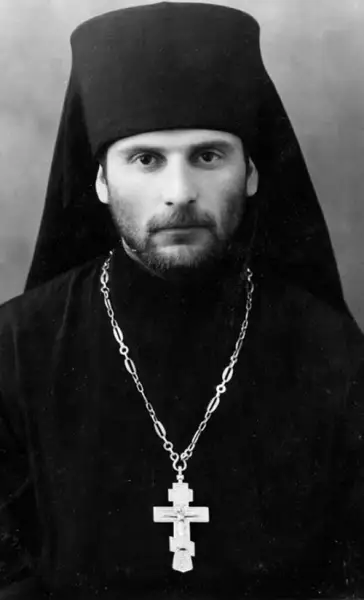
Gabriel of Georgia, born Goderdzi Urgebadze, was a Georgian Orthodox monk whose fearless faith under Soviet rule and radical asceticism made him one of the most beloved saints of the modern Georgian Church. Born in Tbilisi in 1929 and raised fatherless in a family that remembered Christ only faintly, he bought his first Gospel as a schoolboy with coins he had saved. Refused his mother's blessing for the monastic life, he left home for the great monasteries of Georgia and, after army service, built himself a hut in the family courtyard where he prayed in solitude. Ordained deacon and hieromonk in 1955, he served at Sioni Cathedral, at Betania Monastery and at the Old Trinity Church of Tbilisi. On 1 May 1965 he burned a large portrait of Lenin during a May Day demonstration, declaring that glory belonged not to a dead man but to Christ who conquered death. Beaten nearly to death and confined by the authorities to a psychiatric hospital, he was barred from serving liturgically and embraced the ascetic path of the fool for Christ, preaching openly in the streets. As abbot of the women's monastery of Samtavro from 1971 he lived in a tower and later in an unheated hut, recovered a hidden fragment of the Holy Cross revealed to him in a vision, and died at Mtskheta on 2 November 1995. Canonized in 2012, his incorrupt relics now rest in a crypt at Samtavro, drawing pilgrims from across the Orthodox world.
The Complete Life
A Schoolboy and His Gospel
Goderdzi Urgebadze came into the world at Tiflis on 26 August 1929; his baptism followed in infancy, at the Church of Great Martyr Barbara in Navtlugi. His father, Vasili, died in circumstances never made clear when the boy was two years old, and the family called him Vasiko thereafter, in memory of the father he could not remember. He began school at six, and it is said that Christ's name first reached him in his seventh year, an encounter that changed the shape of his childhood: he saved his money and purchased a Gospel of his own. He grew up in a time of communist persecution, when the faithful stashed icons away in attics and other hiding places for safety. The boy would ask for any of these rescued icons once a household had no further use for them, and the images he gathered in this way are preserved today in the church he later built and in the tower of the women's monastery of Samtavro. His mother, Varvara, was not irreligious, but she opposed his longing for the monastic life, and her resistance drove him from the family home on pilgrimage to the monasteries of Samtavro, Svetitskhoveli, Shio-Mgvime, Zedazeni and Betania, the last of which became his principal spiritual influence. In time she took the veil as the nun Anna, and mother and son now rest near one another in the courtyard of Samtavro.
§ Early years
Tonsure and Priesthood
Conscripted into the Soviet Army in 1949, Goderdzi kept his faith quietly, keeping his fasts hidden while garrisoned at Batumi and finding his way to St. Nicholas Church for the liturgy. After his discharge in the 1950s he gave himself wholly to the spiritual life. He put up a hut in the family courtyard as a hermitage of solitude and prayer, worshipped at Sioni Cathedral, and, favored with the blessing of Catholicos-Patriarch Melchizedek III, found work first keeping watch and afterwards reading the psalms. In January 1955 he was ordained a deacon, and on 23 February of that year he was professed as a monk at Motsameta near Kutaisi and given the religious name Gabriel, after Gabriel the Iberian. On 26 February, three days on, Bishop Gabriel Chachanidze made him a hieromonk at the Cathedral of Saints Peter and Paul. Sioni Cathedral claimed his service from 1955 through 1960, after which he labored at Betania Monastery from 1960 to 1962 alongside George Mkheidze, his spiritual father, and the Hieromonk Vasil Pirtskhalava. Both of these fathers died in 1962, the government shut Betania, and Father Gabriel went back to Tbilisi, bringing to completion a seven-domed house-church in the family's own yard and ministering at the Old Trinity Church between 1962 and 1965.
§ Beginning of Monastic Service
The Burning Portrait
On 1 May 1965, in the midst of the May Day demonstration, Hieromonk Gabriel performed the deed that fixed his confession of Christ in memory: a large portrait of Lenin went up in flames at his hand. Before the crowd he proclaimed that a dead man deserved no glory — glory belonged to Christ, who had conquered death and conferred eternal life upon us. The demonstration turned against him; the crowd beat him savagely, the authorities declared a top-level emergency, and servicemen stepped in to save his life. Arrested with a broken jaw and multiple fractures, he was taken to a KGB isolation facility, where investigators tried to force him to confess that the burning had been ordered by church authorities, offering leniency in return. He refused, and called Lenin a beast again, for which he was beaten once more. The incident drew international attention, reported in European and American newspapers, and the sentence that fell to him was not execution but psychiatric commitment in August 1965, from which he was released after three months, partly through the advocacy of the academician Avlipi Zurabashvili. Though his rank as priest was left to him, he was forbidden to serve liturgically; he attended the services as an ordinary believer and received communion among the laity, while the KGB summoned and abused him repeatedly. In this enforced marginality he took up the ancient vocation of the fool for Christ, preaching openly in the streets and embracing behavior the world could only call madness.
§ Protest Against Soviet Power
Tower, Hut, and Vision of the Cross
In 1969 the authorities demolished the small church Father Gabriel had built; he answered by rebuilding it, this time with a single dome. His ascetic life deepened in the years that followed. In 1971 he was named abbot of the women's monastery of Samtavro with its seminary, taking up residence in the monastery's tower. From 1972 until 1990 he went on pilgrimage to those monasteries and churches the Soviet era had shuttered or deserted, keeping their memory before the faithful. In 1987 he left the tower for a small wooden hut that had once served as a chicken coop, and there he lived through the bitter winters without heating as a deliberate discipline of poverty. It was in this period that he beheld in a vision an angel of God, who disclosed where a piece of the venerable Cross of Svetitskhoveli lay hidden, showing him the very spot. With the nuns of the monastery he later brought the sacred piece to light, which is kept today at Samtavro. In 1990 he withdrew to Shio-Mgvime in search of still deeper quiet, but a heavenly vision bade him go back to Samtavro, and he resumed his cell in the old tower once more. Through his last years his preaching was summed up in a few imperatives: love, repentance, humility, and kindness.
§ Later Years
A Foretold Passing
The saint's final years were marked by bodily suffering accepted with patience. Dropsy took hold of him, and a broken leg then kept him abed for a year and a half; yet in spite of grievous pain he would sometimes come outdoors to sit by the church, where those who sought him could see him. His preaching in these last years was simple and direct, urging on all who listened the love of God and of one another, penitence, lowliness of heart and kindness. He announced to those about him, a day in advance, that his passing was at hand, and on 2 November 1995 he died at Mtskheta at the age of sixty-six. His burial followed the ancient monastic rite: no coffin, only a plain shroud, and a grave in the courtyard of the monastery he had served, and his grave was marked with the words that serve now as epitaph and lesson alike: that truth dwells in the spirit's immortality. Orthodox believers came quickly to venerate the place, and the oil from the lamp that burned constantly at his tomb came to be regarded as miraculous, while his remains were held by the faithful to be incorrupt and his intercession marked by powers of healing and clairvoyance attributed to him in life and after death.
§ Later Years
Glorification and the Pilgrims of Samtavro
On 20 December 2012 the Holy Synod of the Patriarchate of Georgia enrolled Gabriel in the calendar of saints, glorifying him under the title of venerable father Gabriel, confessor and holy fool. His grave at Samtavro had already become one of the great pilgrimage sites of the country, and the canonization confirmed what the pilgrims had long known. In January 2014 rumors spread that the saint, appearing in a vision to a nun at Mtskheta, had pledged that pilgrims coming to his tomb just before the Orthodox Christmas of 7 January would have two wishes granted; mass gatherings followed, and extra police units had to be deployed to manage the traffic. Church officials and the nun said to have seen the apparition later dismissed the visions as false, an episode that showed both the fervor and the fragility of popular devotion. On 22 February 2014 the saint's remains were lifted from the grave to await interment in a special crypt at Samtavro. On the way to that reburial his body visited four great Orthodox cathedrals across Georgia, drawing many thousands of the faithful from every corner of the land to venerate the confessor who had stood alone against an empire. An akathist prayer to Saint Gabriel has since been composed and published in English, extending his veneration beyond Georgia.
§ Veneration
The Saint of Mtskheta
Saint Gabriel left behind him a landscape of holy places rather than writings. The church he built at 11 Gia Bakarashvili Street in Tbilisi still stands, its interior filled with objects he gathered from churches demolished across Georgia, a living museum of what the Soviet years tried to erase. The icons he rescued as a boy from attics during the persecution rest in that church and in the tower of Samtavro, and the fragment of the Holy Cross of Svetitskhoveli that his vision recovered is kept at the monastery as one of its treasured relics. His principal shrine is Samtavro Monastery at Mtskheta, where he served as abbot, where his grave lies in the courtyard beside his mother, nun Anna, and where his relics now rest in a crypt. There pilgrims venerate the saint whom the Church honors on 20 October, the day kept on the new calendar for his repose on 2 November of the old. He is depicted in icons in his monastic habit with his pectoral cross, prayer rope and cane, the plain instruments of his ascetic life, and he is honored as a patron of Georgia itself, the nation whose faith he confessed with his body when he stood in the May Day crowd and gave the glory to Christ alone.
§ Veneration
Timeline
- 26 Aug 1929
Born in Tbilisi and baptized in infancy at the Church of Great Martyr Barbara in Navtlugi.
§ Early years
- 1949
Called up into the Soviet Army; garrisoned at Batumi, he hid his fasting and slipped into the liturgies of St. Nicholas Church.
§ Early years
- Jan 1955
Ordained a deacon in January.
§ Beginning of Monastic Service
- 23 Feb 1955
Professed a monk at Motsameta near Kutaisi and given the name Gabriel, after Gabriel the Iberian.
§ Beginning of Monastic Service
- 26 Feb 1955
Ordained a hieromonk at the Cathedral of Saints Peter and Paul by Bishop Gabriel Chachanidze.
§ Beginning of Monastic Service
- 1962
After the deaths of his spiritual fathers and the closing of Betania Monastery, returned to Tbilisi and completed a seven-domed house-church in his family's yard.
§ Beginning of Monastic Service
- 1 May 1965
Burned a huge portrait of Lenin amid the May Day march, hailing Christ before the crowd, and was savagely beaten and taken into custody.
§ Protest Against Soviet Power
- Aug 1965
Committed to a psychiatric hospital instead of execution; released three months later, partly through the intervention of academician Avlipi Zurabashvili.
§ Protest Against Soviet Power
- 1969
Authorities demolished the small church he had built; he rebuilt it with a single dome.
§ Protest Against Soviet Power
- 1971
Appointed abbot of the women's Samtavro Monastery and its seminary by decision of Catholicos-Patriarch Ephraim II and Metropolitan Ilia II.
§ Later Years
- 1987
Moved from the monastery tower to a small wooden hut, formerly a chicken coop, living through harsh winters without heating; in the same period a vision led him and the nuns to recover a hidden fragment of the Holy Cross of Svetitskhoveli.
§ Later Years
- 1990
Withdrew to Shio-Mgvime in search of deeper solitude, but God's vision sent him back to Samtavro, his home until death.
§ Later Years
- 2 Nov 1995
Died at Mtskheta, having foretold his own passing; laid in the earth coffinless and wrapped in a plain shroud, in Samtavro Monastery's courtyard.
§ Later Years
- 20 Dec 2012
Canonized as Saint Gabriel, Confessor and Fool for Christ by the Holy Synod of the Patriarchate of Georgia.
§ Veneration
- 22 Feb 2014
Relics exhumed, toured through four major Orthodox cathedrals of Georgia, and reburied in a special crypt within Samtavro Monastery.
§ Veneration
In Their Own Words
No glory should be given to this deceased man, but glory to Christ, who conquered death and bestowed upon us eternal life.
Truth is in the immortality of the spirit
The Record
- Major works
- House-church built in the courtyard of his family residence at 11 Gia Bakarashvili Street, Tbilisi·Preservation of icons hidden during the communist persecution, now kept at his church and the tower of Samtavro Monastery·Recovery of the fragment of the Holy Cross of Svetitskhoveli, kept at Samtavro Monastery
- Patron of
- Georgia
- Symbols
- monastic habit·pectoral cross·prayer rope·cane
- Canonization
- Canonized on 20 December 2012 by the Holy Synod of the Patriarchate of Georgia as Holy Father Gabriel, Confessor and Fool for Christ.
Prayer
Bibliography
Show 8 sources
- "Преподобный отец Гавриил исповедник и юродивый (1929—1995). Жизнь и деятельность". gabrielberi.ge. Archived from the original on 2016-06-25. Retrieved 2016-05-25.
- "Archimandrite Gabriel Urgebadze". monkgabriel.ge. Retrieved 2 March 2014.
- "The Burning Beast". Death to the World. 1. 25 January 2013 [1994]. Retrieved 2 March 2014.
- Svanidze, Tako (22 February 2014). "Pilgrims seek miracles at opening of saint's tomb". Agenda.ge. Archived from the original on 20 March 2015. Retrieved 2 March 2014.
- "Georgia: Pilgrims seek wish fulfilment at monk's tomb". BBC News. 7 January 2014. Retrieved 2 March 2014.
- Rekhviashvili, Jimsher (7 January 2014). "Reports Of Holy Vision Sparks Mass Pilgrimage In Georgia". Radio Free Europe/Radio Liberty. Retrieved 2 March 2014.
- "Akathist to Saint Gabriel, Confessor and Fool for Christ of Samtavro in Georgia". akathists.com. Retrieved 4 March 2026.
- Mshvenieradze, Dali (2006-2007). ბერის დიადემა. მოგონებები მამა გაბრიელზე [The Monk's Diadem. Memoirs about Father Gabriel. Volumes 1, 2] (in Georgian). Tbilisi. ISBN 99940-65-51-3.
Profile text adapted from the Wikipedia article, licensed CC BY-SA 4.0.
Pray with this saint every day
Save St. Gabriel (Urgebadze) of Georgia to your favorites, read the full profile, and get feast-day reminders in the Saints app.
Get the Saints AppFree on the App Store for iPhone and iPad