
1879 – 1963·Feast April 4
St. Gaetano Catanoso
Apostle of the Holy Face of Jesus
Overview
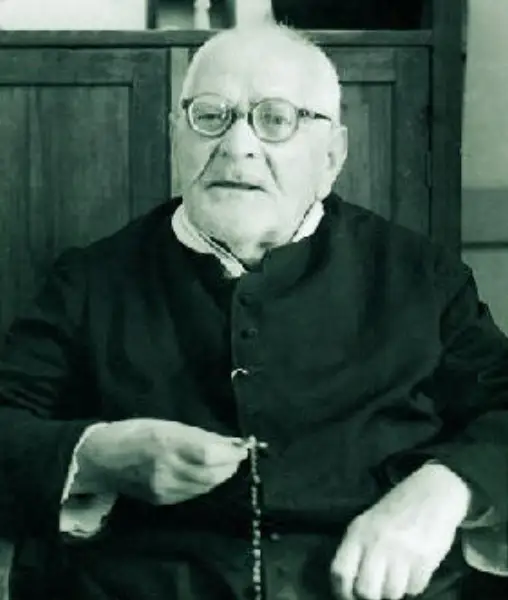
Gaetano Catanoso, a priest of the southern Italian diocese of Reggio Calabria, joined parochial ministry with missionary journeys into the Calabrian mountains and a lifelong contemplation of the Face of Christ. The third-born among eight children of a well-to-do landowning household in 1879, he received priestly ordination in 1902 and thereafter served almost without interruption in charge of souls, most memorably at Pentedattilo, an out-of-the-way hilltop settlement where for nearly twenty years he trekked between hamlets on foot or atop a mule so that scattered households might hear the Gospel. In 1919 he gathered a confraternity to honor the Holy Face, and in December 1934 he brought into being the Suore Veroniche del Santo Volto, sisters whose schools and old-age homes in poor Calabrian towns were meant to defeat illiteracy and organized crime with learning and the Gospel message. He likewise started the Poor Clerics for men considering ordination, restored Marian and Eucharistic practices, and in wartime improvised a refuge for children robbed of their parents. Having lost his sight near the end, he passed away at Reggio Calabria in 1963; John Paul II declared him blessed in 1997 and Benedict XVI enrolled him among the saints in 2005.
The Complete Life
A Childhood in Reggio Calabria
Gaetano came into the world on 14 February 1879 at Chorio di San Lorenzo, within the territory of Reggio Calabria. His parents, Antonio Catanoso and Antonia Tripodi, were landowners of comfortable means, and he was the third-born among their eight sons and daughters. God's call reached him early: in October 1889, still only ten, he presented himself for admission to the seminary, coming to its door at nightfall in the company of his father. Illness repeatedly interrupted that first formation and sent him home to recover, yet he always returned to his books. In 1895 he received the cassock and climbed the pulpit to preach for the first time in his life. The long course of study ended on 20 September 1902, when Cardinal Gennaro Portanova conferred priestly ordination upon him. The new priest was at once entrusted with the seminarians of the diocese, whom he supervised as their prefect until the spring of 1904 — an early taste of the care for clerical vocations that would later move him to establish the Poor Clerics for the same end. Reggio Calabria, scarred by earthquakes and raids, would remain his world for all eighty-four years of his life.
§ Life
A Life Given to the Parishes
Ordination committed Catanoso to the care of souls, and apart from a handful of ancillary offices he never held anything but parochial charges. In March 1904 he received Pentedattilo, a hamlet perched in the hills far from the city, and there he labored for seventeen years among people whom poverty and distance had left largely unserved. The next posting, granted on 2 February 1921, took him to Santa Maria de la Candelaria, a much larger church in Reggio Calabria itself, where his activity widened rather than narrowed. From 1922 to 1949 he guided the seminarians of the diocese as their spiritual director, and for a decade beginning in 1922 he also served the hospitals of the region as chaplain. From 1921 through 1950 he heard confessions for religious communities and for the inmates of the prison, and in 1940 he was named a canon of the cathedral chapter, an honor he exercised right up to his death. The parish, however, remained always at the center: a shepherd first, and everything else besides. Contemporaries marveled that one priest could carry so many charges at once, yet he moved from confessional to hospital ward and from seminary classroom to cathedral stall without any diminution of care.
§ Life
Gospel to the Mountains
What set this Calabrian priest apart was the energy with which he carried the faith to those beyond his parish bounds. Convinced that a shepherd must go after the lost sheep wherever the paths led, he made his way on foot or on mule-back from Pentedattilo to the scattered settlements of the surrounding heights, preaching and reconciling sinners in places no other minister visited. Organization followed zeal. In December 1934 he gathered a company of women into the Suore Veroniche del Santo Volto; the sisters went on to open schools and residences for the aged at San Lorenzo, Roccaforte, Chorio, and other small towns, intending by teaching and by the Gospel to break both ignorance and the grip of the Mafia. For candidates hesitating over a priestly calling he started the Poor Clerics, and among his brother priests he labored for a working partnership whereby they would preach and hear confessions in one another's churches. When war orphaned hundreds of Calabrian children in 1943, he improvised an orphanage to receive them. In every undertaking his method was constant: to bring the sacraments, sound instruction, and practical charity to populations that distance and hardship had cut off from the ordinary life of the Church.
§ Life
Devotion to the Holy Face
Catanoso's inner life revolved around the Face of Christ. In 1919 he brought into being the Confraternita del Santo Volto so that laypeople might share this devotion, and for over forty years he urged it on everyone he met. Around this center he rebuilt popular religion in his parishes: he gave new life to practices honoring Mary and the Eucharist, raised the standard of religious instruction, and insisted that the feasts of the liturgical year be kept with due solemnity. Before the Tabernacle he could be found motionless for hour after hour, and he did all he could to lead the faithful into Eucharistic Adoration themselves. Holiness attracted friendship: his closest companions included Annibale Maria di Francia and Luigi Orione, whom he came to know in 1918. It was Orione who stood by him when he resolved to found a congregation of his own, an undertaking blessed with diocesan approval on 25 March 1958 and, twenty-two years afterward, with pontifical approval from John Paul II on 8 December 1980. Those who watched him understood that his institutions flowed from contemplation rather than from administrative ambition, and that the Face he honored in beggars was first adored in the Blessed Sacrament.
§ Life
Darkness and Quiet Welcome
The last office Catanoso held was that of canon of the archdiocesan cathedral, which he filled from 1940 until his death. Age and infirmity then closed in: sickness overtook him, and his sight failed entirely, yet neither affliction shut him away. Visitors continued to find the door open and the old priest attentive, ready with counsel for whoever climbed the stairs to see him. His reputation for goodness had followed him since middle age, when neighbors already spoke of the unusual quality of his life. On 3 April 1963 Sister Pauline, an asthmatic religious who wished to gaze on him once more, was granted her request; on the morrow, 4 April, he breathed his last in Reggio Calabria at eighty-four. Latin and Italian mingled in the words he left behind — 'In te, Domine, speravi, Gesù, Maria, Giuseppe' — and within hours the sister who had knelt by his body discovered her asthma gone. Half a century of Calabrians who had known him on the mountain paths now came instead to the bedside of their blind and dying priest, and none left uncomforted. He regarded the darkening of his eyes, it was said, as the last penance of a long oblation.
§ Life
From Servant of God to the Altars
His cause began on 15 October 1981, when the Congregation for the Causes of Saints granted its nihil obstat and the diocese proclaimed him a Servant of God. Rome accepted the diocesan inquiry on 3 March 1989; that autumn the theologian consultors gave their verdict, on 26 September, and the cardinals and bishops of the Congregation ratified it on 19 December. On 3 March 1990 John Paul II declared that the priest had practiced heroic virtue, styling him Venerable. Two cures carried the cause onward. The first, Sister Pauline's asthma, had occurred by his remains in 1963; examined between 1993 and 1994, it was validated on 10 February 1995, endorsed by the medical board on 5 October 1995, by the consultors on 25 November 1995, and by the Congregation on 20 February 1996, before the Pope's decree of 25 June 1996 opened the way to beatification on 4 May 1997. The second, a cure of rare meningitis granted to Anna Pangallo on 9 January 2003, brought Benedict XVI to the square on 23 October 2005. The inquiry collected the testimony of a generation of Calabrians who had received absolution, counsel, and bread from his hands, and the Roman stages, examined with normal rigor, unfolded across almost a quarter of a century.
§ Sainthood
A Living Family and a Wider Memory
Catanoso's spiritual family endured and grew after his death. By 2008 the Suore Veroniche del Santo Volto numbered ninety-five nuns living in seventeen houses, continuing the schools and homes for the elderly that their founder had planted in the villages of Calabria. His recognition as patron of chaplains reflects the hospital and prison ministry that filled so many of his years, and his patronage extends to his congregation, to Reggio Calabria, to Fuengirola, and to Calabrian priests. His memory has also crossed the ocean: an American relative, the journalist Justin Catanoso of Greensboro, North Carolina, wrote a memoir of the saint titled 'My Cousin the Saint – A Search for Faith, Family and Miracles', bringing the story of the Calabrian priest to readers far from Pentedattilo's stony paths. Within the wider Church he stands among the promoters of devotion to the Holy Face of Jesus, alongside figures such as Mary of Saint Peter, Leo Dupont, and Thérèse of Lisieux, a testimony to the power of Eucharistic adoration and quiet pastoral fidelity. The devotion he fostered passed to a congregation that still bears his name and his spirit, and his canonization brought Calabria's apostle of the Holy Face before the whole Church.
§ Life
Timeline
- 14 Feb 1879
Born at Chorio di San Lorenzo, in the territory of Reggio Calabria, the third-born among the eight sons and daughters of Antonio Catanoso and Antonia Tripodi.
§ Life
- Oct 1889
Began his studies for the priesthood, though bouts of ill health forced him to return home several times.
§ Life
- 1895
Received the cassock for the first time and mounted the pulpit to preach a sermon for the first time in his life.
§ Life
- 20 Sep 1902
Ordained to the priesthood by Cardinal Gennaro Portanova, afterwards serving as prefect of seminarians until 1904.
§ Life
- Mar 1904
Sent in March 1904 to Pentedattilo, an out-of-the-way hilltop parish he would labor in for the next seventeen years.
§ Life
- 1919
Founded the Confraternita del Santo Volto to spread devotion to the Face of Jesus among the faithful.
§ Life
- 2 Feb 1921
Moved on 2 February 1921 to Santa Maria de la Candelaria, a larger church within the city of Reggio Calabria.
§ Life
- Dec 1934
Founded the Suore Veroniche del Santo Volto, an order of nuns that established schools and homes for the old.
§ Life
- 1943
Opened a makeshift orphanage for children left parentless by the Second World War.
§ Life
- 25 Mar 1958
His congregation received diocesan approval, an initiative encouraged by his friend Luigi Orione.
§ Life
- 4 Apr 1963
Died in Reggio Calabria at the age of eighty-four, after becoming ill and blind.
§ Life
- 8 Dec 1980
His congregation received full pontifical approval from Pope John Paul II.
§ Life
- 15 Oct 1981
The cause for his canonization was introduced and he was titled a Servant of God.
§ Sainthood
- 3 Mar 1990
Proclaimed Venerable after Pope John Paul II confirmed his life of heroic virtue.
§ Sainthood
- 4 May 1997
Beatified by Pope John Paul II in Saint Peter's Square after the healing of Sister Pauline was recognized as a miracle.
§ Sainthood
- 9 Jan 2003
Anna Pangallo was healed in Reggio Calabria from a rare form of meningitis, the miracle credited to his intercession.
§ Miracles
- 23 Oct 2005
Canonized by Pope Benedict XVI in Saint Peter's Square.
§ Sainthood
In Their Own Words
In te, Domine, speravi, Gesù, Maria, Giuseppe
The Record
- Major works
- Suore Veroniche del Santo Volto (founded 1934)·Confraternita del Santo Volto (founded 1919)·Poor Clerics
- Patron of
- patron of chaplains·Suore Veroniche del Santo Volto·Reggio Calabria·Fuengirola·Calabrian priests
- Symbols
- priest's attire·rosary
- Canonization
- Canonized 23 October 2005 in Saint Peter's Square by Pope Benedict XVI
Prayer
Bibliography
Show 6 sources
- "Saint Gaetano Catanoso". Saints SQPN. 13 November 2016. Retrieved 24 March 2017.
- "Saint Gaetano Catanoso". Santi e Beati. Retrieved 24 March 2017.
- "Gaetano Catanoso". Holy See. Retrieved 24 March 2017.
- "Apostle of the Holy Face of Jesus: St Gaetano Catanoso", Vultus Christi, Silverstream Priory
- Catanoso, Justin. "Seems like a miracle: a saint in the family", Triad Business Journal, November 7, 2005
- Catanoso, Justin. "All in the family", U.S. Catholic, Vol. 73, No. 11, pp. 32-34, November 2008
Profile text adapted from the Wikipedia article, licensed CC BY-SA 4.0.
Pray with this saint every day
Save St. Gaetano Catanoso to your favorites, read the full profile, and get feast-day reminders in the Saints app.
Get the Saints AppFree on the App Store for iPhone and iPad