
1st century·Feast November 5
St. Gaius of Ephesus
Bishop of Ephesus and Disciple of the Seventy
Overview
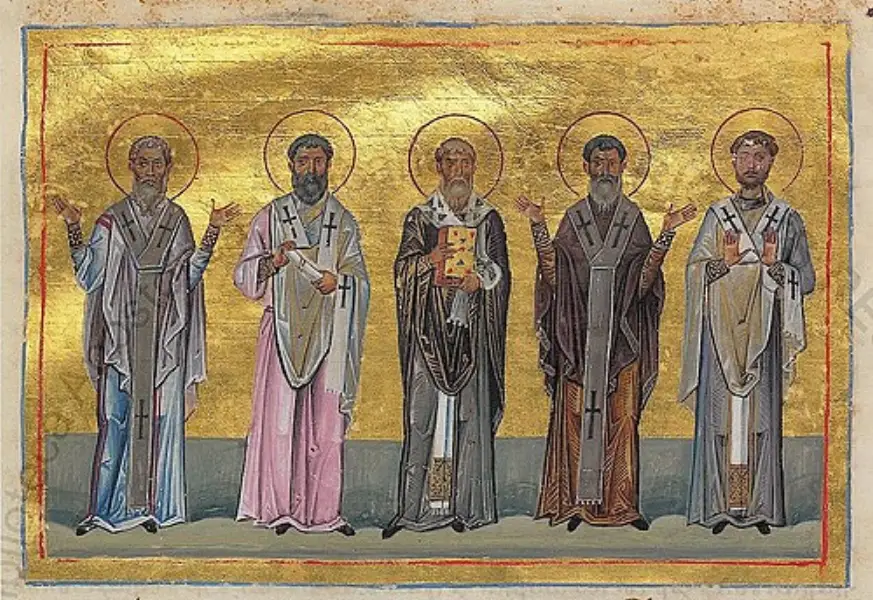
Gaius of Ephesus, known in Greek as Gaios ho Ephesios, belongs to the first generation of Christian missionaries numbered among the Seventy Disciples whom the tradition of the Church honors as having been sent out by Christ himself. The surviving records identify him as Bishop of Ephesus, a connection supported by the greeting in Paul's Letter to the Romans 16:23, where a Gaius is mentioned in association with that city. Some scholars and hagiographers have further suggested that he may be the Gaius to whom the Third Epistle of John was addressed, though the identification remains conjectural. In the Menologion of Basil II he appears in the company of fellow disciples of the Seventy: Patrobulus, Hermas, Linus, and Philologus. Both the Eastern Orthodox Church and the Roman Catholic Church preserve his memory, commemorating him on 4 January together with all the Seventy Disciples, and again on 5 November with a distinct feast. The historical details of his episcopate and the circumstances of his death have not survived; his remembrance rests on the apostolic lists and liturgical calendars of the undivided Church.
The Complete Life
Among the Seventy and the See of Ephesus
The tradition of the Church counts Gaius of Ephesus among the Seventy Disciples, the wider circle of missionaries whom the Lord sent out beyond the Twelve and whom the Eastern churches have venerated since the earliest centuries. His particular distinction was the episcopate: he is remembered as Bishop of Ephesus, one of the great apostolic sees of Asia Minor. This connection to Ephesus finds a possible echo in Scripture itself, for in the sixteenth chapter of the Letter to the Romans, verse 23, Paul sends greetings from a Gaius who served as host to the apostle and to the whole church, and whose hospitality is linked in the same passage with Erastus, the city steward. Hagiographers have also proposed that this Gaius is the beloved recipient of the Third Epistle of John, the man to whom the elder wrote that he had no greater joy than to hear that his children walk in truth. The suggestion remains a pious conjecture rather than a certainty, but it reflects the antiquity and dignity attached to his name. In the Menologion of Basil II, the great illustrated menology of the Byzantine court, he is depicted and named together with Patrobulus, Hermas, Linus, and Philologus, a company of disciples of the Seventy honored as one fellowship.
§ Possible reference in scripture
Commemoration in East and West
Whatever the brevity of his surviving record, the liturgical memory of Gaius of Ephesus has proved durable on both sides of the ancient schism. The Eastern Orthodox Church and the Roman Catholic Church alike remember him on 4 January, when the Seventy Disciples are commemorated together as a company, and the Orthodox calendar keeps a second, distinct feast for him on 5 November. The principal early source for his cult is the Prologue from Ohrid of St. Nikolai Velimirovic, the Serbian hogiographer's compendium of the saints, which transmits the apostolic tradition concerning him to modern readers. Beyond these liturgical witnesses, history is nearly silent: the dates of his birth, his consecration, and his death have not come down to us, and no acts of his episcopate survive. His very obscurity is instructive, for it recalls the hundreds of first-generation Christians whose preaching planted the Church and whose names survive only on the calendars of the liturgy. Gaius stands among them, honored not for deeds that chronicle could preserve but for the apostolic office that tradition has entrusted to his memory.
§ Sources
The Record
- Major works
- Episcopal service at Ephesus
- Symbols
- bishop's vestments·gospel book
- Canonization
- Pre-congregation canonization; venerated since antiquity by the Eastern Orthodox and Roman Catholic Churches
Prayer
Bibliography
Show 4 sources
- St. Nikolai Velimirovic, The Prologue from Ohrid
- "Apostle Gaius of the Seventy", January 4, Orthodox Church in America (OCA)
- "Apostle Gaius of the Seventy", November 5, Orthodox Church in America (OCA)
- "Gaius of Ephesus", OrthodoxWiki (source of the Wikipedia article)
Profile text adapted from the Wikipedia article, licensed CC BY-SA 4.0.
Pray with this saint every day
Save St. Gaius of Ephesus to your favorites, read the full profile, and get feast-day reminders in the Saints app.
Get the Saints AppFree on the App Store for iPhone and iPad