
died c. 507·Feast July 27
St. Galactorius of Lescar
Bishop of Lescar and Martyr of the Visigoths
Overview
Galactorius — Galactoire in French usage — governed the small Pyrenean see of Lescar in the opening years of the sixth century and is honored by the Church as a martyr. The surviving documentation is scanty but firm: his episcopate is a matter of record, contemporaries judged that he ran his diocese well, and in 506 his name stands in the acts of the Council of Agde as 'Galactorius, episcopus de Benarno', listed with Gratus of Oloron and Gratianus of Dax. A far more colorful account of his end comes from the Lescar breviary put to press in 1541: it imagines the bishop leading a troop of fighting men against the Visigoths at Mimizan in 506, applying to Clovis for assistance, and then, once captured, dying for his refusal to deny the Catholic faith. Historians distrust the martial trappings, observing that Alaric II had just displayed goodwill toward Catholics by permitting their bishops to convene; the likelier truth is that Galactorius traveled to Mimizan about 507 to confer with the bishop of Bordeaux and fell in with Visigothic columns retreating southward after the disaster of Vouillé, soldiers bitter enough to butcher a Catholic prelate on the road. His relics rested under the high altar of Lescar Cathedral until the Reformation swept them away. The liturgy keeps his memory on 27 July.
The Complete Life
Bishop of Lescar
Galactorius appears in the record as chief pastor of Lescar, the cathedral town in the Bearn whose church stood above Beneharnum, the old fortified settlement on the slope below — the place from which the diocese drew its earliest name. That he actually held the office is not disputed: the sources attest his tenure explicitly, and the tradition adds the telling judgment that he governed his diocese capably, a compliment seldom paid to the bishops of remote Pyrenean sees in the early sixth century. The French have always called him Saint Galactoire, and the church of Lescar has carried his name from his own lifetime to the present day. Of his birth, his schooling, and the hour of his elevation to the episcopate, nothing certain remains; the age was too stormy — the Visigothic kingdom of Toulouse tottering before Frankish arms — for chroniclers to bother with the small dioceses of the mountains. One fact, though, fixes him in history: in 506 he sat among the bishops of Aquitaine and Novempopulania, a college still free to meet in council under a Visigothic king.
§ Life
The Council of Agde
The one dated event of Galactorius's episcopate is his presence at the Council of Agde in 506, an assembly of the bishops of southern Gaul whose acts preserve his name. In the conciliar record he is described as 'Galactorius, episcopus de Benarno', the bishop of the place of Beneharnum, listed together with Saint Gratus of Oloron and Gratianus of Dax, and in the company of delegates representing the bishops of Tarbes and of Aire. The council at which he assisted was a significant moment for the Catholic Church of the Visigothic realm: King Alaric II had authorized the bishops to gather, an act of tolerance toward his Catholic subjects, and the fathers legislated for the discipline of the Church in territory that would soon pass under Frankish rule. Galactorius's participation places him in the mainstream of Gallican episcopal life and shows the young diocese of Lescar, despite its size, fully integrated into the ecclesiastical structures of the age. His signature in the acts is also, apart from the testimony of a well-governed diocese, the principal historical witness to his existence.
§ Life
The Legend of Mimizan
Popular memory wrapped the bishop's last days in the colors of epic. The version handed down in the breviary printed at Lescar in 1541 — nearly a millennium after the events — has him commanding a band of armed men against the Visigoths at Mimizan in 506, then turning to the Frankish king Clovis for reinforcements. Captured by the enemy, he is said to have answered every pressure to abandon his religion with refusal, and so to have perished as a martyr at the hands of his jailers. To mark the spot where he fell, the story continues, the faithful of the region erected a sanctuary in his honor; and when that building in time disappeared, the belltower of the church of Mimizan rose in its place, keeping the martyr's memory alive on a coast far removed from his own cathedral town. However the details are weighed, the death itself was never doubted: the bishop of Lescar died by violence at Mimizan, and the church of his own city preserved his memory as that of a martyr from an early date. The breviary narrative, whatever its embellishments, preserves the essential confession — that he would not trade his faith for his life when the choice was put to him on the road. For the Christians of the Bearn, retelling the story each 27 July, the image of their bishop standing firm before soldiers became a lesson in constancy handed down across the generations.
§ Legend
History Weighs the Legend
Critical historians have never accepted the battlefield romance at face value. It strains belief, they argue, that a bishop of Lescar would march out against Alaric II in 506, the very year in which that king showed his benevolence toward his Catholic subjects by letting their bishops assemble at Agde in council. A more plausible reconstruction puts Galactorius on the road toward 507, journeying to Mimizan for a meeting with his colleague of Bordeaux, when he fell into the path of Visigothic soldiers streaming south toward the Pyrenees — the broken army that Clovis had shattered at Vouillé. Humiliated by catastrophe, hostile to the Catholic faith, and hunting for someone on whom to vent their rage, such troops needed little excuse to make away with a Catholic bishop who crossed their line of march. If this reading is right, Galactorius perished not as a combatant but as a wayfarer, yet no less truly as a martyr — a prelate of the Catholic communion put to death by soldiers of an anti-Catholic temper — and the Church's memory of his bloodshed rests on a foundation of history.
§ Interpretation
Relics and Memory at Lescar and Mimizan
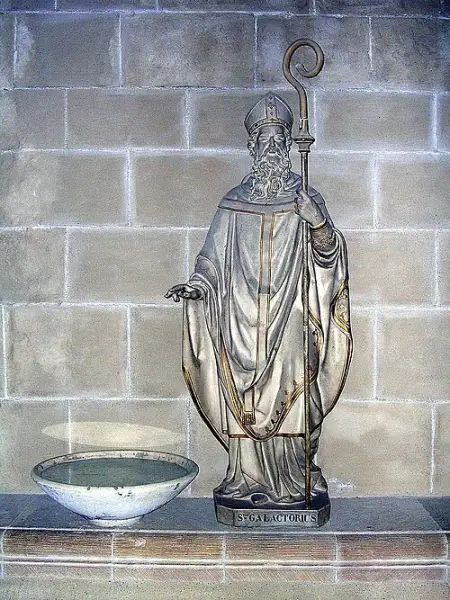
Devotion to the martyr bishop struck roots in two separate places. At Lescar his remains were kept in a reliquary casket directly beneath the high altar of the cathedral, where they lay in honor until the upheavals of the Reformation; when and by what means they vanished, no record tells. At Mimizan the ground where tradition said he died was first occupied by a religious edifice raised to his memory, succeeded in due course by the belltower that still identifies the town's church of Sainte-Marie, a former priory remembered in the inventories of the French ministry of culture. Art keeps his likeness alive as well: a stained glass panel in the church at Mimizan portrays the saint, and a statue of him stands within Lescar Cathedral, close to the spot where his bones reposed for so many centuries. The Roman calendar assigns his feast to 27 July, and among the early bishops of the Bearn he remains the martyr of the generation when Catholic Aquitaine passed from Visigothic into Frankish hands. Few bishops of so small a see left so many material memorials, and fewer still have their features recoverable today in glass, stone, and place name across two distant towns.
§ Relics
Timeline
- 506
Attended the Council of Agde, appearing in the acts as 'Galactorius, episcopus de Benarno' alongside the bishops of Oloron and Dax.
§ Life
- 506
The Lescar breviary tells how he took up arms against the Visigoths at Mimizan and begged Clovis to come to his aid.
§ Legend
- 507
Probably met his death at Mimizan, killed by Visigoth troops retreating toward the Pyrenees after their rout at the Battle of Vouillé.
§ Interpretation
- 1541
The breviary of Lescar, printed this year, recorded the legend of his armed resistance and martyr's death.
§ Legend
In Their Own Words
Galactorius, episcopus de Benarno
The Record
- Major works
- Administration of the diocese of Lescar·Participation in the Council of Agde (506)
- Patron of
- Lescar
- Symbols
- bishop's vestments·martyr's palm
- Canonization
- Pre-congregation canonization; venerated as a martyr, feast kept on 27 July
Prayer
Bibliography
Show 5 sources
- Évêques et la Cathédrale de Lescar: Des origines à la Réforme. D. Labau. Pau, 1972, p. 31
- "Beneharnum is the name of the former oppidum situated at the foot of the hill of Lescar" (article note)
- Base Mérimée : Église prieurale Sainte-Marie, Ministère français de la Culture (in French)
- Mimizan, Clins d'œil au passé, Georges Cassagne, édition Atlantica, 2007, p 14
- Site Nominis
Profile text adapted from the Wikipedia article, licensed CC BY-SA 4.0.
Pray with this saint every day
Save St. Galactorius of Lescar to your favorites, read the full profile, and get feast-day reminders in the Saints app.
Get the Saints AppFree on the App Store for iPhone and iPad