
c. 1096 – 1176·Feast April 18
St. Galdino
Archbishop of Milan and defender of the papacy
Overview
Galdino della Sala was born in Milan around 1096 into the della Sala family, reckoned among the minor nobility of the city. Serving as archdeacon of the Milanese church, he stood with Pope Alexander III when the schism of 1159 divided the Church after the death of Adrian IV, while Emperor Frederick Barbarossa threw his support behind Antipope Victor IV. After Frederick besieged Milan and broke its resistance within six months, Galdino went into exile, joining the Pope at Genoa and accompanying him through Maguelonne, Montpellier, and Clermont, then onward to Sicily and Rome. When Alexander regained the city in 1165, he created Galdino Cardinal Priest of Santa Sabina on 15 December and named him Archbishop of Milan a year later; in 1167 he added the office of apostolic legate for Lombardy. Once the Lombard League drove Barbarossa from the region, Galdino took possession of his see, removed clergy loyal to the antipope, and consecrated new bishops for nine Lombard cities. He won equal renown for generosity to the poor of Milan and for ransoming those jailed over debts. On 18 April 1176 he died in the pulpit, moments after finishing a sermon against the Cathars. Alexander III enrolled him among the saints, and his feast is kept on 18 April, honored especially where the Ambrosian Rite is followed.
The Complete Life
A Son of Milan
Milan in the closing years of the eleventh century was among the greatest cities of the Holy Roman Empire, and it was there, around 1096, that Galdino first saw the light. His family, the della Sala, belonged to the minor nobility of the city — respected, but far removed from the great houses that disputed control of its streets and its church. Nothing in the record suggests that his beginnings promised eminence; his rise came through service to the Milanese church rather than through birth. The city of his upbringing was proud, mercantile, and restless under imperial overlordship, and within his own lifetime that restlessness would erupt into open conflict with Emperor Frederick Barbarossa, who would besiege Milan and reduce it within six months. Growing up in such a setting formed a man attentive to the ties between altar and city, between the Bishop of Rome and the Lombard towns that looked to him for protection. By the time the great schism of 1159 split the Church, Galdino had reached the office of archdeacon in the Milanese church, a position of real authority that placed him among the leading clerics of the see. From that post he would take a public stand whose consequences followed him for the rest of his life.
§ Life
Exile for the Pope
The death of Pope Adrian IV in 1159 opened a schism that split the whole Church. The Roman option was Alexander III; the rival was Victor IV, sustained by Emperor Frederick Barbarossa and the cardinals who answered to him. The Milanese church declared for Alexander, and Galdino, as its archdeacon, made his position a public matter at a moment when such candor carried a price. Frederick answered the city's allegiance by force of arms: he came against Milan with an army and reduced it within six months. Galdino's response was not retreat into silence but literal exile. He joined Alexander at Genoa and stayed with the papal household as it moved — to Maguelonne, to Montpellier, to Clermont — and later, on the Pope's return journey in 1165, to Sicily and Rome. Those years of wandering hardened his reputation as a man the papacy could trust. When Alexander was restored, the reward was swift. In the consistory of 15 December 1165 Galdino was named Cardinal Priest of the titular church of Santa Sabina. A year later the Pope raised him to the archbishopric of Milan itself, and the year after that appointed him apostolic legate for Lombardy, giving him authority over the whole region he had suffered to defend.
§ Life
Rebuilding a Lombard Church
Galdino's years as archbishop were spent reclaiming the Lombard church for the Roman obedience. When the Lombard League succeeded in expelling Barbarossa from the region, Galdino at last took possession of his see — until then a contested post held in exile. His first task was purification: he moved to depose any Lombard priests who remained faithful to Victor IV, clearing away the clergy the antipope's cause had left behind. In their place he built. One after another he consecrated new bishops — at Lodi and Alba; at Cremona and Vercelli; at Asti and Turin; at Novara and Brescia; and at Alessandria — restoring a hierarchy aligned with Rome from the Alps to the Po. As apostolic legate for Lombardy he carried this work beyond his own province, acting as the Pope's man across the whole region whose towns had bled for the same cause. Yet his mission was never only political. He was remembered for conspicuous charity in Milan toward the poor, and especially toward those imprisoned for debt, whose freedom he secured. And he preached: his sermons against the Cathars, whom orthodox Catholics regarded as heretics, occupied the last hours of his life. He governed, reconciled, gave, and taught — the whole office of a bishop in a wounded land.
§ Life
Death in the Pulpit
The closing years of Galdino's life found him at the height of his powers and his labors. Archbishop of Milan, cardinal, and legate for Lombardy, he bore three offices at once, and the record gives no hint that he eased his pace with age. Having lived through siege, exile, and schism, he spent his final seasons consolidating what the victory of the Lombard League and the restored papacy had won: a compliant clergy replaced, suffragan sees refilled with consecrated bishops, and the faithful of Milan instructed against the Cathar teaching that had been spreading through northern Italy. It was in that last employment that he died. On 18 April 1176, aged seventy-nine or eighty, he preached a sermon against the Cathars, and having just completed it, collapsed and died there in the pulpit — the place where he had spent himself for the truth. His body was laid to rest in the Cathedral of Milan, where his relics were venerated by the people he had served. Few bishops have died in a manner so perfectly matching their lives: sword in hand, so to speak, at the very moment of defending the faith from its adversaries.
§ Life
Raised to the Altars
Galdino's canonization followed quickly upon his death, a sign of how fully his fidelity had registered in Rome. Pope Alexander III — the very pontiff whose cause Galdino had championed through schism, siege, and exile — enrolled Galdino in the canon of the Roman Catholic Church's saints within that same pontificate. There was no long juridical process of the later kind; this was the era in which the Pope who knew a man's service could enroll him among the saints on the weight of that service. The Church fixed his liturgical feast on 18 April, the anniversary of his death in the pulpit, and it has remained attached to that date ever since. The observance took particular root in Milan and its province, and it is celebrated with special devotion in the churches that follow the Ambrosian Rite, the ancient liturgical usage of the archdiocese Galdino governed. In that rite his memory stands alongside the long line of holy bishops of Milan, from Barnabas to Ambrose and Borromeo, in whose succession the lists of the archdiocese record him simply and exactly: St Galdino della Sala, 1166 to 1176. He is venerated in the Roman Catholic Church as cardinal, archbishop, and martyr of duty — a man whose last act was a sermon.
§ Sainthood
Patron of Milan and Lombardy
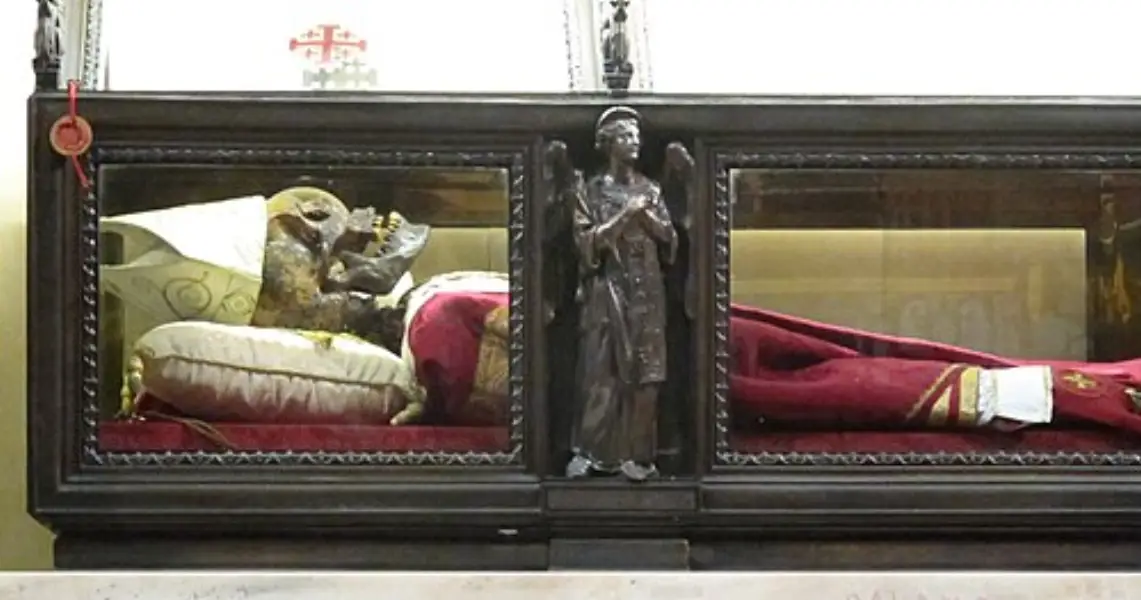
Nine centuries on, Galdino remains woven into the religious identity of the region he served. The Church names him a patron both of the Archdiocese of Milan and of Lombardy as a whole — an unusual double patronage that reflects the two halves of his career: the pastor of a single see and the papal legate for an entire land. His iconography is that of the dignitary he became: the crozier of an archbishop and the attire of a cardinal, the two offices he held together in his final decade. His relics rest in the Cathedral of Milan, where pilgrims and the faithful of the city have honored them since his burial. Beyond the devotional sphere, his story endures as a piece of Lombard history: the account of a Milanese nobleman's son who chose the papal side in the great quarrel between empire and papacy, shared the exile of a hunted Pope, returned to govern his native church, and died in the act of preaching against its enemies. In the struggle of the Guelphs and Ghibellines and in the victories of the Lombard League, his name marks the point where the faith of Milan and the freedom of its cities were, for a time, one and the same cause.
§ Sainthood
Timeline
- 1096
Born in Milan into the della Sala family, counted among the city's minor nobility.
§ Life
- 1159
As archdeacon, publicly backed Pope Alexander III against Antipope Victor IV when the schism opened after Adrian IV died.
§ Life
- 15 Dec 1165
Created Cardinal Priest of the titular church of Santa Sabina by Pope Alexander III in the December consistory.
§ Life
- 18 Apr 1166
Consecrated Archbishop of Milan by Pope Alexander III.
§ Life
- 1167
Named apostolic legate for Lombardy by Alexander III, a year after becoming archbishop.
§ Life
- 18 Apr 1176
Died in the pulpit at Milan immediately after completing a sermon against the Cathars.
§ Life
The Record
- Patron of
- Archdiocese of Milan·Lombardy
- Symbols
- Crozier·Cardinal's attire
- Canonization
- Canonized by Pope Alexander III in Rome, Papal States, during that pontificate.
Prayer
Bibliography
Show 3 sources
- Miranda, Salvador. "GALDINO (1096/1100-1176)". The Cardinals of the Holy Roman Church. Florida International University. OCLC 53276621.
- santiebeati.it: states that he was born in 1096; other accounts place it at any time in the first few decades of the 12th century.
- 18 aprile S. Galdino vescovo - Santo del Calendario Santi Beati Martiri la vita e le opere mese di Marzo.
Profile text adapted from the Wikipedia article, licensed CC BY-SA 4.0.
Pray with this saint every day
Save St. Galdino to your favorites, read the full profile, and get feast-day reminders in the Saints app.
Get the Saints AppFree on the App Store for iPhone and iPad