
1148 – 1181·Feast November 30
St. Galgano Guidotti
The Knight of the Sword in the Stone
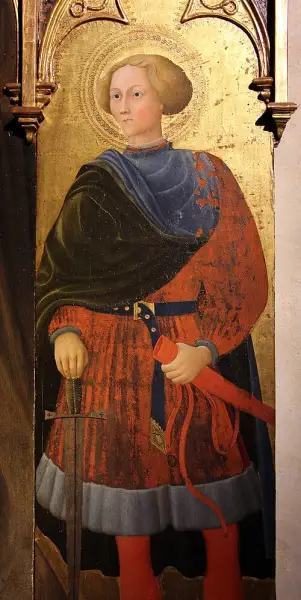
Overview
Galgano Guidotti, a Tuscan knight of the twelfth century, is the saint of the sword in the stone: the blade he drove into the rock of Montesiepi in a moment of conversion still stands there, close by the roofless walls of the abbey that bears his name near Siena. He was born at Chiusdino in 1148, heir of a feudal landholder; his mother, Dionigia, is well attested, while the name of his father, Guido or Guidotto, rests on a sixteenth-century paper in which the family surname was first recorded. As a young man he took up the knight's trade and, by the account of his biographers, wasted his strength in disorderly living. Everything changed when his horse unseated him on the road by Siena: led by the archangel Michael to the hill of Monte Siepi, he was shown a vision of a round temple filled with Christ, his Mother, and the Apostles, and told to repent. His skeptical thrust at the rock became the miracle — the steel sank in and has never moved. He remained on the hill as a poor hermit, gentle even with wild creatures, and died there in 1181, thirty-three years old. Within four years Lucius III had enrolled him among the saints.
The Complete Life
A Riotous Knight of Chiusdino
Chiusdino, the village where Galgano was born in 1148, lay in the wooded hill country southwest of Siena, and there the household of a feudal lord raised its heir. Of his parents the records speak unevenly: Dionigia, the mother, is named in the earliest sources, but the father's name, given as Guido or Guidotto, first turns up in a document of the sixteenth century, the same late text from which the family name Guidotti derives. What is certain is the son's station and its temptations. As the son of a landed lord he was trained to horse and weapon, and he embraced the knight's profession with the appetite of his years. The witnesses to his cult do not soften the picture: Galgano, they say, passed his youth in riotous excess, the sort of headstrong, violent career that the militarized countryside of twelfth-century Tuscany made easy for a young man of property. Tradition saw in this unpromising beginning only a further proof that grace, when it came, would be unmistakable. The Tuscany into which he was born was a patchwork of petty lordships and private war, and the training of its nobility meant the practice of arms in feud as often as in any higher cause.
§ Legend
The Archangel and the Vision on Monte Siepi
The legend of his turning places the scene on the highway near Siena. Galgano's horse reared and flung its rider to the ground, and from the dust an unseen hand — the archangel Michael, the story says — set him upright and steered him toward Monte Siepi, a harsh outcrop of hill not far from his native Chiusdino. Sleep or trance brought him the sight of a temple built in a circle at the summit, its center filled by Jesus and Mary with the Apostles in attendance, and a command to repent of his wicked life. Galgano's answer was the scoff of a hardened man: he could no more change his ways, he said, than drive a blade through solid rock. As he spoke he pulled the sword from its sheath and brought it down on the stony slope — and the steel ran into the living stone as though into water. There it has stood ever since, immovable. The knight who had meant to mock the command accepted it instead: he cast off his old life, took up residence on the hilltop as a pauper hermit, and never wielded a weapon again.
§ Legend
Hermit of Montesiepi
Monte Siepi became at once his cell and his monument. The penitent knight lived on what the hill gave, and the legend delights in the peace he made with its creatures: the wild beasts, no longer fleeing him, came to be his companions. One tale tells of an assassin — a corrupt monk dispatched by the Devil himself — whom the wolves of the mountain caught and destroyed before the crime could be done, gnawing the killer's bones. Pilgrims began to find their way up the slope, and the solitary's death turned the hill into a sanctuary. In 1184, at the urging of Hugh, bishop of Volterra, Cistercian religious settled at Montesiepi, while the disciples who had clustered around Galgano's memory went out across Tuscany to live as Augustinian hermits, sowing his manner of penance through the region. Below the hermitage there rose, finished by 1220, the imposing abbey of San Galgano, one of the great Cistercian houses of Italy, built in effect as a monumental warrant of the sanctity of the knight who had died on the hill above it.
§ Canonization and veneration
The Sword in the Stone
Everything in Galgano's cult converges on the relic in the Rotonda at Montesiepi: a sword, hilt uppermost, buried in bedrock a few steps from the ruins of the abbey. To the men and women of the Middle Ages it preached without words — the instrument of a violent trade rendered useless by the very act of penance, a knight's whole profession fixed and silenced in stone. Our own century has put the object to the test. In 2001 Luigi Garlaschelli studied the exposed metal and reported that its makeup and workmanship fit the period of the legend; he further established that the visible hilt and the hidden portion below belong to a single piece, not to an assembly of fragments. The round shape of the chapel raised over the tomb in 1184 was itself a piece of spirituality, a building that copied the temple of his vision. In painting and sculpture at Siena and Volterra, where his cult burned brightest, artists returned again and again to the same emblems: the hill, the sword, the hermit's cloak, the knight made poor.
§ The sword in the stone
Death at Thirty-Three
Galgano's career as a hermit lasted barely a decade. He died on Monte Siepi in 1181, thirty-three years of age — the span of Christ's own earthly life, a parallel his early devotees did not fail to draw. His death date carries a minor complication in the sources: the traditional day is 3 December 1181, though some scholars prefer 30 November 1180, and it is 30 November that the Roman calendar now keeps for him, by disposition of John Paul II issued in 2004. Burial was on the hill of his penance, and the cures reported at his grave drew crowds within months. By 1184 a rotunda, built to resemble the temple of his vision, enclosed the tomb and turned the hermit's grave into a place of public prayer. His cloak, kept as a relic, has traveled less far than his fame: it reposes in the church of Santuccio in Siena, while the remains of the hermitage itself can still be traced on the hillside above the ruined abbey. The shortness of the life gave it the shape of a single gesture: one violent morning on the road, ten quiet years on the hill, and a death that fixed both forever in the memory of the Val di Merse.
§ Canonization and veneration
The First Formal Canonization
Galgano's elevation to the altars was rapid even by medieval standards and procedurally epoch-making. Lucius III declared him a saint in 1185, four years at most after his death, and the inquiry that preceded the decree is identified by scholars as the first cause the Roman Church carried through a formal judicial process. The documentation of that process, the Inquisitio in partibus, survives in the transcription Sigismondo Tizio copied into his Historiae Senenses and in the edition published by Fedor Schneider in the early twentieth century. Alongside the acts stands a shelf of lives: the Legenda beati Galgani and the Legenda beati Galgani confessoris, the Leggenda di Sancto Galgano, the Vita sancti Galgani de Senis, and the Vita beati Galgani, scattered through codices of the fourteenth and fifteenth centuries kept at Florence, Siena, the Vatican Library, and Veroli. When the Cistercian abbey below the hill was completed around 1220, the order adopted him as its own, and his feast and images flourished in the two cities that claimed him most, Siena and Volterra. The swiftness of the process, within four years of the burial, marks the moment when papal Rome began to substitute sworn inquiry and verified miracle for the older, looser acclaim of local devotion.
§ Canonization and veneration
Tuscany's Excalibur
The Tuscan knight has slipped the bonds of ecclesiastical history and entered the mythology of the sword in the stone. Because his blade predates the great Arthurian romances, enthusiasts have asked whether the story of the hermit's miracle fed the legend of Excalibur; an installment of the documentary series Ancient X-Files weighed the proposed links among the relic, St. Galgano, Sir Gawain, and King Arthur, and a seventh-season challenge on the competition show Forged in Fire had bladesmiths forge 'Excalibur', described as a broadsword inspired by Galgano's tale. The relic itself has had its trials: thieves tried to pry it loose in 1960 and broke it, and conservators set it in cement when they restored it. Above them both the landscape of his holiness remains intact in its ruin — the enormous unroofed abbey in the valley, the little rotunda on the hill — a site now counted among the most haunting in Tuscany, visited as much for its beauty as for the saint whose conversion built it. Few relics in Europe have drawn so much curiosity from so many directions — scientists, television producers, and pilgrims — and none, perhaps, owes so much of its fame to the man who tried to destroy it.
§ The sword in the stone
Timeline
- 1148
Born at Chiusdino in the Sienese countryside, son of a feudal lord.
§ Legend
- 3 Dec 1181
Died on the hill of Montesiepi in Tuscany, aged thirty-three; some scholars instead date his death to 30 November 1180.
§ Legend
- 1184
A round chapel, modeled on the temple of his vision, was built over his tomb and drew many pilgrims.
§ Canonization and veneration
- 1184
At Bishop Hugh of Volterra's urging, Cistercians settled at Montesiepi, while Galgano's own followers spread through Tuscany as Augustinian hermits.
§ Canonization and veneration
- 1185
His canonization process began only a few years after his death, the first the Roman Church conducted with a formal process.
§ Canonization and veneration
- 1220
The large Cistercian monastery of San Galgano Abbey had been built below his hermitage, and he was claimed as a Cistercian saint.
§ Canonization and veneration
- 1960
The sword in the stone was broken in an attempted theft and afterwards repaired and fixed in place with cement.
§ The sword in the stone
- 2001
Luigi Garlaschelli's analysis of the protruding metal confirmed its composition and style were compatible with the era of the legend.
§ The sword in the stone
- 2004
Pope John Paul II ordered that the Roman Catholic Church celebrate Saint Galgano on 30 November.
§ Canonization and veneration
In Their Own Words
composition of the metal and the style are compatible with the era of the legend
The Record
- Major works
- Hermitage at Montesiepi·Round chapel over his tomb (1184)·San Galgano Abbey (built by 1220)
- Symbols
- sword in the stone·hermit's cloak·knight's armor
- Canonization
- Canonized 1185 by Pope Lucius III, in the first canonization conducted with a formal process by the Roman Church
Prayer
Bibliography
Show 7 sources
- Weinstein, Donald (1982). Saints & society : the two worlds of western Christendom, 1000-1700. University of Chicago Press. p. 107. ISBN 978-0-226-89055-5.
- Haegen, Anne Mueller von der; Strasser, Ruth F. (2013). "Chiusdino". Art & Architecture: Tuscany. Potsdam: H.F.Ullmann Publishing. p. 424. ISBN 978-3-8480-0321-1.
- Vauchez, A., "La santità nel medioevo", Il Mulino, Bologna, 1989
- "Inquisitio in partibus", transcribed by Sigismondo Tizio in Historiae Senenses and transcribed in "Analecta Toscana IV; Der Einsiedler Galgano von chiusino und die Anfange von San Galgano" by Fedor Schneider (1914–1924)
- "Galgano" in David Hugh Farmer, Oxford Dictionary of Saints (Oxford University Press, 1997)
- Carroll, Rory (16 September 2001). "Tuscany's Excalibur is the real thing, say scientists". The Guardian. Retrieved 3 November 2018.
- Chodyński, Antoni Romuald (2014). "Fasciculi Archaeologiae Historicae. Fasc. 27 (2014)". IAIE Pan, Call No. P III 349. Institute of Archaeology and Ethnology of Polish Academy of Sciences.
Profile text adapted from the Wikipedia article, licensed CC BY-SA 4.0.
Pray with this saint every day
Save St. Galgano Guidotti to your favorites, read the full profile, and get feast-day reminders in the Saints app.
Get the Saints AppFree on the App Store for iPhone and iPad