
c. 550 – c. 645·Feast October 16
St. Gall
Irish missionary hermit and founder of the abbey
Overview
Gall, known in Latin as Gallus, lived from about 550 to about 645 and stands in hagiographic tradition as one of the twelve companions whom Columbanus led from Ireland to the continent. Some scholarship has questioned that origin, suggesting he may have come from the borderland between Lorraine and Alemannia and first met Columbanus at Luxeuil in the Vosges. Either way, he became a representative of the Irish monastic tradition in Europe. As a young man he studied under Comgall at Bangor Abbey, one of the great centers of Christian learning, where Columbanus was his fellow student. He accompanied Columbanus to Luxeuil in Gaul and, after the founder's exile in 610, up the Rhine to Bregenz in Alemannia. Illness held him at Arbon when Columbanus crossed the Alps for Italy in 612, and there his own path opened: he went to live as a solitary in the woodland southwest of Lake Constance, beside the upper waters of the Steinach, and gathered twelve disciples around him, and became known throughout Switzerland as a powerful preacher. He declined election as Bishop of Constance and later the abbacy of Luxeuil, guarding his solitude to the end. He died at about ninety-five in Arbon. His hermitage grew into the Abbey of Saint Gall, whose city, Saint Gallen, still carries his name.
The Complete Life
Origins and the Schools of Bangor
Where Gall came from is a question the sources themselves debate. The ninth-century biographers of Reichenau, who recast the fragmentary oldest Life of the saint, held that he was an Irishman who entered Europe in Columbanus's company; the modern scholar Hilty countered in 2001 that the historical Gallus more likely came from the Vosges or Alsace, while Schär proposed in 2010 that his line was Irish even though his birth and upbringing were Alsatian. Tradition has kept the Irish account, and it is certain at least that his formation was wholly Irish in spirit. According to the ninth-century hagiographies, he went as a young man to study under Comgall at Bangor Abbey, a monastery whose renown as a center of Christian learning reached across Europe. There he studied alongside Columbanus, and around the two of them gathered the movement that would carry Irish monasticism to the continent. One family tie the record preserves clearly: Deicolus, himself a missionary saint, was Gall's elder brother. From Bangor the young monk carried two possessions that would mark his whole life — the learning of the Irish schools and the readiness to leave everything, including his homeland, for the sake of the Gospel among strangers.
§ Biography
With Columbanus to the Continent
About the year 589, Columbanus set out for mainland Europe with twelve companions, and Gall went with them. The missionaries established themselves first at Luxeuil in Gaul, which became the base of the Irish mission in the Frankish kingdom. The idyll ended in 610, when exile overtook Columbanus at the hands of leaders hostile to the faith, and Gall went with him to Alemannia, east of the Rhine. There the mission turned toward the lake country: the two men sailed up the Rhine to Bregenz, preaching among the Alemanni. At Bregenz their roads divided. In 612 Columbanus crossed the Alps for Italy, where he would die at Bobbio, but Gall was prevented by illness from going with him and was nursed at Arbon, on the Swiss shore of Lake Constance. What looked like a misfortune proved a providence. Once recovered, he did not attempt to rejoin his master; instead he stayed in Alemannia and, with several companions, embraced the solitary life in the woodlands southwest of the lake, near the source of the river Steinach. The mission of Columbanus had planted a church in the region; the illness of Gall left behind the man who would make it take root.
§ Biography
Hermit and Preacher of Alemannia
In the solitude near the Steinach, Gall's vocation matured into a double work: prayer in the wilderness and preaching to the people. Cells were soon added to his own for twelve monks, whom he carefully instructed, so that the hermitage became in effect a small monastery in the Irish manner — a master, his disciples, and the Scriptures shared among them. His reputation as a preacher spread quickly, and he became known throughout Switzerland as a powerful voice for the Gospel. Honor came looking for him twice, and twice he turned it away. When the See of Constance fell vacant, the clergy gathered to elect a new bishop were unanimous in his favor; he refused, arguing that church law barred the choice of a stranger. Some years later, in 625, when Eustasius — abbot of Luxeuil, the monastery Columbanus had founded — died, members of that community came to ask Gall to take over its government. He was by then an old man, and he declined to quit his solitude for any office that would entangle him in the cares of the world. The hagiographers add the tale for which he is best pictured: the deliverance of Fridiburga, betrothed of King Sigebert II, from demonic possession, for which the king granted him the royal estate at Arbon.
§ Hagiography
The Irish Pattern of Prayer and Work
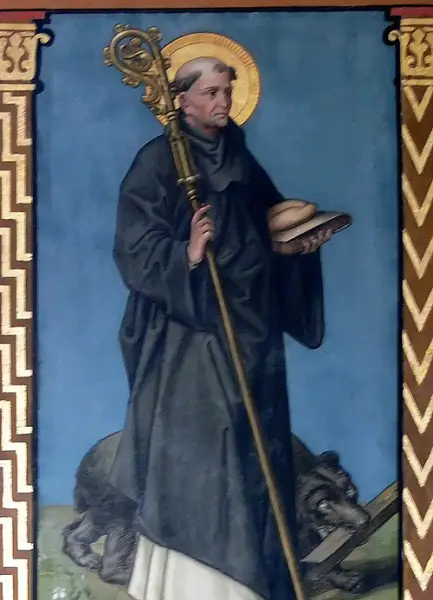
Gall's spirituality was the spirituality of Bangor and Luxeuil transplanted into Alemannian forest: severe, scriptural, and rooted in the pairing of contemplation with manual labor. After his death his disciples remained gathered in the dwelling he had raised, keeping the rule of St. Columban — prayer joined to the labor of hands, reading joined to teaching — a phrase that sums up the whole rhythm of his foundation. Almost certainly he possessed a modest collection of books, kept for the liturgical worship of himself and his disciples, a detail that reveals how central the written word was to his way of life; the Irish monks who crossed to the continent had brought learning and books with them, reproducing them painstakingly on vellum and thereby preserving texts lost elsewhere in the upheavals of the age. His refusal of the episcopate and of the abbacy of Luxeuil belongs to the same spiritual logic: the conviction that hidden fidelity mattered more than visible rank. Even the famous legend of the bear — the beast that charged him at his evening fire, was rebuked into gentleness, and gathered firewood to share his warmth — expresses the eremitical ideal he embodied: peace between the holy man and the wild, won not by force but by blessing.
§ Abbey of St. Gall
Old Age at Arbon
Gall lived to an extreme old age, dying at about ninety-five around the years 645 to 650 at Arbon, the town where illness had first detained him half a lifetime earlier. He ended his days as he had spent his maturity: not as a bishop, not as an abbot bearing title, but as the master of a small community of monks settled around his hermitage above Lake Constance. For several decades after his death his cell stood just as he left it, and his disciples remained in the place, keeping the Columbanian rule of prayer, handwork, reading, and teaching. His tomb became the center of the brotherhood, and the priests who gathered around it began adding to the little collection of books he had kept for worship and study — an accumulation that would one day flower into one of the great libraries of the medieval world. A cult grew swiftly around the place and the man: from as early as the ninth century a whole series of Lives of Saint Gall circulated, with Wettinus enlarging the tradition between 816 and 824 and Walafrid Strabo revising it again between about 833 and 884, along with a book of the saint's miracles. The story told of his last years is thus also the story of a foundation outgrowing its founder.
§ Abbey of St. Gall
The Abbey and the City That Bear His Name
The clearest monument to Gall is the abbey that rose from his clearing. In 719 the brotherhood's first abbot, St. Otmar, expanded the hermit's cell into the Abbey of St. Gall, which grew into the seed of the Canton of St. Gallen in Switzerland's east; from 747 the community followed the Rule of St. Benedict, and under Otmar as many as fifty-three monks joined, with lands acquired in Thurgau, the Zurich region, and Alemannia up to the River Neckar. Made a royal monastery by Emperor Louis the Pious in the ninth century after conflict with the see of Constance, the abbey and its celebrated scriptorium, attested from 760 onward, held an illustrious place in the intellectual and Catholic history of Europe until its secularization in 1798, and the books gathered at his tomb became the basis of the Abbey Library of Saint Gall. His own small bell, carried from Ireland on his seventh-century journey, ranks among the three oldest surviving bells in Europe. His cult spread wide: in the Bohemian lands he was known as St. Havel, and Wenceslas I erected a Prague church in his honor soon after his 1230 coronation, with the district of Havel Town rising around it. He is patron of Switzerland and of Saint Gallen, of birds, geese, and poultry, and his feast is kept on 16 October.
§ Legacy
Timeline
- 550
Born around this date; tradition places his birth in Ireland, though some scholars argue for the Vosges or Alsace.
§ Biography
- 589
Set out for the continent with Columbanus and the traditional twelve companions, after their years of study at Bangor.
§ Biography
- 610
Followed the exiled Columbanus to Alemannia after leaders opposed to Christianity drove him from Luxeuil.
§ Biography
- 612
Left behind at Arbon by illness when Columbanus traveled on from Bregenz to Italy; began his eremitical life in Alemannia.
§ Biography
- 625
Refused the government of Luxeuil after Abbot Eustasius died, choosing solitude over office of rank.
§ Biography
- 645
Died at about ninety-five years of age in Arbon.
§ Biography
- 719
St. Otmar, first abbot of the brotherhood, extended Gall's hermit cell into the Abbey of St. Gall.
§ Abbey of St. Gall
The Record
- Patron of
- birds·geese·poultry·Switzerland·St. Gallen
- Symbols
- Abbot blessing a bear that brings him a log of wood·Hermit's tau staff·A loaf·Pilgrim's staff
- Canonization
- Pre-congregation saint, venerated since antiquity in the Catholic Church, the Eastern Orthodox Church, and the Church of Ireland.
Prayer
Bibliography
Show 6 sources
- Joynt, Maud, tr. and ed., The Life of St Gall, Llanerch Press, Burnham-on-Sea, 1927. ISBN 0-947992-91-X
- Schär, Max, Gallus. Der Heikiger in seiner Zeit, Schwabe Verlag, Basle, 2011. ISBN 978-3-7965-2749-4
- Schmid, Christian, Gallusland. Auf den Spuren des heiligen Gallus, Paulus Verlag, Fribourg, 2011. ISBN 978-3-7228-0794-2
- Grattan-Flood, William. "St. Deicolus." The Catholic Encyclopedia Vol. 4. New York: Robert Appleton Company, 1908.
- Poncelot, Albert. "St. Gall." The Catholic Encyclopedia. Vol. 6. New York: Robert Appleton Company, 1909.
- Butler, Alban. The Lives of the Saints, Vol. X, 1866.
Profile text adapted from the Wikipedia article, licensed CC BY-SA 4.0.
Pray with this saint every day
Save St. Gall to your favorites, read the full profile, and get feast-day reminders in the Saints app.
Get the Saints AppFree on the App Store for iPhone and iPad