
died 550·Feast April 6
St. Galla of Rome
Roman Widow and Foundress beside St. Peter's
Overview
Galla belonged to the last generation of the old Roman senatorial aristocracy and turned its ruins into mercy. Daughter of the patrician Quintus Aurelius Memmius Symmachus — consul in 485 and executed on Theodoric's order in 525, condemned without justice — and sister-in-law of the philosopher Boethius, she was given in marriage while still young and lost her husband within little more than a year of the wedding. Her answer was to abandon the world of her class: carrying her fortune to the Vatican Hill, she erected a hospital and a monastery beside the basilica of St. Peter and spent the remainder of her days — she died in 550 — in nursing the ill and feeding the destitute. Roman tradition credited her with a marvel, the curing of a girl deaf and mute by means of water she had blessed. The pantry where she stored bread for the poor became, according to a pious legend, the place where an icon of the Mother of God showed itself in 524; an oratory built around the image gave rise to one of Rome's storied shrines. Both the Catholic and the Orthodox calendar keep her memory on 6 April.
The Complete Life
A Daughter of the Symmachi
Galla's cradle stood at the apex of Roman society. Her father, Quintus Aurelius Memmius Symmachus, called Symmachus the Younger, held the consulate in 485 and presided over one of the great senatorial houses of the fading empire; his son-in-law, and Galla's brother-in-law, was Boethius, the scholar-statesman whose writings would carry classical philosophy into the Middle Ages. The decade of Galla's maturity, however, brought the family to ruin. In 525 Theodoric, king of Italy, sent her father to his death on charges without foundation, in the same purge that destroyed Boethius. Galla's personal losses had come earlier: matched with a husband while she was still young, she found herself a widow before the marriage had passed its first anniversary. Thus, while still in her youth, she had known the marriage bed, the tomb, and the executioner's block — every bond of her world severed within a few years — and she disposed of a considerable patrimony with which to answer them. The Rome of her girlhood still spoke Latin in its courts and worshiped in its ancient basilicas, yet the Gothic kings watched its old families with suspicion, and the disaster that would soon engulf the Symmachi was already visible to careful observers.
§ Life
Retreat to the Vatican Hill
Galla answered her widowhood not by retreat into private grief but by a deliberate consecration of her fortune and her person to the service of God. Being wealthy, she decided to withdraw from aristocratic Rome and settle on the Vatican Hill, the slope of pilgrimage that rose above the burial place of the Apostle Peter. There, near St. Peter's Basilica, she founded a hospital and a convent, binding her name forever to the service of the sick and the poor in the very precincts of the great basilica. The choice was radical: a noblewoman of the Symmachi, reared in opulence, made herself a neighbor to the destitute pilgrims and paupers who thronged the Vatican. She remained on the hill for the rest of her life, and the foundations she established outlived her by centuries, growing into the Roman institutions that would one day bear her name. Her vocation, rooted in the double wound of early widowhood and family catastrophe, became in the memory of the Church a model of what a widow's freedom, rightly offered, could accomplish for the people of God.
§ Life
Hospital and Convent by the Apostle's Shrine
The work that fixed Galla's name in Rome began with her own hands and her own purse. On the Vatican Hill, within sight of the great basilica raised over the grave of St. Peter, she erected two institutions: a hospital for the care of the suffering and a convent for the pursuit of the religious life. The pairing was deliberate, joining works of mercy to a house of prayer, and both were sustained from her private fortune, which she seems to have administered as a trustee for the poor rather than as an heiress retaining her wealth. Into this foundation she poured the rest of her days. The sick who were carried up the hill found in her not a distant patroness but a nurse who tended them herself, and the destitute who gathered at her door found stores laid in against hunger — the very storeroom that legend later chose as the scene of the Madonna's icon. Pilgrims to the Apostle's tomb, many of them sick or penniless, found lodging and medicine where a noble widow had made her home among them. It was a complete program of charity: shelter, healing, food, and prayer, all within a stone's throw of the confessor's grave, all lasting longer than the empire whose daughter had built it.
§ Life
Generosity and Healing
What contemporaries noticed first in Galla was her openhandedness. The fortune of the Symmachi did not return with her to the palaces of the city; it flowed instead into wards and refectories on the Vatican slope, into the hospital and convent she had planted within sight of the Apostles' shrine. Her giving had a permanence unusual even among noble benefactors, for she bound herself to the works she funded, remaining by them her whole life long and serving the sick and indigent with her own hands. Alongside this settled charity the tradition preserves a mark of higher favor: the report that a mute and deaf child recovered speech and hearing after drinking water which the widow had blessed and given her. Her manner of widowhood impressed the church at large — so much so that students of the period believe her the model behind 'De statu viduarum', a letter on the state of widows composed by Fulgentius of Ruspe, which commended exactly the path she had taken: wealth surrendered, mourning transformed into service, and solitude made fruitful for the poor.
§ Life
A Lifetime beside St. Peter's
Galla remained on the Vatican Hill until her death, never abandoning the hospital and convent she had raised near the basilica of the Prince of the Apostles. The pattern of her final years was the same as the pattern of her vocation: tending to the sick and the poor, supplying the pantry that fed them, and interceding for those who came to her in affliction. She died in 550, having outlived by a generation the father whose judicial murder in 525 had stripped her family of its head, and having buried, some twenty-five years earlier, the husband of her single year of marriage. The Rome in which she closed her eyes was the Rome of Gothic decline, a city living in the shadow of war and scarcity, in which her quiet institution beside St. Peter's was a small and constant light. Her death did not end her presence in the city: her tomb and her foundations kept her memory alive among the poor she had served, and within a century her life was thought worthy of a place in the Dialogues of Gregory the Great.
§ Life
Veneration in East and West
Galla was never formally canonized, for her cult arose in the centuries before the papacy reserved the making of saints to itself; she belongs to the pre-congregation saints whom the Church honors by uninterrupted tradition. She is considered a saint both in the Catholic Church and in the Eastern Orthodox Church, and her feast is celebrated on 6 April. Her principal shrine in Rome is the church of Santa Galla in the Ostiense quarter, a new church dedicated to her and consecrated in 1940, when the devotions of the older oratory were given a modern home. Her ancient memorial, the oratory by the Vatican that came to be called Santa Galla Antiqua, preserved her name in the heart of the city's sacred geography. The highest civic-ecclesial tribute of modern times came with the colonnade of St. Peter's Square, where her image stands among the 140 statues of saints that adorn the space before the basilica she served, placing the widow of the Vatican Hill permanently among the company of the Church's confessors and martyrs. That her face looks down on the square where pilgrims gather from every nation is a fitting tribute to a woman who spent her whole Roman life within sight of the Apostle's grave.
§ Legacy
The Icon, the Oratory, and the Hospice
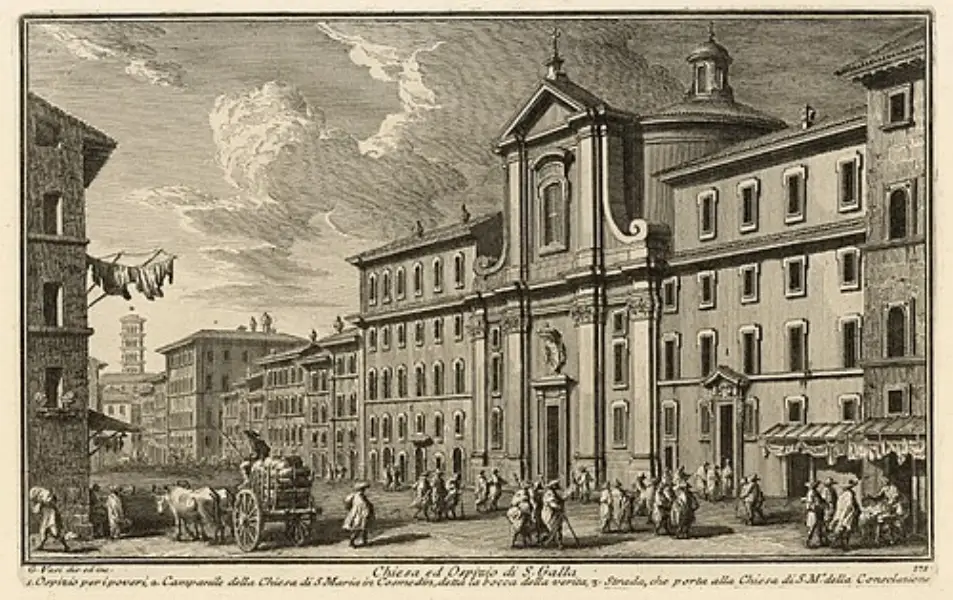
Rome wove Galla's memory into its very streets. The icon that legend located in her pantry drew a shrine: an oratory raised at the site, Santa Maria in Portico, enshrined the image of the Mother of God that from 590 onward, in years of pestilence, was borne through the city in procession to plead for its deliverance. Around the shrine there grew a second work of mercy in her name when Celestine III established next door the Hospice of St. Galla, offering a night's lodging to the destitute — a direct continuation, under her patronage, of the refuge she had first provided. When the venerated icon was moved to the new church of Santa Maria in Campitelli, the old oratory took the name by which it is still known, Santa Galla Antiqua, in honor of its founder. Her story reached literature through the Dialogues of Gregory the Great, which recount her life. In 1940 a new church of San Galla was consecrated in the Ostiense district, and her image now looks out from the colonnade of St. Peter's Square among its 140 saints.
§ Hospice and church of St. Galla
Timeline
- 485
Her father, the Roman patrician Symmachus the Younger, was appointed consul.
§ Life
- 524
By tradition, an image of the Mother of God manifested itself in the storeroom of her house, where the saint laid up provisions for the needy.
§ Hospice and church of St. Galla
- 525
Her father, Quintus Aurelius Memmius Symmachus, was unjustly condemned to death by Theodoric.
§ Life
- 550
Died in Rome after a lifetime of tending the sick and poor on the Vatican Hill.
§ Life
- 590
The icon venerated in her oratory began to be carried in processions to avert the plague.
§ Hospice and church of St. Galla
- 1940
A new church dedicated to her in the Ostiense quarter of Rome was consecrated.
§ Legacy
The Record
- Major works
- Hospital and convent near St. Peter's Basilica
- Patron of
- widows·the poor and the sick
- Symbols
- widow's veil·alms
- Canonization
- Pre-congregation canonization; venerated by the Catholic Church and the Eastern Orthodox Church
Prayer
Bibliography
Show 7 sources
- Holweck, Frederick George. A Biographical Dictionary of the Saints, B. Herder Book Company, 1924, p. 412
- Mershman, Francis. "St. Galla." The Catholic Encyclopedia Vol. 6. New York: Robert Appleton Company, 1909
- Schofield, Nicholas. "Santa Maria in Campitelli: an old Roman church with strong British connections", Venerable English College, Rome, 26 February 2020
- Abbé Laumonier. The Pilgrim's Guide to Rome, R. & T. Washbourne, 1900, p. 93
- Butler, Alban. "St. Galla, Widow", The Lives of the Saints, 1866
- "Chiesa di San Galla", Turismo Roma
- Herbermann, Charles, ed. (1913). "St. Galla". Catholic Encyclopedia. New York: Robert Appleton Company.
Profile text adapted from the Wikipedia article, licensed CC BY-SA 4.0.
Pray with this saint every day
Save St. Galla of Rome to your favorites, read the full profile, and get feast-day reminders in the Saints app.
Get the Saints AppFree on the App Store for iPhone and iPad