
720 – c. 802·Feast January 17
St. Gamelbert
Bavarian priest and founder of Metten Abbey
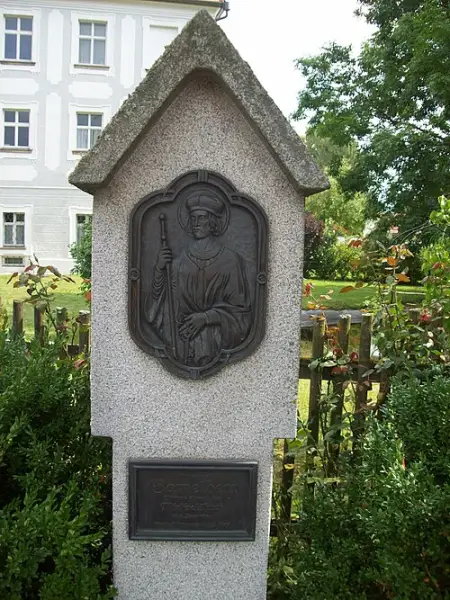
Overview
Gamelbert was a Christian priest of the eighth century who labored in what is now Stephansposching in Bavaria, Germany. Born in 720 at Michaelsbuch to wealthy aristocratic parents who destined him for a military career, he preferred the quiet of his father's flocks, finding in the open silence of meadow and woodland a school of prayer. A priest of the neighborhood took over his instruction, and he received ordination to the priesthood. After a pilgrimage to Rome, during which he baptized an infant named Utto who would become his godson and spiritual heir, he inherited his parents' estate and devoted it to the church, establishing a parish on his own land at Michaelsbuch, where he served as parish priest for more than fifty years. Gentle by nature and unfailingly generous to the poor, he acquired woodland across the Danube from Duke Tassilo III and in 766 cleared the ground for the Benedictine abbey of Metten, bringing Utto from Reichenau to be its first abbot. He died on 17 January around 802. Pilgrims sought his tomb; a monk of Saint Emmeram wrote his life around the year 1000; and Pope Pius X ratified his ancient cult with beatification in 1909.
The Complete Life
The Herdsman Who Would Not Be a Soldier
Gamelbert was born in the year 720 at Michaelsbuch in Bavaria, the son of wealthy aristocrats who had mapped out his future in the military profession of their class. The boy's inclinations ran another way. Sent to tend his father's flocks, he found that the calm of open field and woodland gave his soul the quiet it needed for prayer and meditation, and he showed little taste for the trade of arms his parents intended for him. Providence supplied a guide: a priest of the neighborhood took over his instruction, and from this humble village tuition the future founder of abbeys received the formation that would carry him to ordination. The pattern of his early life would define the whole of it, a lord's son who preferred sheep to soldiers, silence to campaign, and the long patience of a shepherd to the sudden deeds of a nobleman's career. In the art that later recalled him, he appears as a priest at prayer in a little chapel, his flock gathered about him, an image that remembers the boy who first met God among the pastures of the Danube valley.
§ Life
Ordination, Rome, and a Baptism by the Way
The teaching of the local priest bore fruit when Gamelbert was ordained to the priesthood for the church in the region of what is now Stephansposching in Bavaria. Of his ministry in those early years the sources preserve a single memorable episode, a pilgrimage to Rome, the pilgrimage that anchored so many Germanic vocations to the tomb of the apostles. On the road home he took lodging in a dwelling where a mother was newly delivered of a son, and she begged the priest to christen the infant. The child received the name Utto, and the baptism proved providential: Utto would become Gamelbert's godson, his pupil for the priesthood, and in God's design the first abbot of the monastery his godfather founded. The story binds the two saints together from the beginning, the aristocratic herdsman of Michaelsbuch and the infant carried to the font, destined between them to plant Benedictine monasticism on the banks of the Danube. When his parents died, Gamelbert came into his inheritance, and he made of it immediately a consecrated thing, reserving the estate not for his own enrichment but for the service of the church.
§ Life
A Parish on His Own Land
From his inheritance Gamelbert established a parish on property he owned at Michaelsbuch, and there he worked for more than fifty years as a parish priest, an extraordinarily long pastorate that made him the spiritual father of generations of Bavarian countryfolk. His biographers characterize him as gentle by nature and unfailingly generous to the poor, and pilgrims and the needy alike would later find their way to his tomb. His ambition, however, was not confined to one village. From Duke Tassilo III, the Agilolfing ruler of Bavaria, he obtained woodland lying across the river, in the stretch between Mariaposching and Deggendorf; the rent he owed for it was the levy called the Medema, and from that payment, tradition derives the very name of Metten, given both to the place and to the monastery that rose there. In 766 Gamelbert cleared the ground and brought into being the Benedictine abbey of Metten in Lower Bavaria, not far from Michaelsbuch. Having schooled his godson Utto for priestly orders, he summoned him from the monastery of Reichenau, where the young monk then lived, and installed him as Metten's first abbot, though other sources credit Utto himself with founding the house on his own land in the same year.
§ Life
Prayer in the Stillness of the Fields
The spirituality that emerges from Gamelbert's life is a contemplative one rooted in creation. He refused a soldier's prospects because, in his own experience of herding, the peaceful stillness of fields and forests opened his mind to prayer and meditation; the pastures of Michaelsbuch were his first cloister. This was no idle rusticity but a discipline: the vita tradition presents a man who joined the cultivation of land to the cultivation of soul, clearing woodland for God as he had cleared the undergrowth of distraction from his own heart. His gentleness was proverbial, and it expressed itself in concrete almsgiving; the poor of his parish depended on an unfailing generosity that made no distinctions. For half a century he exercised the most unspectacular of ministries, the daily care of a country parish, baptism, Mass, the burial of the dead, and he joined to it the founding labor of a Benedictine house whose monks would pray for the region long after his death. In him the eighth-century Bavarian church shows its character: faith planted by aristocratic generosity, ordered by episcopal and ducal authority, and made fruitful by the stability of a priest who never left his flock.
§ Life
Death on the Feast of His Memory
Gamelbert died on 17 January, around the year 802, at Michaelsbuch, the village of his birth, his priesthood, and his half-century of pastoral labor. He had lived to see his abbey of Metten established under his godson Utto, the parish of his inheritance flourishing, and the woodland of the far bank of the Danube transformed into ground cleared for God. The place of his burial quickly became a destination: many pilgrims and needy people made their way to his tomb, seeking the intercession of the priest whose generosity they remembered. Death on the seventeenth of January fixed the date of his memory; his memorial has been kept on that day from the early centuries of his cult to the present calendar. The sources record no deathbed scene and no last discourse, only the fact that the old pastor was gathered to his fathers and that the faithful immediately began to pray at his grave. In that immediate pilgrimage of the poor and the devout lies the first testimony to the sanctity that the church would formally recognize a millennium later, when his cult received the papal confirmation that beatification confers.
§ Veneration
From Local Cult to Papal Confirmation
The memory of Gamelbert passed through the normal channels by which Bavarian sanctity was preserved. Around the year 1000, two centuries after his death, a monk of Saint Emmeram's Abbey in Regensburg wrote his vita, fixing the outline of the herdsman-priest and his foundations. In 1414 his figure was painted on the cover of a Bible at Metten Abbey, a testimony that the house he founded still cherished its founder's image. The decisive act came in the modern era: on 25 August 1909, Pope Pius X confirmed the ancient cult of Gamelbert, the act by which the church beatifies a saint whose veneration has flourished immemorially. By a pleasing providence the same papal decree confirmed at the same time the cult of Blessed Utto of Metten, binding the godfather and the godson in beatitude as they had been bound in the foundation of the abbey. In art Gamelbert appears as a priest at prayer in a little chapel, his sheep gathered about him, the badge of his earliest calling. Modern curiosity has even touched his earth: in 2017 an archaeological dig at a Michaelsbuch construction site uncovered five Christian graves dating from roughly the eighth to the twelfth century, together with the post pits of what may have been an early church, conceivably the very parish of his foundation.
§ Veneration
Metten and the Memory of Michaelsbuch
Gamelbert's most enduring work is Metten Abbey, the Benedictine house he founded in 766 on the Danube woodland bought from Duke Tassilo III. Under its first abbot, Utto, Gamelbert's godson and pupil, the monastery took root among the oldest of Bavarian abbeys, and the tax called the Medema, paid for the woodland, gave both place and monastery the name of Metten. The abbey kept his memory in the painted Bible cover of 1414, and the region kept it in the parish he planted at Michaelsbuch, where he ministered for more than fifty years. His beatification in 1909, joined to that of Utto, restored the pair to wider Catholic devotion, and his feast of 17 January is kept as his memorial day. Even the ground has continued to speak: the 2017 excavation at Michaelsbuch, which brought to light five early medieval Christian skeletons and the post pits of a possible early church, has prompted local inquiry into whether the blessed priest's own place of worship has been found. The scholarly literature, from the vita composed at Saint Emmeram around 1000 to the modern studies of the abbey's beginnings, preserves the outlines of a life whose greatness was entirely pastoral.
§ Veneration
Timeline
- 720
Born at Michaelsbuch in Bavaria to a wealthy aristocratic family.
§ Life
- 766
Cleared land on the north bank of the Danube and founded the Benedictine Metten Abbey in Lower Bavaria.
§ Life
- 17 Jan 802
Died on 17 January at Michaelsbuch, after more than fifty years as a parish priest.
§ Veneration
- 1000
A monk of Saint Emmeram's Abbey composed his vita, around this year.
§ Veneration
- 1414
His image was painted on the cover of a Bible kept at Metten Abbey.
§ Veneration
- 25 Aug 1909
Pope Pius X confirmed his ancient cult, beatifying Gamelbert together with Blessed Utto of Metten.
§ Veneration
- 2017
Archaeologists at a construction site in Michaelsbuch uncovered five early medieval Christian graves and post pits of a possible early church.
§ Veneration
The Record
- Major works
- Founded the parish of Michaelsbuch on his inherited property·Founded the Benedictine Metten Abbey in Lower Bavaria, 766
- Symbols
- A priest in an oratory surrounded by sheep
- Canonization
- Beatified by Pope Pius X through confirmation of his cult on 25 August 1909
Prayer
Bibliography
Show 7 sources
- "Gamelbert - 17. January", Heilige.de.
- "St Gamelbertus", The British Museum.
- "Geschichtlicher Abriss, 766: Vermutliches Gründungsjahr des Kloster Metten". Kloster Metten.
- Odden, Per Einar. "Den salige Gamelbert av Michaelsbuch (720-~802)", Den katolske kirke, November 28, 2015.
- "Vita Gamalberti presbyteri Michaelsbuchensis", Geschichtsquellen des deutschen Mittelalters.
- Becker, H. 1971. "Gamelbertus von Michaelsbuch." Beiträge zur Geschichte des Bistums Regensburg 5: 7–21.
- Prinz, Friedrich. 1962. "Die Anfänge der Benediktinerabtei Metten." Zeitschrift für bayerische Landesgeschichte 25: 20–32.
Profile text adapted from the Wikipedia article, licensed CC BY-SA 4.0.
Pray with this saint every day
Save St. Gamelbert to your favorites, read the full profile, and get feast-day reminders in the Saints app.
Get the Saints AppFree on the App Store for iPhone and iPad