
died 11 May 760·Feast May 11
St. Gangulphus
Burgundian knight, hermit, and martyr of marriage
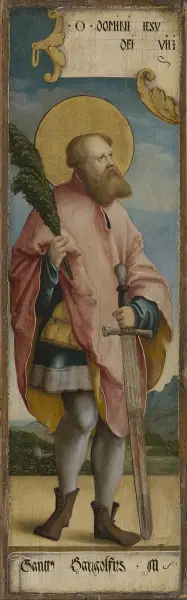
Overview
Gangulphus of Burgundy, remembered in a dozen forms of his name from Gengoul to Gangolf, was a Burgundian courtier who died a martyr on 11 May 760. His historical existence rests on a single document, a charter issued at the court of Pepin the Short in 762 recording him as the master of vast estates, his kin a clan whose power dominated the whole district. Born to one of the noblest houses of Burgundy and raised by virtuous Christian parents, he was known in youth for honesty, chastity, and propriety, and after their death he governed his estates with industry, supplying the needs of churches and of the destitute across his lands. He took part in the wars of his time as an important nobleman, yet also preached the gospel in Frisia, and at length renounced his wealth to embrace the life of a hermit. His legend tells of a miraculous fountain, of a wife's adultery and a miraculous judgment, and finally of his murder at his castle of Avallon by his wife's lover, a priest who wounded him in the thigh as he slept. Miracles at his tomb, a cult spread across France, Germany, and beyond, and the memory of an unhappy husband made a saint have kept his name alive for twelve centuries.
The Complete Life
A Son of the Illustrious Houses of Burgundy
Gangulphus came into the world sprung from a house numbered among the noblest of Burgundy, a region whose great households dominated their districts and exercised extensive power. His education was directed by his parents, who were virtuous Christians, and from them he learned the faith that would govern his whole life. As a youth he was already marked by great honesty, chastity, and propriety: he frequented the churches, read religious texts, and shunned every libertine circle. On his parents' death he inherited a considerable estate, and the legend paints him as a model landowner, administering the household economy with ease and industry while caring for the churches and the destitute who depended on his lands. The one genuinely historical document of his life confirms this picture of wealth and standing: the charter of 762 from Pepin's court records him as the master of vast estates, his kin a clan whose power dominated the whole district. When the time came for him to marry, however, he made a choice that would shadow his later years: the woman he wed brought none of his own virtues to the marriage.
§ Legend
Courtier, Soldier, Preacher, Hermit
Gangulphus lived the double life of a great nobleman of the eighth century. As an important lord he took part in the wars of his time, serving among the fighting aristocracy of the Burgundian lands, and his historical attestation links him to the court of Pepin the Short, the Carolingian king. Yet the same tradition gives him a second and stranger employment: he gave himself to evangelizing Frisia, the mission field across the northeastern frontier where Christian teachers labored among still-pagan peoples. The courtier was also a missionary. The legend crowns this double vocation with a decisive renunciation: Gangulphus resolved to give up his wealth and become a hermit, withdrawing from the world his family had dominated. Local memory attached this eremitical turn to the region of Saint-Gingolph on the lake of Geneva, where tradition places him in retreat, given over wholly to prayer and penance. A noble who fights, preaches, and finally embraces voluntary poverty for God's sake belongs to a recognizable type of early medieval sanctity, the soldier-saint, and it is in that lineage that the church has always placed him.
§ Legend
The Fountain at Bassigny
The most famous episode of Gangulphus' legend belongs to his journey homeward from the Frisian missions. On the road back to Burgundy he found at Bassigny a property on which stood a fountain issuing fresh and good water, and he bought it. His friends mocked the purchase, objecting that a fountain in distant Bassigny could be of no use on his own estates. Gangulphus answered them with a sign: back on his own ground he drove a stick into the earth, and the next morning he told his servant to draw it out. From the hole gushed a new fountain of fresh water, a miracle that made the point his friends had missed, that the gifts of God are not bound by distance or by human calculation. The fountain became the emblem of the saint; artists painted him as a Burgundian knight with a spring of water issuing from beneath his sword. The same fountain served, in the somber sequel of his story, as the instrument of a divine judgment: when his wife protested her innocence against charges of adultery, Gangulphus had her dip her hand into the miraculous water, and her hand was completely and miraculously scalded.
§ Legend
Judgment Left to God, Penance in the Castle
When the miraculous scalding of her hand proved his wife's infidelity with a priest, Gangulphus responded with a restraint that became the moral center of his legend. He forbade her ever again to share his marriage bed and ordered the priest to go abroad, but he shed no blood and sought no vengeance; he had left her vindication to the divine tribunal, and the divine tribunal had spoken. He retired to the fortress of Avallon, close by Vézelay, and gave himself to works of penance and charity, converting a nobleman's stronghold into a place of prayer and almsgiving. The tradition also remembers him at the site now called Saint-Gingolph, where he lived as a hermit, given over wholly to prayer and penance. This is the spirituality of the early medieval lay saint: not flight from the world in youth but the consecration of wealth, marriage, and even calamity; not the vengeance of an offended husband but the patience of a man who trusted God with his honor. His cult would later make him the especial patron of husbands unhappily married, invoked against marital difficulties and adultery, precisely because he had suffered both and overcome them without sin.
§ Legend
Murder at Avallon
Gangulphus' leniency did not heal his wife's heart; it freed her to plot. She soon had her lover return, and the priest, hurrying back and resolved to remove the husband who stood in the way of their adultery, attacked Gangulphus as he slept, intending to cut off his head. The blow missed its mark and wounded the saint in the thigh, yet even this miscalculated stroke proved mortal. The dying man was given the church's final rites on that eleventh of May, 760, and expired of the wound, a nobleman killed in his own castle by the minister of his own dishonor, thereby ranked among the martyrs of the church. The story closes with a grim symmetry. The priest fled the country together with Gangulphus' wife, but both soon suffered illnesses and died, a providential retribution the legend records without relish. Miracles, it is said, promptly began at the martyr's tomb at Avallon. The feast of his memory was fixed on the eleventh of May, the day of his death, and his iconography would remember the manner of his passion in the spear he sometimes carries, together with the shield marked with the cross of the faith he died confessing.
§ Legend
The Tomb That Spoke
Gangulphus was never canonized by papal process; his sanctity was ratified by the ancient and unanswerable testimony of his cult. Miracles were said to take place at his tomb from the first, and his remains were carried to Varennes-sur-Amance, within the diocese of Langres; there his cult put down roots and grew, and from that center his relics were in time distributed to churches across France, Germany, the Low Countries, and Switzerland. His name appears in numerous martyrologies of the tenth and eleventh centuries, in France and Germany, and later in England and Italy; the Life of the saint was probably written at Varennes itself. Around the year 960 the remarkable canoness Hrotsvitha of Gandersheim, the first dramatist of the Latin Middle Ages, composed a poetic version of his life, giving the Burgundian martyr a place in Ottonian literature. Part of his head is venerated at the Gangolfskirche in Bamberg, the oldest existing church of that city and still a living parish, and daughter churches and chapels under his name rose at Hollfeld, on the Milseburg in the Rhön, at Wolpertswende in Upper Swabia, at Fladungen in Franconia, and as far as Sankt Gangloff in Thuringia.
§ Veneration
From Chant to the Ingoldsby Legends
Twelve centuries of memory have gathered around Gangulphus, and they display the whole range of medieval and modern devotion. Place after place took his name, from the parish churches of Franconia and Swabia to the lakeside town of Saint-Gingolph, where local legend mistook him for an imagined trooper of the Theban Legion supposedly fled from Agaunum, grafting a second martyrdom onto his story. He became the patron of tanners, shoemakers, children, and horses, and the heavenly advocate of unhappy husbands, invoked against knee pains and against diseases of the eyes and skin. Literature claimed him too: Richard Barham wrote a comic poem about the saint, A Lay of St. Gengulphus, in The Ingoldsby Legends of the nineteenth century. In our own day his liturgical memory has been resurrected with scholarly care: the Psalterium Foundation collected the surviving materials of his medieval Office, reconstructing it from disparate fragments, much of which had not been sung in over five hundred years, and in early 2022 the Gregorian chant ensemble Hartkeriana sang and recorded the reconstructed Office. The knight with the fountain, the shield, and the spear thus keeps his feast still, on the eleventh of May.
§ The Office of St Gangulphus
Timeline
- 11 May 760
Fatally wounded in his sleep by his wife's lover, he received the last sacraments at his castle of Avallon on 11 May.
§ Legend
- 762
A deed from the court of Pepin the Short attested him as a great landowner of Burgundy, the sole historical document naming him.
§ Gangulphus
- 960
Hrotsvitha of Gandersheim composed a poetic version of his life around this year.
§ Veneration
- 2022
The chant ensemble Hartkeriana sang the reconstructed Office of Saint Gangulphus and committed it to recording, a project of the Psalterium Foundation.
§ The Office of St Gangulphus
The Record
- Patron of
- Patron of husbands unhappily married·Patron of tanners, shoemakers, children, and horses·Invoked against knee pains and against sicknesses of the eyes and skin·Invoked against marital difficulties and adultery
- Symbols
- A Burgundian knight with a fountain springing under his sword·A shield bearing a cross·The spear with which he was murdered
- Canonization
- Pre-congregation; venerated as a martyr from the early medieval period
Prayer
Bibliography
Show 5 sources
- Barbero, Alessandro. "Santi laici e guerrieri. Le trasformazioni di un modello nell'agiografia altomedievale".
- "San Gengolfo".
- "St. Gangolf, Bambergs aelteste bestehende Kirche und lebendige Gemeinde". Archived from the original on 2007-07-26. Retrieved 2007-06-01.
- "The Psalterium Foundation | Stichting Psalterium". Retrieved 2022-08-14.
- "St Gengulphus | Gangulphus – Gengoux – Gengoult – Gangolf – Gingolph". Retrieved 2022-08-16.
Profile text adapted from the Wikipedia article, licensed CC BY-SA 4.0.
Pray with this saint every day
Save St. Gangulphus to your favorites, read the full profile, and get feast-day reminders in the Saints app.
Get the Saints AppFree on the App Store for iPhone and iPad