
1777 – 1853·Feast June 12
St. Gaspare Bertoni
Founder of the Stigmatines and patient sufferer of Verona
Overview
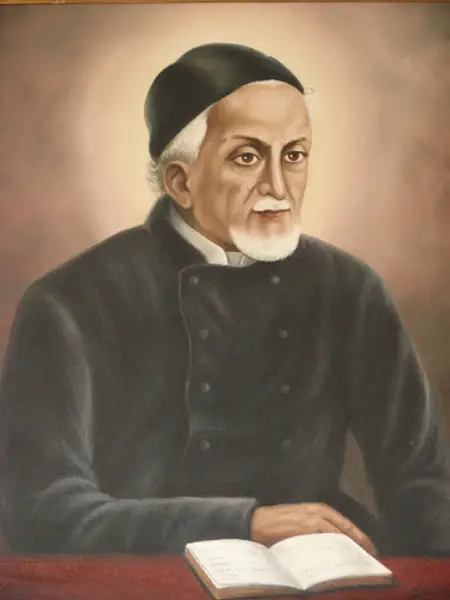
Gaspare Luigi Bertoni was a Catholic priest of Verona who brought into being the Congregation of the Sacred Stigmata of Our Lord Jesus Christ, known from his day to ours as the Stigmatines. Born on 9 October 1777 to a lawyer father, Brunora Ravelli's husband, he lost his sister in childhood and was educated at home before studying under the Jesuits and the Marian Congregation at Saint Sebastian's School. He began studies for the priesthood in 1796, the very year French troops began a two-decade occupation of northern Italy, and joined the Gospel Fraternity for Hospitals, nursing the wounded, the sick, and the displaced. Ordained on 20 September 1800, he served as chaplain to the Daughters of Charity of Magdalene of Canossa, as spiritual director of the seminary, and as a public intercessor for the imprisoned Pope Pius VII. He established Marian oratories, schools for the poor, and devotion to the Five Wounds of Christ, and on 4 November 1816 founded the Stigmatines. The last two decades of his life he passed as a helpless invalid, enduring fevers and a chronic infection of the right leg that demanded more than three hundred operations, yet from his hospital bed he continued as counsellor and spiritual director until his death on 12 June 1853.
The Complete Life
A Veronese Childhood in a Falling Republic
Gaspare Luigi Bertoni first saw the light at Verona on 9 October 1777, a subject of the Republic of Venice in the last decades of its existence. His father, Francesco Bertoni, practiced the profession of the law, and his mother was Brunora Ravelli; from them, and from the early loss of his sister, who died while Gaspare was still a child, came the first formation of his character. His initial education he received at home from his parents, a schooling later joined to formation under the Jesuits and the Marian Congregation at the school of Saint Sebastian in his native city. The Verona of his boyhood was prosperous, cultured, and Catholic, but the Europe around it was convulsing; the French Revolution broke out while he was an adolescent, and its armies were already moving toward the Italian states. He entered upon preparation for the priesthood in 1796, and on the first of June of that same year troops of France began an occupation of the northern Italian cities that would last two decades. The young seminarian thus grew to manhood in a church and a city under foreign bayonets, an experience that would give his whole apostolate its character of emergency charity and steadfast pastoral stability.
§ Life
Ordination Amid the Ruins of War
The French occupation of 1796 turned Verona and its region into a landscape of wounded soldiers, sickness, and displacement, and Bertoni answered with direct service. He joined the Gospel Fraternity for Hospitals and labored to help those wounded and ill, devoting himself with special attention to those displaced or otherwise harmed by the effects of the occupation. Four years of such service carried him to the priesthood: he was ordained on 20 September 1800, a pastor formed not in quiet decades but in the emergency wards of a war-torn countryside. His gifts soon drew wider responsibilities. He became chaplain to the Daughters of Charity, the congregation founded by Magdalene of Canossa, and spiritual director of the seminary, forming the clergy of his diocese in an age when the old structures of Catholic Europe were being dismantled. When Napoleon imprisoned Pope Pius VII, Bertoni stood among the leaders of those who offered public prayers and support for the captive pontiff. In all this he was, in the description of those who knew him, a rather frail and average-looking man, whose significance lay not in presence or office but in an uncanny steadiness of pastoral charity.
§ Life
Oratories, Schools, and the Congregation of the Stigmata
Bertoni's pastoral work in Verona bore institutions that outlived him. He established the Marian Oratories, centers of prayer and formation for the young, and he planted the devotion to the Five Wounds of Christ as a mark of his spirituality. For the children of the poor he founded schools, among them the Scuole Alle Stimate in the center of Verona, begun in 1816, which grew into classical, scientific, and linguistic high schools and still preserves a library holding the precious collection of books that Bertoni himself bought. The summit of his founding work came on 4 November 1816, when he established the Congregation of the Sacred Stigmata of Our Lord Jesus Christ, a community of priests and brothers who would take the wounds of the Crucified as their program of life and their name. From that Veronese beginning the Stigmatines spread through Italy and, in time, across the world; as of 2012 the congregation counted ninety-four houses with four hundred twenty-two members, including three hundred thirty-one priests. The founder had asked of his men no spectacular enterprise, but rather a hidden, adaptable service of the church, modeled on the Holy Family's hidden years in Egypt.
§ Life
The Five Wounds and the Hidden Life
The spirituality of Gaspare Bertoni centered on the Sacred Stigmata, the five wounds of Christ, to which he dedicated his congregation and his schools, and which he preached as the measure of every Christian vocation. Devotion to the Five Wounds ran through his oratories, his teaching, and his founding charism, and it explains the emblem his followers chose and the churches they raised in his memory, from the Stimmate of Verona, where he is buried, to the Parish of the Five Wounds in the Philippines. His spirit was formed in the school of suffering: the last twenty years of his life he passed in nearly continuous illness, beset by fevers and a continuing infection of the right leg that required over three hundred operations, and he transformed that helplessness into an apostolate of counsel, hearing from his hospital bed the streams of souls who sought him as spiritual director. He had learned his charity in the hospital wards of the French occupation, and he ended as he began, attending to the wounded. Frail and unremarkable in appearance, he embodied a spirituality of ordinary fidelity, in which heroism meant not great deeds but the daily endurance of pain offered for the church.
§ Life
Two Decades on a Bed of Pain
The final two decades of Bertoni's life were a long passion. Frail by constitution, he became progressively the prisoner of his ailments: fevers recurred without relief, and a continuing infection settled in his right leg, defying every remedy that the medicine of the age could devise. More than three hundred operations were performed on the leg in the effort to stem the disease, a calculation that conveys both the cruelty of his sufferings and the tenacity with which he clung to life for the sake of his work. Yet the invalid's room became the center of the congregation and of the diocese. From his bed he went on advising souls and guiding his congregation right up to his death, receiving religious and laypeople, watching over the Stigmatines their founder had left in infancy, and forming in patience the character he could no longer form in activity. He died at Verona on 12 June 1853, aged seventy-five, in the kingdom that Lombardy–Venetia had become; burial followed in the Veronese church of the Stimmate, the church his congregation served. The man whom three hundred surgeries could not deter had finished his course precisely where his charism pointed, at the side of the Crucified.
§ Life
A Cause of More Than Eighty Years
The process that led Bertoni to the altars moved through every stage of the church's careful scrutiny. The inquiry opened at Verona, gathering testimony and collecting his writings; Pope Pius X formally introduced the cause on 2 March 1906, giving him the title of Servant of God, and the apostolic process followed. The theologians, in a decree of 9 August 1915, pronounced his writings sound in doctrine, and on 18 December 1929 Rome ratified both processes through the Congregation of Rites. On 15 December 1966 Pope Paul VI proclaimed him Venerable, acknowledging his life of heroic virtue. The miracle for beatification concerned Giuseppe Anselmi, a priest of the Stigmatines cured of severe stomach complications in Brasília on 28 May 1937; its process ran through 1946–1950, obtained Roman ratification on 11 November 1967, and won papal assent on 3 October 1975, whereupon Paul VI beatified Bertoni in Saint Peter's Square on 1 November 1975. The second miracle was validated on 30 November 1984 and approved by Pope John Paul II at the beginning of 1989, and on 1 November 1989, fourteen years to the day after the beatification, he canonized the founder of the Stigmatines a saint.
§ Veneration
From Verona to Las Piñas
The legacy of Gaspare Bertoni extends from the schools of Verona to the churches of Asia. The Stigmatines carry his charism in houses across the world, and his Scuole Alle Stimate continues in his city as a middle and high school offering classical, scientific, and linguistic studies around the library that preserves his own books. His memory crossed the oceans in our own time: on 1 June 1985, in collaboration with the archbishop of Manila, Cardinal Jaime Lachica Sin, the Stigmatine Fathers and Brothers established in Las Piñas the Parish of the Five Wounds of Our Lord Jesus Christ, the only church in the Philippines and Asia dedicated to the Sacred Stigmata, with Father Danilo Panato as inaugural parish priest. There the novena to the Five Wounds is prayed every Friday, and between 1989 and 1991 the community commissioned the venerated image of the Resurrected Jesus with his five glorious wounds. On 14 January 2012 Bishop Jesse Eugenio Mercado of Parañaque elevated the parish to a Diocesan Shrine of the Five Wounds, where the chaplet of the Five Wounds is prayed daily with ecclesiastical approval, and whose feast is kept each Third Sunday of Easter. The saint of the hidden life thus receives, two centuries on, a worldwide congregation of the wounded and the healed.
§ Congregation of Sacred Stigmata of Our Lord Jesus Christ
Timeline
- 9 Oct 1777
Born in Verona, capital of the Republic of Venice, to Francesco Bertoni, a lawyer, and Brunora Ravelli.
§ Life
- 1 Jun 1796
The armies of France inaugurated twenty years of occupation across the northern Italian cities just as he entered seminary studies.
§ Life
- 20 Sep 1800
Ordained to the priesthood at Verona.
§ Life
- 4 Nov 1816
Founded the Congregation of the Sacred Stigmata of Our Lord Jesus Christ, the Stigmatines.
§ Life
- 12 Jun 1853
Died in Verona at the age of seventy-five, after two decades of illness, and was buried in the church of the Stimmate.
§ Life
- 2 Mar 1906
Pope Pius X introduced his cause, granting him the title of Servant of God.
§ Veneration
- 9 Aug 1915
Theologians approved his writings as in harmony with the magisterium by decree.
§ Veneration
- 18 Dec 1929
The informative and apostolic processes were validated in Rome by the Congregation of Rites.
§ Veneration
- 28 May 1937
The Stigmatine priest Giuseppe Anselmi was cured of severe stomach complications in Brasília, the miracle of his beatification.
§ Beatification
- 1946
The process for the miracle required for beatification commenced in Verona.
§ Beatification
- 1950
The diocesan process for the miracle of beatification concluded.
§ Beatification
- 15 Dec 1966
Pope Paul VI proclaimed him Venerable in recognition of his life of heroic virtue.
§ Veneration
- 11 Nov 1967
The miracle process for beatification was validated in Rome.
§ Beatification
- 1 Nov 1975
Beatified by Pope Paul VI in Saint Peter's Square after papal approval of the miracle on 3 October.
§ Beatification
- 30 Nov 1984
The second miracle needed for canonization was examined and ratified by the Congregation for the Causes of Saints.
§ Canonisation
- 1 Jun 1985
The Stigmatines established in Las Piñas, with Cardinal Jaime Sin, the Parish of the Five Wounds, the only such church in Asia.
§ Congregation of Sacred Stigmata of Our Lord Jesus Christ
- 1 Nov 1989
Canonized by Pope John Paul II in Saint Peter's Square.
§ Canonisation
- 14 Jan 2012
Bishop Jesse Mercado elevated the Las Piñas parish to the Diocesan Shrine of the Five Wounds of Our Lord Jesus Christ.
§ Congregation of Sacred Stigmata of Our Lord Jesus Christ
The Record
- Major works
- Founded the Congregation of the Sacred Stigmata of Our Lord Jesus Christ (Stigmatines), 1816·Established the Marian Oratories in Verona·Founded schools for the poor, including the Scuole Alle Stimate in Verona·Promoted the devotion to the Five Wounds of Christ
- Patron of
- Patron of the Stigmatines
- Symbols
- Priest's cassock
- Canonization
- Canonized by Pope John Paul II on 1 November 1989 in Saint Peter's Square, Vatican City; beatified by Pope Paul VI in 1975
Prayer
Bibliography
Show 6 sources
- Gaspar Bertoni (1777-1853) - biography.
- Agasso, Domenico. "San Gaspar Luigi Bertoni Priest and founder". Santi e Beati.
- Kempf SJ, Constantine. The Holiness of the Church in the Nineteenth Century: Saintly Men and Women of Our Own Times, translated from the German by Father Francis Breymann, SJ, 1916.
- Saulnier CSS, Donald. "Our Founder", congregation of the Sacred Stigmata.
- Index ac status causarum beatificationis servorum dei et canonizationis beatorum (in Latin). Typis polyglottis vaticanis. January 1953. p. 83.
- "Biblioteca alle Stimate – Verona".
Profile text adapted from the Wikipedia article, licensed CC BY-SA 4.0.
Pray with this saint every day
Save St. Gaspare Bertoni to your favorites, read the full profile, and get feast-day reminders in the Saints app.
Get the Saints AppFree on the App Store for iPhone and iPad